Which Red Sea Liveaboard Route Suits You: 20, 50 or 100+ Logged Dives
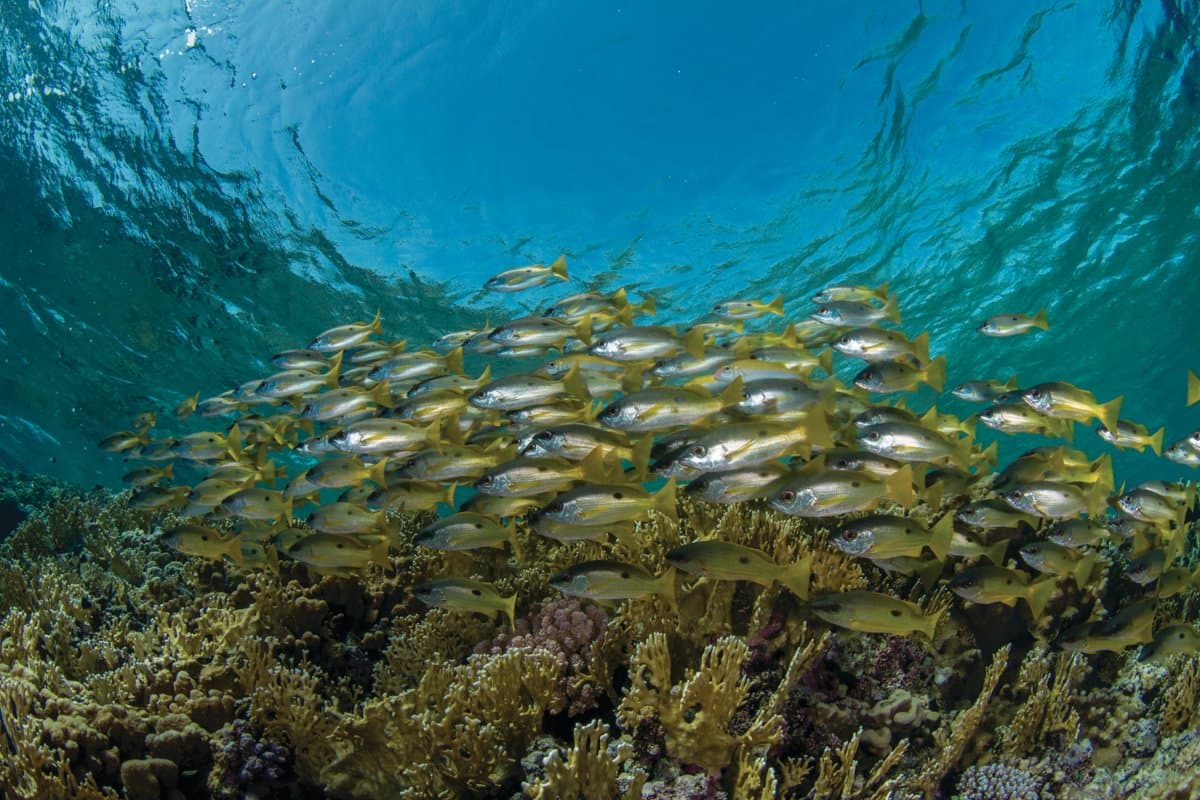
Egyptian Red Sea liveaboards run three families of route, often on the same boats and at similar prices. What separates them is the water. The northern wrecks and reefs are mostly sheltered and shallow enough for newer divers. The deep south mixes calm reef systems with exposed offshore islands. The Brothers, Daedalus and Elphinstone sit alone in open sea, with current and depth to match.
Choosing the right route for your logbook matters more than choosing the boat. A diver on the wrong itinerary spends the week sitting out dives or hanging on to the guide's fin.
Below, each of three experience bands is matched to a route. The minimums quoted are what operators typically publish as of October 2026. They differ between companies and change, and the crew can stand anyone down from a dive whatever their card says. For the wider picture of routes, seasons and fares, start with our Red Sea liveaboard routes and prices.
What the numbers on your card actually mean
Three things get checked when you board, and they are not the same thing.
Certification sets your depth. Open Water training covers dives to 18 metres. Advanced Open Water extends that to 30 metres, and a Deep speciality to 40. Egypt's diving regulator, the Chamber of Diving and Watersports (CDWS), caps recreational dives on air at 40 metres, and only where the diver's training and experience allow it. For nitrox it caps the oxygen partial pressure at 1.4. In practice most guides hold each diver to the depth their card qualifies them for.
Logged dives show practice. A cruise director reads the logbook, not just the total. Fifty dives in moving water tell them more than a hundred in a lake. Bring the log, paper or app, and make sure it shows depth, time and conditions.
Recency matters too. If your last dive was two years ago, do a refresher before you fly. Our guide to liveaboard certification requirements by destination sets out how this works across 21 routes worldwide.
The short version
| Your experience | Route that fits | Why it fits | What to brush up first |
|---|---|---|---|
| Open Water, up to about 20 logged dives | Northern wrecks and reefs | Sheltered moorings, shallow wrecks, dives straight off the big boat, night dives in calm water | Buoyancy around wreck structure, air consumption, deploying a DSMB |
| Advanced, about 50 logged dives | Deep south: St John's, Fury Shoals, Rocky Island and Zabargad | A mix of calm reefs and exposed walls, more zodiac drops and drift pick-ups, a step up without full open-ocean exposure | Drift diving, zodiac entries, nitrox |
| 100+ logged dives, nitrox, ideally Deep | Brothers, Daedalus and Elphinstone | Open-sea reefs, strong and changeable current, the action at 20 to 40 metres | Negative entries, DSMB in current, gas planning on four-dive days |
The bands overlap. A 50-dive Advanced diver qualifies for most Brothers, Daedalus and Elphinstone trips on paper, and the sections below explain when that is a good idea.
Newly certified, up to about 20 dives: the northern wrecks and reefs
This is the classic first Red Sea liveaboard, and it suits newer divers for practical reasons. Most trips leave from Hurghada and work the Strait of Gubal, the wreck reef of Abu Nuhas, the SS Thistlegorm and the reefs of Ras Mohammed. Our northern wrecks route page has the full itinerary and dates.
What the diving is like. Many dives start from the mother boat, moored on the sheltered side of a reef, so you step off the back deck and come home to the same ladder. The zodiacs still come out for some sites. At Abu Nuhas the shallower wrecks, such as the Giannis D and the Carnatic, have most of their decks and holds between about 10 and 26 metres, and plenty to see well above 18. Night dives at sheltered moorings are usually on the plan where permitted, and calm, shallow water is the best place to try your first ones.
The Thistlegorm is the exception. Her superstructure sits at about 16 metres, the holds at roughly 24 to 28, and the seabed and propeller at about 32. Current over the wreck can reach around 2 knots, so you descend and ascend on a line. An Open Water diver will see the upper wreck but not the holds or the propeller, and one major operator asks for 20 logged dives before anyone dives her at all.
Typical minimums. Open Water certification is usually enough for the route. One operator publishes 10 logged dives for its northern trips and 20 for the Thistlegorm. Ras Mohammed is often dived as a drift along the wall at Shark and Yolanda reefs, and the guide decides on the day whether the current suits the group.
The case for Advanced first. Even here, Advanced Open Water opens the deeper half of the best dives. Some boats run the course on board, but it uses dives you would rather spend on the itinerary, so do it before you fly. From December to March the northern water is at its coolest, and one operator recommends a 5 or 7 mm full suit.
About 50 dives with Advanced: the deep south
The deep south runs from the Marsa Alam side down towards the Sudanese border. It covers Fury Shoals and Sataya Reef, the St John's reefs, and the offshore islands of Rocky Island and Zabargad. Our deep south route page lists the itineraries that sail.
What the diving is like. It is two kinds of diving in one week. St John's is a cluster of reefs with very different characters. Dangerous Reef has a flat bottom at about 20 metres and usually little current. Habili Ali, a submerged plateau with sheer drop-offs, can run very strongly, and operators keep it for experienced groups. Gota Kebir and the nearby reefs have shallow tunnels and swim-throughs that need good buoyancy rather than nerve. Sataya is a horseshoe reef where spinner dolphins rest in the lagoon. They are wild animals: you watch from a distance and let them choose whether to come closer.
Rocky Island and Zabargad are the stretch. They are offshore, exposed to weather, and dived as walls in current, often from the zodiac with a drift and an open-water pick-up at the end. That is where a 50-dive diver first meets the skills the Brothers will demand, with calmer reefs close by to recover on.
Night dives happen at sheltered anchorages where permitted. Operators state that night diving is not allowed in the protected marine parks.
Typical minimums. This is where published figures start to diverge. One operator asks for Open Water with 30 logged dives on its Rocky, Zabargad and St John's trips. Another asks for 50 logged dives on any cruise visiting the marine parks, which it lists as the Brothers, Zabargad, Daedalus and Rocky, and advises Advanced or Deep training because many dives go below 18 metres. Plan on Advanced and around 50.
Watch the itinerary names. A route that mixes Daedalus with Sataya and St John's carries Daedalus's conditions for at least a day or two, so treat it as an offshore trip when you assess yourself.
100+ dives, nitrox and deep training: Brothers, Daedalus and Elphinstone
This is the route people mean by "BDE", and the most searched question about it has a plain answer. It is not a trip for newly certified divers.
Typical minimums. Published figures run from 30 to 50 logged dives. At least two large operators state or recommend 30 logged dives, one accepting Open Water certification, and one recommends being certified to 30 metres and comfortable with drift dives. Others ask for Advanced and 50, and several Egyptian operators describe the 50-dive figure as a marine-park rule. We have not found that regulation in writing, so treat 50 as the safe planning number rather than settled law. Some boats also require a dive computer for every diver, and the crew's judgement on the day overrides any minimum.
What the diving is like. The Brothers are two rocks about 67 kilometres off El Quseir. Daedalus is an isolated reef roughly 80 kilometres out from Marsa Alam, normally reached by an overnight crossing. Elphinstone is closer to shore but just as exposed, with plateaus between 20 and 40 metres and current that often runs above 2 knots.
Most dives start from a zodiac. Surface conditions can be rough, so guides often call a negative entry: you roll in with an empty BCD and descend straight to the reef without regrouping at the surface. The dive is usually a drift along the wall, and it ends with a safety stop under your DSMB in open water while the zodiac comes to you. There is no reef to hold your stop against, and the boat is often out of sight.
The animals add their own pressure. Hammerheads at Daedalus peak from June to August and tend to sit deeper, in the blue off the north plateau on early dives. The pull to follow them down and out is real. Oceanic whitetips peak in October and November around Elphinstone and the Brothers and often come close near the surface, which calls for calm behaviour, a steady vertical position and no reaching out. Our Brothers, Daedalus and Elphinstone route page has the season detail and live dates.
Operators state that night diving is not allowed in the marine parks of the Brothers and Daedalus, so the evenings at the islands are for rest.
Why we suggest 100 rather than 50. The minimum gets you aboard. Around 100 varied dives, a good share in current, is closer to the point where entry, drift, gas checks and the blue-water ascent stop taking all your attention and you can watch the sharks. A 60-dive diver with two weeks of drifting off Marsa Alam may be readier than a 150-dive diver who has never left a quarry.
Nitrox earns its place here. Four dives a day at 25 to 30 metres builds nitrogen quickly, and enriched air extends your no-stop time at those depths. It also sets a ceiling. At the CDWS limit of 1.4, a 32 per cent mix gives a maximum operating depth of about 34 metres. Know that number before the hammerheads appear. Our comparison of the Brothers and the northern wrecks covers the differences between the two routes site by site.
How to build experience between trips
The three routes make a natural progression over two or three trips, and the gaps between them are where the useful learning happens.
- Spend a week on a day boat first. Three dives a day from Hurghada, Safaga or Marsa Alam adds around 15 to 20 logged dives in Red Sea conditions.
- Take Advanced and nitrox before the deep south. Add a Deep speciality before the Brothers if most of your dives so far have been above 25 metres.
- Practise your DSMB on every dive. Deploy it from your safety stop at 5 metres on calm days until you can do it without losing depth. Doing it for the first time in a down-current off Daedalus is the wrong way round.
- Log the conditions, not just the numbers. Note current strength, entry type and whether you drifted. That is what a cruise director reads.
- Do a northern trip before an offshore one. It teaches the liveaboard rhythm of early briefings, four dives a day and zodiac pick-ups in water that forgives mistakes.
Safety that applies on every route
Listen to the whole briefing. It covers the current direction, the entry, the planned depth, the turn point and how the pick-up will work. If anything is unclear, ask before you kit up, not on the zodiac.
Carry a DSMB and a dive computer on every dive. Several operators make both mandatory. A whistle or other audible signal is cheap insurance for a long surface wait.
Stay with your guide and buddy. On offshore walls the group is your safety plan. Drifting off the reef into the blue alone, even to follow a shark, is how divers end up surfacing far from the zodiac.
Treat 40 metres as a limit, not a target. Most of the best encounters on these routes happen between 15 and 30 metres.
Check your insurance. Operators typically require cover that includes emergency evacuation and recompression treatment.
On prices, the routes are closer together than people expect. In our current calendar, seven-night northern wreck weeks start from US$751 per person sharing (about $107 a night), deep south weeks from €791 (about €113 a night) and Brothers, Daedalus and Elphinstone weeks from €1,062 (about €152 a night). These are from-prices and change with dates. Our Red Sea liveaboard cost guide breaks down what you pay on top.
If you would like a second opinion on which route your logbook suits, send us a short note through the concierge, or browse the Red Sea liveaboard dates.
Related Guides
Related Articles
When to Dive the Red Sea: Month-by-Month Guide
The Red Sea dives well every month of the year, but what you see and how much you pay changes dramatically. Here is the honest month-by-month breakdown — water temperatures, species windows, operator availability, and the two weeks most serious divers target.
How Much Is a Red Sea Liveaboard? Real Prices by Route
Real Egyptian Red Sea liveaboard fares from our own departures, route by route, with per-night maths and every extra you pay on top: park fees, visa, nitrox, tips, flights.
