How Much Is a Red Sea Liveaboard? Real Prices by Route
A week on an Egyptian Red Sea liveaboard currently starts at $751 or €780 per person on our calendar and climbs to about $1,743 for the offshore shark route in high season. That is the fare. Park and reef fees, the visa, nitrox and crew tips usually add roughly €250 to €550 on top, and flights come after that.
The Red Sea is still the best-value liveaboard diving within easy reach of Europe. The spread between a cheap week and an expensive one is wide, though, and most of it comes down to two things: how far offshore the boat goes, and when.
Where these numbers come from
Every fare below comes from the Red Sea departures we currently list, 26 sailings between October 2026 and August 2027, all of them 7 nights. Prices are per person sharing a cabin, "from" the lowest cabin category, and they change with dates and availability. Some operators price in euros and some in US dollars, so we have kept each fare in its own currency rather than convert it and pretend to a precision the exchange rate doesn't allow.
Red Sea liveaboard prices by route
| Route type | Nights | From (per person) | Per night | Standard fare |
|---|---|---|---|---|
| Northern wrecks & reefs | 7 | $751–980 | $107–140 | $1,155–1,400 |
| Northern Red Sea & Brothers | 7 | $1,400–1,526 | $200–218 | not discounted |
| Brothers, Daedalus & Elphinstone (BDE) | 7 | €1,062 / $1,743 | €152 / $249 | €1,180 / not discounted |
| Southern mixes (Daedalus, St Johns, Sataya) | 7 | €780–950 | €111–136 | €975–1,056 |
| Deep south (Zabargad, Rocky Island) | 7 | €791–957 | €113–137 | €1,055–1,063 |
| Premium southern (Daedalus & Elba Reef) | 7 | €1,349–1,499 | €193–214 | €1,499 |
Across everything we list, that works out at $107 to $249 per night on dollar-priced boats and €111 to €214 per night on euro-priced ones.
Northern wrecks and reefs
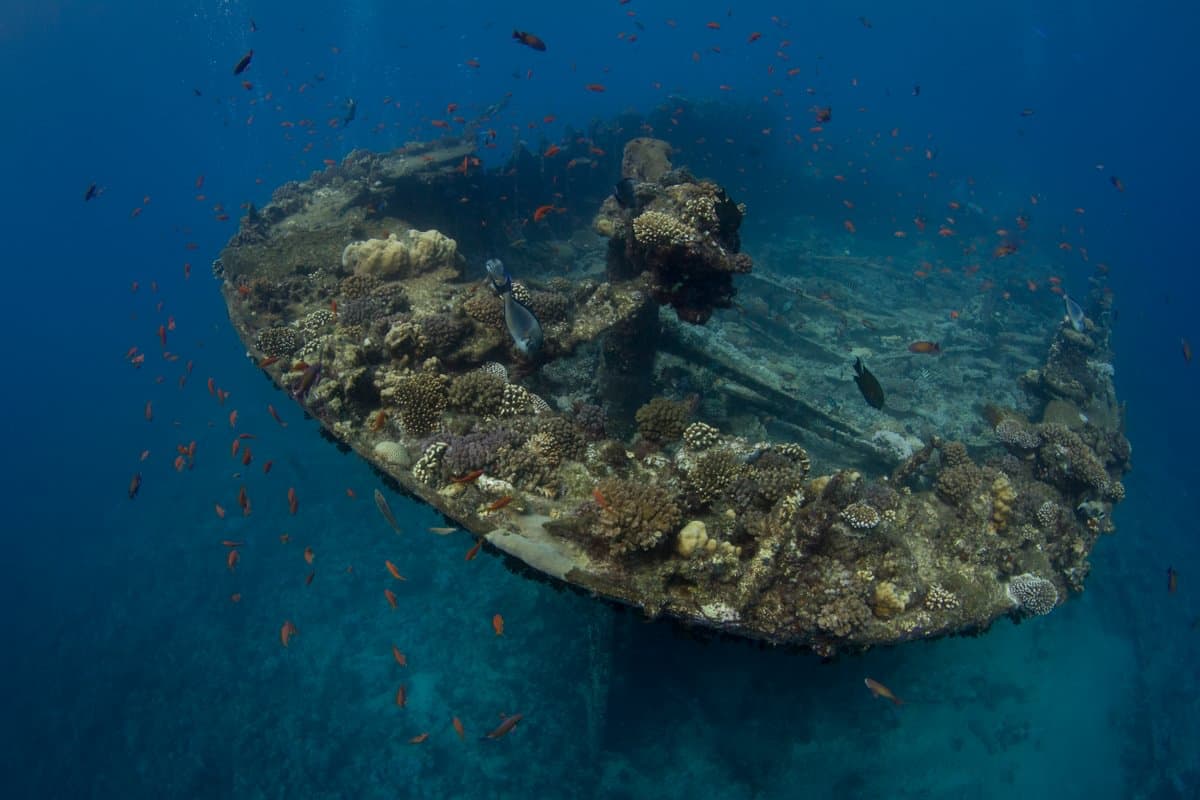
The cheapest week in Egypt, and for good reason. Northern itineraries out of Hurghada stay inside the Gulf of Suez and the Strait of Gubal: short hops between sites, sheltered anchorages at night and modest fuel bills. You dive the Thistlegorm, the wreck graveyard at Abu Nuhas and, on most routes, the reefs of Ras Mohammed. At $107 to $140 a night it is hard to find better diving for the money anywhere.
Brothers, Daedalus and Elphinstone
The offshore route costs more because it is a different kind of trip. The Brothers and Daedalus sit far out in open water, the crossings are long and often lumpy, and the boat burns a lot more fuel getting there. You are paying for sharks: scalloped hammerheads at Daedalus with a June to August peak, and oceanic whitetips at Elphinstone and the Brothers, best in October and November.
The clearest comparison in our list is one boat that runs both routes. A northern wrecks week on it costs $751 in late December. The same boat's BDE week in May or August costs $1,743. More than double, for a combination of the offshore route and peak season.
Expect a logbook check. Operators set their own minimums for the offshore reefs, commonly somewhere between 30 and 50 logged dives, and a diver who falls short can be kept out of the water on exactly the dives they paid for.
The south: Daedalus, St Johns and the deep south
Southern trips from the Marsa Alam side are where the value sits right now. Mixed itineraries taking in Daedalus, Sataya's dolphin reef and the St Johns reefs run from €780, and the deep-south weeks to Zabargad and Rocky Island sit in the same €113 to €137 per night band. For remote reefs that see far fewer boats than the north, that is good money.
The premium southern week at €193 to €214 per night dives similar water. The difference is the boat: larger cabins, more space, more polish. Whether that is worth it is a personal call. The reef doesn't change.
How prices move through the year
Two patterns stand out in our current list.
The deepest reductions fall in the cooler months, November to March. The northern wrecks weeks sailing on 19 and 26 December are at $751 against a standard fare of $1,155, about 35% off. Southern weeks over Christmas and New Year are at €791 against €1,055, about 25% off. That runs against the usual advice that holiday weeks are the expensive ones, and it reflects unsold berths on these particular sailings rather than a rule. Holiday flights still cost more, which can eat some of the saving.
The shark season sells at full price. The BDE weeks in May and August and the Northern & Brothers weeks in November and April carry no reduction at all, and the one November BDE week we list is only 10% off. Operators have little reason to discount the hammerhead and whitetip months.
Standard fares move too. The same northern boat lists $1,155 as its standard fare in December, $1,281 in January and March, and $1,400 in November. Winter weeks are cheaper partly because the water is cooler, around 22°C in January and February, so pack a 5mm suit and a hood. Our month-by-month Red Sea guide covers conditions in detail.
What a reduced fare looks like
When a departure carries a reduction, the calendar shows the operator's standard fare struck through next to the current one. On our Red Sea list those reductions run from 10% to 35%:
- About 10% is common on several southern weeks and on the premium southern boat (€878 against €975, €1,062 against €1,180, €1,349 against €1,499).
- 20–25% shows up on southern weeks from October through early January (€780 against €975, €791 against €1,055).
- 25–35% has so far appeared only on northern wrecks weeks between November and March.
Reductions apply to the fare. Park fees, nitrox, rental and tips are charged at the normal rate, so a 30% saving on the boat is not 30% off the trip. Reductions also come and go as cabins sell; our deals page shows what is open now.
What the fare usually includes
On most Egyptian boats the fare covers your berth, all meals, water, tea, coffee and soft drinks, up to three or four guided dives a day, a 12-litre tank with air fills and weights. Many operators include a shared transfer between the airport and the boat on the first and last days. Check each of these per boat, because inclusions vary more than the headline prices suggest.
The extras you actually pay
These figures come from current operator fee sheets and official sources. Confirm the exact amounts with your boat before you travel.
- Park, port and reef fees: roughly €130–270 per person per week. Operators bundle them differently. One quotes a single government reef tax of US$200 per person for its 7-night trips. Another itemises a marine park fee, environmental tax, port fees and a fuel surcharge that together come to €250. Some are prepaid with the booking, others are collected in cash on board.
- Egyptian visa: US$30. The single-entry visa on arrival rose from $25 to $30 in March 2026 and is bought at a counter before passport control at Hurghada and Marsa Alam. Bring cash. The free Sinai-only entry stamp does not cover trips from these airports.
- Nitrox: roughly US$50–120 for the week. One operator charges $90 for a single cylinder and $120 for twins; some boats include it. With four dives a day it shortens surface intervals and is money well spent.
- Equipment rental: about US$210 for a full set for the week at one operator, plus around $60 for a dive computer. Many boats require every diver to dive with a computer. Rental usually has to be booked in advance, and at least one operator adds Egypt's 14% tax to extras paid on board.
- Crew and guide tips: commonly €50–120 per diver per week, or about 10% of the fare where operators suggest a percentage. Tips are usually paid in cash at the end of the trip and shared between crew and guides.
- Drinks: alcohol, and on some boats tonic and soda, are extra.
- Dive insurance: many Egyptian operators require proof of dive accident cover, including evacuation, at check-in. Make sure the policy covers liveaboard diving and the depths you plan to dive. Our dive insurance guide explains what to look for.
Flights and transfers
Most northern trips leave from Hurghada, so you fly into Hurghada (HRG), which has the widest choice of low-cost and charter flights from Europe. Off-peak return fares from the UK are often under £250; school holidays push them up. Southern trips usually leave from Port Ghalib or further south, so Marsa Alam (RMF) is the better airport. Port Ghalib is 15 to 20 minutes from the terminal. Marsa Alam has fewer direct flights, many of them winter charters.
Land at the wrong airport and you pay in time or money. Hurghada to Port Ghalib is around 2.5 to 3 hours by road, and Hamata is about 2 hours south of Marsa Alam airport. If your included transfer runs only from one airport, book flights to that airport.
Two worked examples
- Northern wrecks week in December: $751 fare + about $200 in reef fees + $30 visa + about $90 nitrox comes to around $1,070, plus €80–100 in tips, before flights.
- BDE week in May: $1,743 + about $200 + $30 + about $90 comes to around $2,060, plus €80–120 in tips, before flights.
Getting good value without gambling
- Travel in winter if you can handle 22°C water. December to February northern weeks are the cheapest diving in Egypt, and visibility is often at its best.
- Stay flexible on dates. Reductions appear when a boat has berths to fill and disappear once it doesn't. Watching the Red Sea calendar for a few weeks will tell you more than any rule of thumb.
- Know what the cabin price buys. "From" prices are the lowest category, usually a lower-deck twin. Upper-deck cabins and suites cost more. Solo divers are normally paired with a cabin-mate; a private cabin costs extra.
- Book the route you are qualified for. Paying BDE prices without the logged dives to get in the water at the Brothers is the most expensive mistake in Red Sea diving. A northern week first builds the log and the confidence for the offshore reefs.
- Compare totals, not headlines. A fare that includes nitrox and fees can work out cheaper than a lower fare that doesn't.
- Don't pick on price alone. The UK's Marine Accident Investigation Branch has issued safety advice for divers after a run of serious Red Sea liveaboard incidents. Ask any boat about its safety equipment, drills and crew before you book, whatever the fare.
If whitetips are the reason you are going, the oceanic whitetip season page shows the odds month by month, and the Red Sea destination guide covers the regions in more depth.
When you have a rough budget and a month in mind, the Red Sea departures calendar shows what is bookable now, or you can send us a short brief through the concierge and we will match the route to your dates and logbook.
Red Sea dates with space right now
The next sailings with space on our calendar, updated live:
| Date | Destination | Route | Nights | From |
|---|---|---|---|---|
| 17 Oct 2026 | Red Sea | Golden Mix — Daedalus, Sataya & St Johns | 7 | €780 |
| 24 Oct 2026 | Red Sea | Pelagic Trail — Hammerheads & Dolphins | 7 | €878 |
| 29 Oct 2026 | Red Sea | Daedalus & Elba Reef | 7 | €1,349 |
| 7 Nov 2026 | Red Sea | Pelagic Trail — Hammerheads & Dolphins | 7 | €950 |
| 7 Nov 2026 | Red Sea | Red Sea Wrecks | 7 | $980 |
| 14 Nov 2026 | Red Sea | Brothers, Daedalus & Elphinstone | 7 | €1,062 |
| 19 Nov 2026 | Red Sea | Daedalus & Elba Reef | 7 | €1,499 |
| 21 Nov 2026 | Red Sea | Northern Red Sea & Brothers | 7 | $1,400 |
Related Guides
Related Articles
Red Sea Route Deep Dive: Brothers Islands vs Northern Wrecks
The two most popular Red Sea liveaboard itineraries compared in honest detail — what each route offers, who it's best for, and which one to choose.
Red Sea BDE Trip Report: 7 Days on Emperor Elite
A week on the Brothers-Daedalus-Elphinstone route in October. Twenty dives, hammerheads on the dawn plateau, an oceanic whitetip that circled for 35 minutes, and an honest look at one of the Red Sea's most reliable pelagic itineraries.
