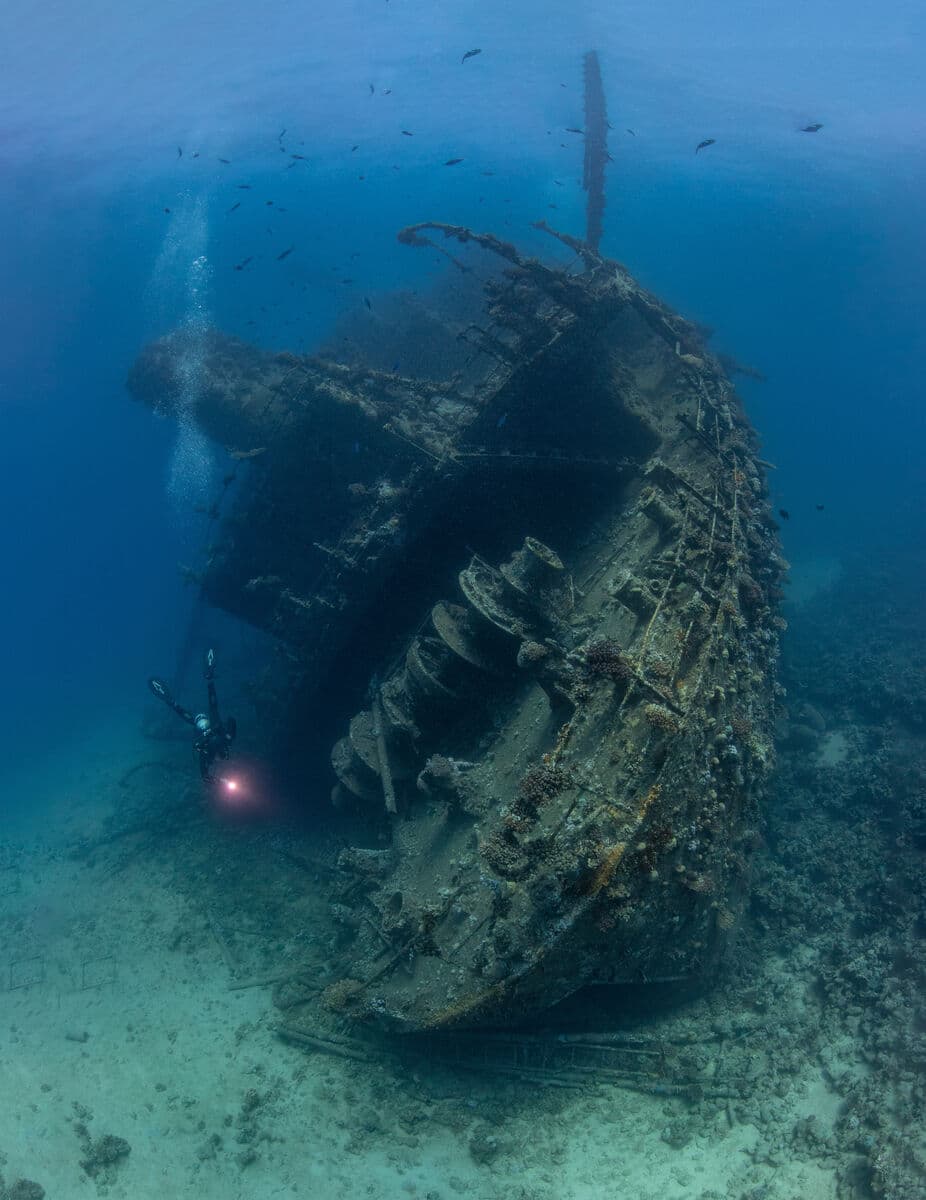
Abu Nuhas
Four ships on one reef, a century of maritime disaster laid out in clear northern Red Sea water.
Abu Nuhas is the northern Red Sea's ship graveyard — a low, treacherous reef northwest of Shadwan Island that has claimed at least seven vessels in the shipping lane out of the Gulf of Suez. Four of those wrecks sit within recreational limits along the reef's northern flank, close enough that a good liveaboard itinerary lets you dive all of them across a day or two. If you care about wreck diving and you are heading for Egypt, this is one of the sites that put the region on the map.
Quick answer: Abu Nuhas is a wreck diving on a coral reef, dived on fixed moorings or as short drifts depending on sea state in Red Sea. Best season: March-May and September-November for the best mix of calm surface, warm water and visibility; diveable year-round from liveaboards. Level: Open Water and up for the shallow wrecks (Giannis D, Carnatic); Advanced with wreck experience for the deeper Kimon M and any penetration. Depth: 3-32 m depending on the wreck; most decks and holds sit in the 10-26 m range. Typical visibility: Typically 20-30 m, often excellent, though it drops when wind stirs up the windward side.
Facts verified September 2026
Why Abu Nuhas is the Red Sea's wreck classroom
Abu Nuhas is a triangular coral reef that barely breaks the surface right where ships funnelling out of the Gulf of Suez have to thread a busy channel. For more than 150 years that combination of shallow coral and heavy traffic has done predictable damage, and the reef now holds at least seven documented wrecks. Four of them lie close together along the northern side in sport-diving depths, which is why divers call this stretch the ship graveyard.
What makes it special is the concentration and the contrast. You can dive a Victorian sail-and-steam clipper and a 1980s cargo freighter on the same morning, watch how the sea has treated 150 years of iron versus 40, and do it all in water that regularly gives you 20 to 30 metres of visibility. Few places let you read maritime history this directly, and fewer still let you do it without pushing past recreational limits.
The four wrecks you came for
Each hull has its own character, and most liveaboards work through two or more depending on conditions and your group's experience.
- Giannis D — the crowd favourite. A roughly 100 m Japanese-built freighter that struck the reef in 1983, she lies broken with a dramatically canted stern section down to about 24 m and a mast rising to around 4 m that doubles as a perfect safety-stop perch. The engine room and accommodation offer atmospheric, well-lit penetration for trained divers.
- Carnatic — the elegant antique. A 90 m British P&O sail-and-steam ship lost in 1869 while carrying cotton, copper and Royal Mint gold. She sits on her side around 24 m with the bow shallower near 12 m; decades underwater have left a delicately soft-coral-encrusted skeleton full of glassfish. Historic and photogenic.
- Chrisoula K — the 'tile wreck'. A Greek cargo vessel that sank in 1981 with a hold full of Italian floor tiles you can still see stacked. The stern lies around 26 m in sand, the bow reaches up to roughly 3 m against the reef.
- Kimon M — the 'lentil wreck', the deepest and least dived. A 120 m freighter carrying lentils, her stern rests near 32 m. Being deeper and more exposed, she is the advanced option and is skipped when the sea is up.
Conditions and who it is for
Be honest with yourself about this reef. The wrecks sit on the windward, northern side, so the surface is often choppy and mooring can be genuinely difficult; when the wind pushes past about 20 knots, boats may not be able to tie in at all and the day gets moved. Current is the other variable. It usually runs north to south and can be strong, and the northeast corner where currents converge deserves real respect.
That said, the site rewards a range of experience. The Giannis D and Carnatic sit shallow enough for competent Open Water divers in good conditions, and they make superb introductory wrecks. The Kimon M's depth and any serious penetration are Advanced territory, ideally with a wreck course and a good light. Most divers here are comfortable to 30 m and have some experience reading current. Dive it as a moored dive or a short drift, follow the guide's brief on the corner, and keep something in reserve for the swim back to the line.
When to dive it
Abu Nuhas is diveable all year from a liveaboard, but the shoulder seasons give you the best odds. Spring (March to May) and autumn (September to November) tend to combine warmer water, calmer surface and strong visibility, which matters on an exposed windward reef where a blown-out day means no mooring.
Water sits roughly between 22 and 28°C across the year, coolest in winter when a good exposure suit earns its keep and warmest late summer. Summer brings the warmest water and long days but also the season's strongest northerlies at times, so surface comfort can suffer even when the diving below is calm. Whatever the month, keep a flexible mindset: skippers here read the wind and reshuffle the schedule, and that judgement is what keeps the site safe.
How you actually dive Abu Nuhas
This is a boat-access site with no shore option — you reach it by day boat from Hurghada or, far more commonly and comfortably, by liveaboard on a northern Red Sea wrecks-and-reefs route. Liveaboards win here for a simple reason: they can sit on the reef, wait out a windy morning, and drop you when the mooring is workable rather than being tied to a fixed day-trip timetable.
A typical plan moors on the northern side and works one or two wrecks per dive, often pairing the shallow Giannis D or Carnatic with a reef amble, and saving the deeper Kimon M for a fresh, well-briefed first dive of the day. Most itineraries fold Abu Nuhas in alongside the SS Thistlegorm and the reefs of the Strait of Gubal, so you get the graveyard as part of a broader wreck week rather than a single stop.
Faneca dives Abu Nuhas aboard the liveaboards Blue Melody and Blue Horizon on our Northern Red Sea Wrecks and Reefs itineraries, where the reef is paired with the SS Thistlegorm and the Strait of Gubal — access is weather-dependent on this exposed windward site, so the exact wrecks dived flex with the wind.
Abu Nuhas: common questions
What is the best season to dive Abu Nuhas?
March-May and September-November for the best mix of calm surface, warm water and visibility; diveable year-round from liveaboards
What experience level do I need for Abu Nuhas?
Open Water and up for the shallow wrecks (Giannis D, Carnatic); Advanced with wreck experience for the deeper Kimon M and any penetration
How deep is Abu Nuhas?
3-32 m depending on the wreck; most decks and holds sit in the 10-26 m range
What marine life will I see at Abu Nuhas?
Glassfish clouds, giant morays, lionfish, scorpionfish, octopus, Picasso and other triggerfish, nudibranchs and reef fish colonising the hulls; occasional passing dolphins
