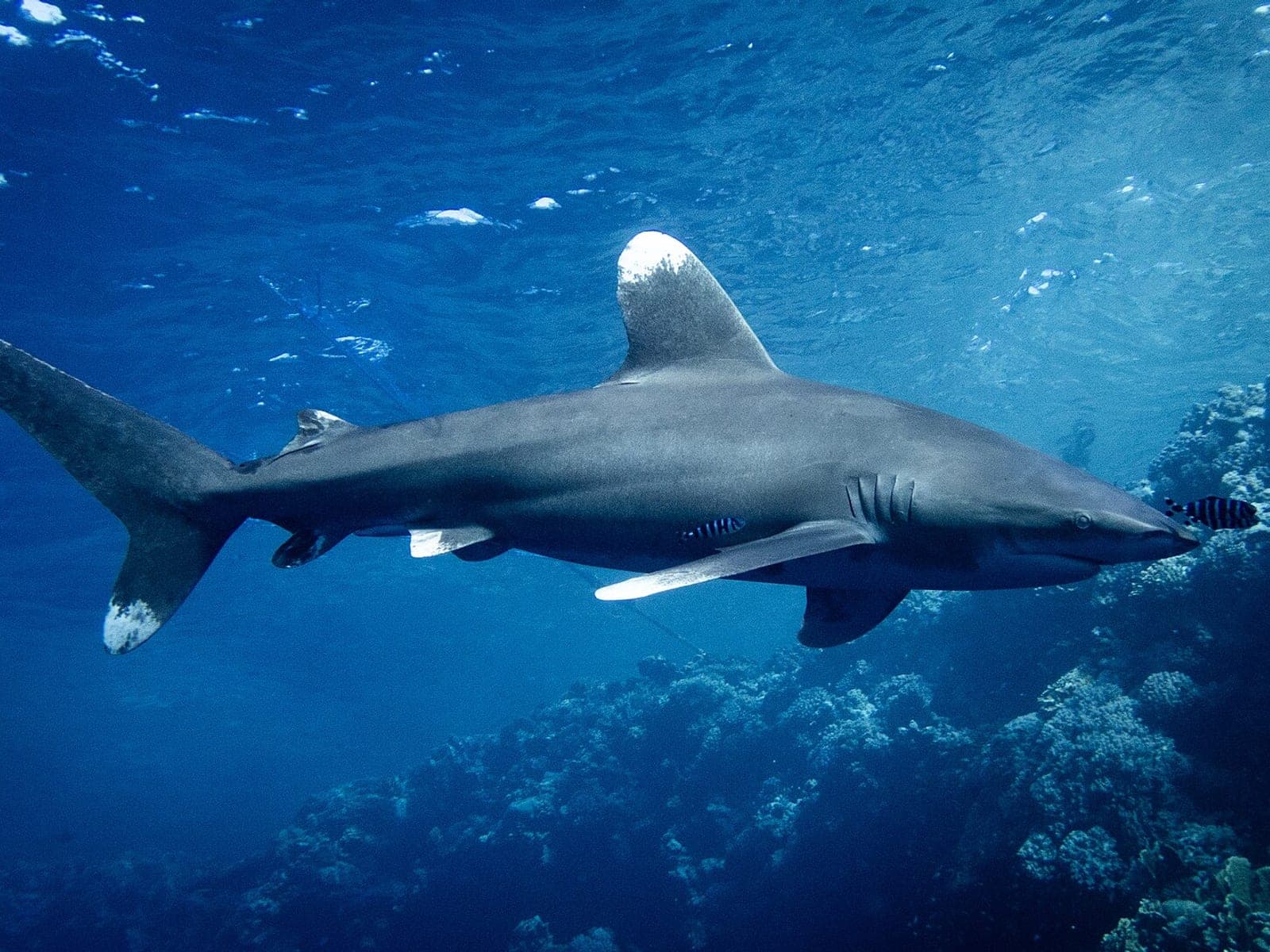
Elphinstone Reef
The Red Sea's most electric shark wall, a lone reef adrift in open blue off Marsa Alam.
Some dive sites earn their reputation slowly. Elphinstone Reef did it the hard way, one heart-in-mouth oceanic whitetip encounter at a time. This narrow finger of coral sits alone in open water off Marsa Alam, its walls dropping into cobalt on every side, and it draws divers who want the real thing: big pelagics, honest current and the sense that you are a guest in genuinely wild water. Diving Elphinstone Reef is not a gentle introduction to the Red Sea. It is the Red Sea at full voltage, and once you have done it properly, most other sites feel a little tame.
Quick answer: Elphinstone Reef is a drift and wall diving around an exposed offshore pinnacle reef in Red Sea. Best season: Year-round; oceanic whitetips peak Oct–Dec, mantas & rays Jul–Oct. Level: Advanced — AOW or equivalent, with drift experience. Depth: Plateaus from 20–40 m; walls drop past 100 m (deep archway at 52–65 m). Typical visibility: Typically 20–40 m, up to 60 m when plankton is low.
Facts verified September 2026
Why Elphinstone Reef is a Red Sea pilgrimage
Elphinstone is a slim reef, roughly 375 metres long, running north to south with steep walls plunging on all four sides. It is small enough to swim the length of in a single dive, yet it punches far above its size because of where it sits: alone in open ocean, a magnet in the blue for anything passing through. That isolation is the whole point. Pelagics use it as a waypoint, and the walls funnel current and life into a handful of predictable meeting places.
The reef has two personalities, defined by its plateaus. The northern plateau is the longer of the two, shelving from around 20 metres before it tips over into the abyss. The southern plateau is shorter and a touch deeper, starting near 25 metres, and it is the classic hammerhead corner on an incoming current at first light. Off the southern tip lies Elphinstone's most whispered-about feature: a deep arch, often called the sarcophagus, sitting between roughly 52 and 65 metres. It is a technical, decompression-range dive that has no business on a recreational plan, and the honest advice is to admire it from above unless you are properly trained and equipped.
What you'll see underwater
Elphinstone is a shark site first and a spectacular coral wall second, though the walls alone would justify the trip. The soft corals here are exceptional, purples and pinks stacked against red gorgonian fans, wire coral and black coral threading the deeper reef. But most divers come with one silhouette in mind.
The headline act is the oceanic whitetip, that broad, unhurried shark with the rounded, white-tipped fins. They are curious rather than shy, and a close pass in open water is one of diving's genuinely unforgettable moments. Beyond them, the cast is deep:
- Oceanic whitetip sharks — the star, most reliable October to December
- Scalloped hammerheads — early morning off the southern plateau on incoming current
- Grey reef and silvertip sharks patrolling the walls, with occasional tiger sightings
- Napoleon wrasse, giant moray eels and hawksbill turtles on the reef itself
- Schooling barracuda and giant trevally hunting along the drop-offs
- Mantas and stingrays passing through, most often July to October
Conditions and who Elphinstone diving is for
This is where honesty matters. Elphinstone is not a beginner site, and no reputable guide will pretend otherwise. The reef is fully exposed to open sea, the surface can be lumpy, and the current is variable and frequently strong, two knots or more, generally setting north to south. That current is your friend when you use it, carrying you effortlessly along a wall, and your problem the moment you fight it near a corner where flows collide.
You should hold an Advanced Open Water certification or equivalent and, more importantly, have real drift-diving experience and dialled buoyancy. The temptation to chase a shark down the wall is constant, so disciplined depth and gas management are non-negotiable. Come with a surface marker buoy you can deploy without thinking, stay with your guide's plan, and treat the blue with respect. Divers who meet the site on its own terms find it exhilarating; those who overreach find it stressful. Know which one you are before you giant-stride.
When to dive Elphinstone Reef
Elphinstone can be dived year-round, and the reef always delivers walls and reef life. But the calendar shapes what shows up in the blue. If oceanic whitetips are your reason for coming, target October to December, when the cooling water brings them in numbers and they linger through winter. This is the peak window and the busiest, so book ahead.
The warmer months from July to October shift the odds toward mantas and stingrays, with hammerheads a dawn possibility across much of the season. Water temperatures swing from the low-20s Celsius in winter to high-20s in late summer, so plan your exposure protection accordingly, a 5 mm suit is a sensible year-round baseline, thicker if you feel the cold on repetitive days.
How you actually dive it
Elphinstone sits close enough to shore, around 12 kilometres, to be reached by day boat from the Marsa Alam coast, and plenty of divers do exactly that. But the site rewards patience, and the best experience comes from a liveaboard. A boat that moors nearby overnight lets you drop in at sunrise or dusk, when the sharks are most active and, crucially, before the day-boat crowd arrives. Having the reef to yourselves in that first grey light is a different sport entirely.
The typical dive is a negative or prompt entry near a plateau, a drop to scout the corner and the blue, then a drift along the wall as the current carries you, finishing with a slow ascent in open water under an SMB. You rarely touch the reef top until safety-stop depth. Elphinstone also anchors the celebrated Brothers, Daedalus and Elphinstone route, the 'BDE' or 'Simply the Best' itinerary, which strings it together with two more world-class offshore reefs into one of the finest shark weeks in the world.
Faneca dives Elphinstone aboard Blue Melody and JP Marine on our southern Red Sea and Brothers–Daedalus–Elphinstone (BDE) routes — and this is a reef best experienced by liveaboard, mooring close by for the sunrise dives that day boats simply cannot reach.
Elphinstone Reef: common questions
What is the best season to dive Elphinstone Reef?
Year-round; oceanic whitetips peak Oct–Dec, mantas & rays Jul–Oct
What experience level do I need for Elphinstone Reef?
Advanced — AOW or equivalent, with drift experience
How deep is Elphinstone Reef?
Plateaus from 20–40 m; walls drop past 100 m (deep archway at 52–65 m)
What marine life will I see at Elphinstone Reef?
Oceanic whitetips, scalloped hammerheads, grey reef & silvertip sharks, Napoleon wrasse, giant moray, hawksbill turtles, barracuda, mantas
