Daedalus Reef
The lone striped lighthouse where the open Red Sea delivers its sharks.
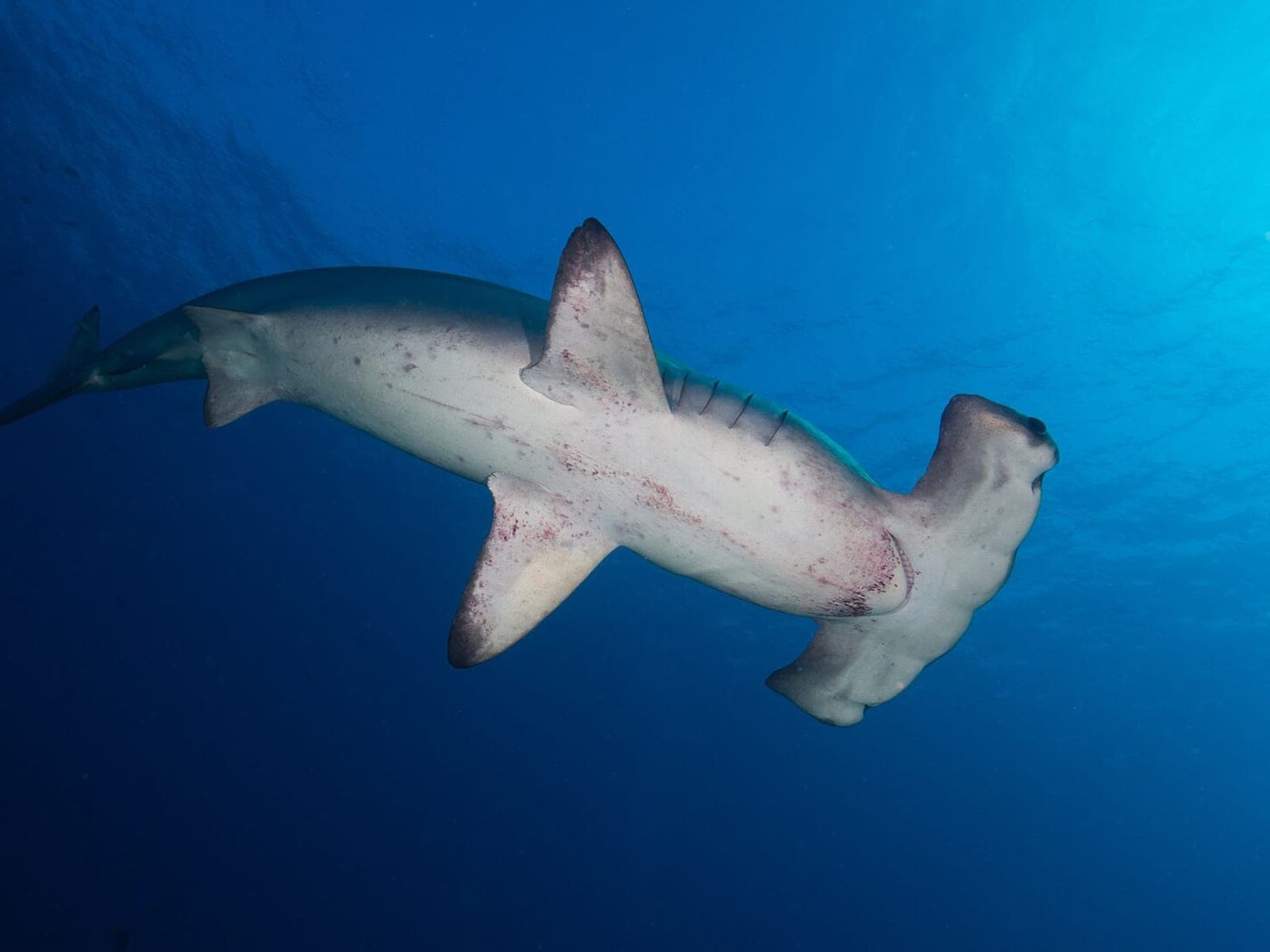
Eighty kilometres out from Marsa Alam, past the point where the coast has long dropped below the horizon, a single black-and-white lighthouse marks a coral platform standing alone in deep blue water. This is Daedalus Reef, known to Egyptian charts as Abu el-Kizan, and diving it feels less like visiting a dive site than boarding a ship anchored in the middle of the sea. There is no shore, no shelter, and nothing between you and open water but the reef itself. That exposure is exactly why divers cross a night of ocean to reach it: Daedalus is one of the Red Sea's great pelagic arenas, a liveaboard-only reef where hammerheads school along the walls and the current does the work of bringing the ocean to you.
Quick answer: Daedalus Reef is a drift and wall diving around an oceanic pinnacle-reef, with a shallow plateau in Red Sea. Best season: March–May and September–November overall; summer to autumn for schooling hammerheads. Level: Intermediate to advanced — the north point is genuinely advanced in strong current. Depth: 5 m to 40 m+; recreational limit around 30–40 m along the walls. Typical visibility: Typically 20–30 m, frequently exceeding 30 m.
Facts verified September 2026
Why Daedalus Reef is a bucket-list dive
Daedalus is an oval coral platform, a little over a kilometre long, rising from a seabed some 550 metres down. That single fact explains almost everything about the diving. Deep, open water presses in on all sides, upwelling currents sweep nutrients up the walls, and big animals patrol the edges where the reef meets the blue. The marine-park designation and the sheer distance from shore keep the coral in superb condition — thickly overgrown soft corals and fans, huge porites formations, and busy cleaning stations along walls that fall away vertically beneath you.
The lighthouse gives the reef its landmark: a 30-metre striped tower first built in 1863, still manned, standing on an artificial island at the reef's centre. You will moor in its lee, ride out to the walls by zodiac, and come back to it between dives. For most divers the draw is not the postcard, though — it is the reputation. Daedalus is widely rated among the best places in the Red Sea to see scalloped hammerheads schooling, and it delivers a genuinely wild, oceanic feel that the inshore reefs cannot match.
What you'll see underwater
Daedalus is a two-part experience: world-class pelagic action out in the blue, and a dense, colourful reef when you turn back to the wall. The north plateau is the theatre for the big encounters, where the current splits and schools of hammerheads hang in the flow. The southern point is the classic spot for thresher sharks, and manta rays pass through in the cooler months.
Expect to see, conditions and season depending:
- Scalloped hammerheads — often in schools off the north plateau on early, incoming-current dives
- Thresher sharks — most reliable around the south point, favouring cooler water
- Oceanic whitetip and silky sharks — patrolling the blue, more frequent late summer into autumn
- Manta rays and dolphins — mantas mainly winter and spring; dolphins common at the north
- Anemone City — a long stretch of the western side carpeted in anemones, endemic Red Sea anemonefish and dottybacks
- Reef life — moray eels, groupers, bluespine unicornfish, wrasse, and hunting packs of trevally and tuna
Conditions and who Daedalus Reef diving is for
Be honest with yourself about your experience before booking Daedalus. This is intermediate-to-advanced diving, and the north point in a running current is firmly at the advanced end. Current typically flows north to south along the walls and splits over the northern tip, where it can be strong and changeable — the same energy that concentrates the sharks. You need confident buoyancy, comfort with negative entries from a zodiac, a reliable SMB and the discipline to hold a line in the blue rather than chase animals into open water.
Above the surface, Daedalus is exposed. With no landmass to break the weather, wind builds real swell, and the boat ride out and the entries can be lively. Underwater, though, the visibility is a reward for the effort — commonly 20 to 30 metres and often more, with water between roughly 24 and 30°C across the season. A 3mm suit suits high summer; bring a 5mm and a hood for the cooler, sharkier months. If your logbook is still building, treat Daedalus as a goal to work toward — it is far more rewarding when the conditions are within your comfort zone.
When to dive it, and how the diving works
Liveaboards run to Daedalus roughly from mid-March to mid-December. For the best all-round mix of warm water, calm-ish seas and visibility, aim for March–May or September–November. If the hammerheads are your priority, summer into early autumn is the classic window for schooling behaviour, while threshers and oceanic whitetips tilt toward autumn and into winter, and mantas favour the cooler months. There is no bad time so much as different headline acts.
The routine is simple and efficient. You sleep aboard moored by the lighthouse and dive the walls by zodiac drop, generally working the eastern wall in the morning and the western wall in the afternoon to stay with the light and the current. Plan for up to three dives a day, front-loaded with early starts when the pelagic odds are best. Because Daedalus is reachable only by liveaboard, it is almost always dived as part of a multi-site offshore trip rather than a single stop — which is exactly how it should be experienced.
Faneca dives Daedalus on offshore Red Sea routes — most often the classic Brothers–Daedalus–Elphinstone (BDE) itinerary — aboard Blue Melody and JP Marine, and because the reef is liveaboard-only this is genuinely the only way to experience it properly.
Daedalus Reef: common questions
What is the best season to dive Daedalus Reef?
March–May and September–November overall; summer to autumn for schooling hammerheads
What experience level do I need for Daedalus Reef?
Intermediate to advanced — the north point is genuinely advanced in strong current
How deep is Daedalus Reef?
5 m to 40 m+; recreational limit around 30–40 m along the walls
What marine life will I see at Daedalus Reef?
Scalloped hammerheads, thresher and oceanic whitetip sharks, manta rays, dolphins, trevally, tuna, anemonefish
