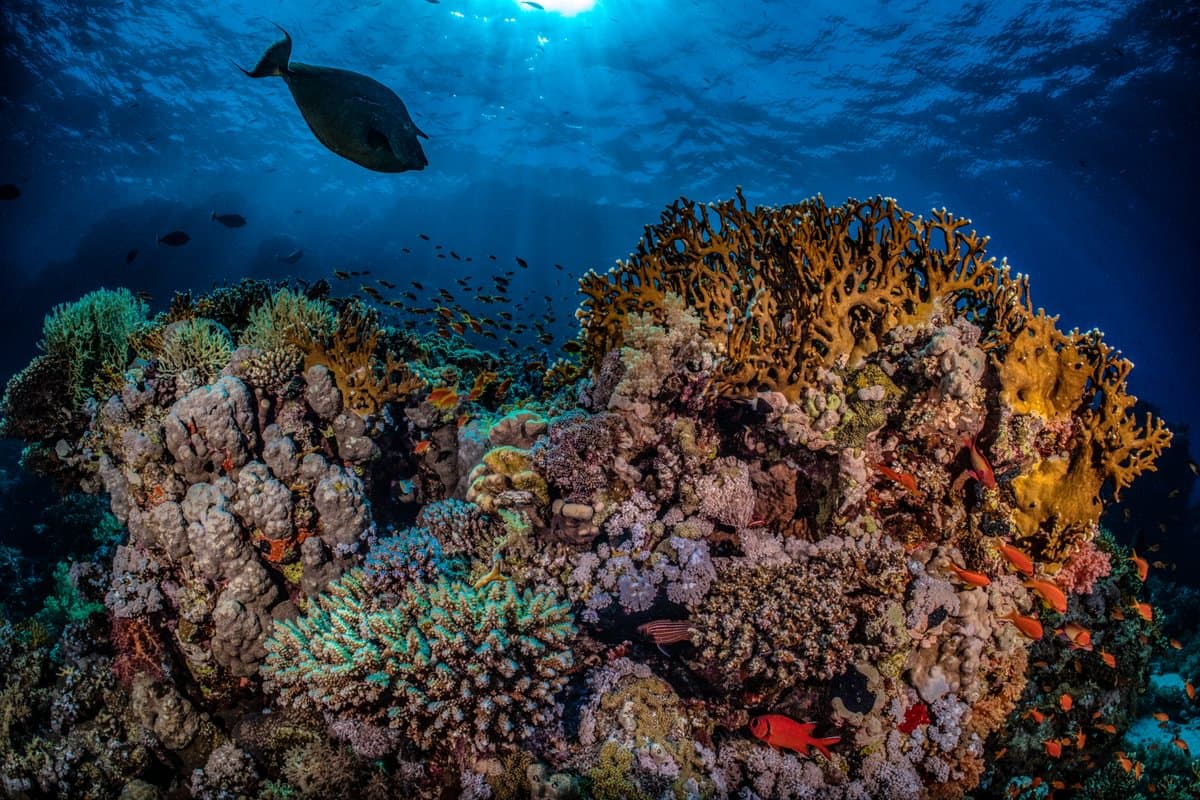
Brothers Islands
Two volcanic pinnacles in open water where sharks, walls and shipwrecks meet.
Sixty-odd kilometres from the nearest coast, two specks of rock break the surface of the central Red Sea and drop straight into the blue. Brothers Islands diving is the reason a lot of divers save their offshore permits and their nerve for one week a year: sheer walls smothered in soft coral, two historic wrecks draped over the reef, and a genuine chance of hammerheads, oceanic whitetips and threshers in the same trip. This is remote, current-swept, liveaboard-only diving, and it rewards divers who come prepared. Here is what the site is really like, and how to get the most from it.
Quick answer: Brothers Islands is a wall and drift diving, plus two wreck dives in Red Sea. Best season: Roughly March to November (marine park access is seasonal); hammerheads May–October, oceanic whitetips and threshers into autumn. Level: Advanced — experienced divers only. Depth: Reef tops from 5 m; walls and plateaus to 40 m; wrecks and drop-offs continue well beyond recreational limits. Typical visibility: Typically 20–30 m, often more.
Facts verified September 2026
What makes Brothers Islands diving special
Big Brother and Little Brother are the exposed tips of two volcanic cones rising from deep water, separated by about a kilometre of open sea. Because they sit alone in the blue, they act as a magnet: pelagic life that has no reason to visit a coastal reef comes here to feed, patrol and be cleaned. That isolation is the whole appeal, and it is also why you cannot reach them on a day boat.
Big Brother is the larger of the two, crowned by a Victorian stone lighthouse built by the British in the 1880s. It carries the reef's two famous wrecks and some of the healthiest coral walls in the Egyptian Red Sea. Little Brother is smaller and wilder — a single teardrop of reef with no wreck, denser coral fans, and the more reliable shark action of the pair. Both were declared protected marine areas in 1983, which is a large part of why the reefs remain in the condition they are.
What you'll see underwater
The walls themselves are the first thing that lands. Broccoli soft coral and giant gorgonian fans cover almost every surface, hung with clouds of anthias and glassfish. But most divers come for what patrols the edge of the drop-off.
Marine life you can realistically hope for here:
- Grey reef and silvertip sharks, often on the plateaus and along the walls year-round
- Scalloped and great hammerheads, seasonal and best off Little Brother's points
- Oceanic whitetip sharks, frequently cruising the shallows in autumn — curious and to be respected
- Thresher sharks, most often at dawn, drawn to the cleaning stations
- Dogtooth tuna, schooling barracuda, jacks and big Napoleon wrasse
- Anthias, glassfish, sweepers and unicornfish carpeting the reef
Conditions and who Brothers Islands diving is for
This is an honest section, because Brothers is not a site to underestimate. The current typically runs north to south and can shift from a pleasant push to a serious drift, and both islands are known for occasional downcurrents — vertical water that can pull you deeper before you notice. Add depth, blue-water walls with no bottom in sight, and a location hours from any recompression chamber, and the picture is clear.
Realistically this is advanced diving. Most operators and the site itself expect a solid logbook — good buoyancy, comfort with drift and negative entries, and experience diving deep walls in current. You should be confident deploying an SMB and staying with your guide and group. If you are still building experience, it is worth logging more coastal Red Sea dives first and coming back when Brothers will be a highlight rather than a handful. Visibility is usually a generous 20 to 30 metres and often better, and water sits between about 23°C in winter and 30°C at the height of summer.
The Numidia and Aida wrecks
Big Brother's two wrecks are among the most photogenic in the Red Sea, precisely because the coral has claimed them so completely.
The Numidia, a 137-metre British cargo steamer, struck the island's northern tip in 1901 on a voyage to India. She now lies almost vertically down the reef slope — the bow section in the shallows around 8 metres, the structure plunging into the dark well past recreational depth. Her most famous cargo, a pair of locomotive wheels, still rests among the wreckage, and the whole hull has become a vibrant, living reef of hard and soft coral.
The Aida, a 75-metre Italian supply and transport ship, went down in 1957 against the island's western wall. Her shallowest remains sit around 15 metres and the structure runs down past 40, superstructure and all, thick with coral and patrolled by groupers. Both wrecks are dived as walls first and wrecks second, which keeps them manageable if you watch your depth and gas.
When to dive it, and how you actually dive it
Brothers is a seasonal site. Marine park access generally runs from around March into November, with the water and weather at their kindest through late spring, summer and early autumn. If sharks are your priority, hammerheads are most consistent from May to October, while oceanic whitetips and thresher encounters strengthen into the autumn months. Winter closes much of the offshore diving down and brings rougher surface conditions.
In practice you dive Brothers as a series of wall and drift dives. Boats moor at the sheltered end and you enter to cover a wall or plateau, drifting with the current and finishing back near the mooring or by pick-up. Early morning dives give the best odds at the cleaning stations for threshers and hammerheads. Nitrox is strongly recommended given the depths, and a good SMB and a torch for the coral overhangs earn their place in your kit. Because the islands stand alone offshore, every dive here is boat-based from a liveaboard — there is no shore, no day-trip, and no shortcut.
Faneca dives Brothers on our offshore Brothers–Daedalus–Elphinstone (BDE) itineraries aboard Blue Melody and Blue Horizon — and because the islands are liveaboard-only, this remote a site is genuinely best experienced from a boat that sleeps you on top of the reef and puts you in the water at first light.
Brothers Islands: common questions
What is the best season to dive Brothers Islands?
Roughly March to November (marine park access is seasonal); hammerheads May–October, oceanic whitetips and threshers into autumn
What experience level do I need for Brothers Islands?
Advanced — experienced divers only
How deep is Brothers Islands?
Reef tops from 5 m; walls and plateaus to 40 m; wrecks and drop-offs continue well beyond recreational limits
What marine life will I see at Brothers Islands?
Grey reef, silvertip and oceanic whitetip sharks, scalloped and great hammerheads, threshers, dogtooth tuna, barracuda, Napoleon wrasse, dense soft corals and giant gorgonians
