Oceanic Whitetip Season in the Red Sea: When, Where and How to Dive Them
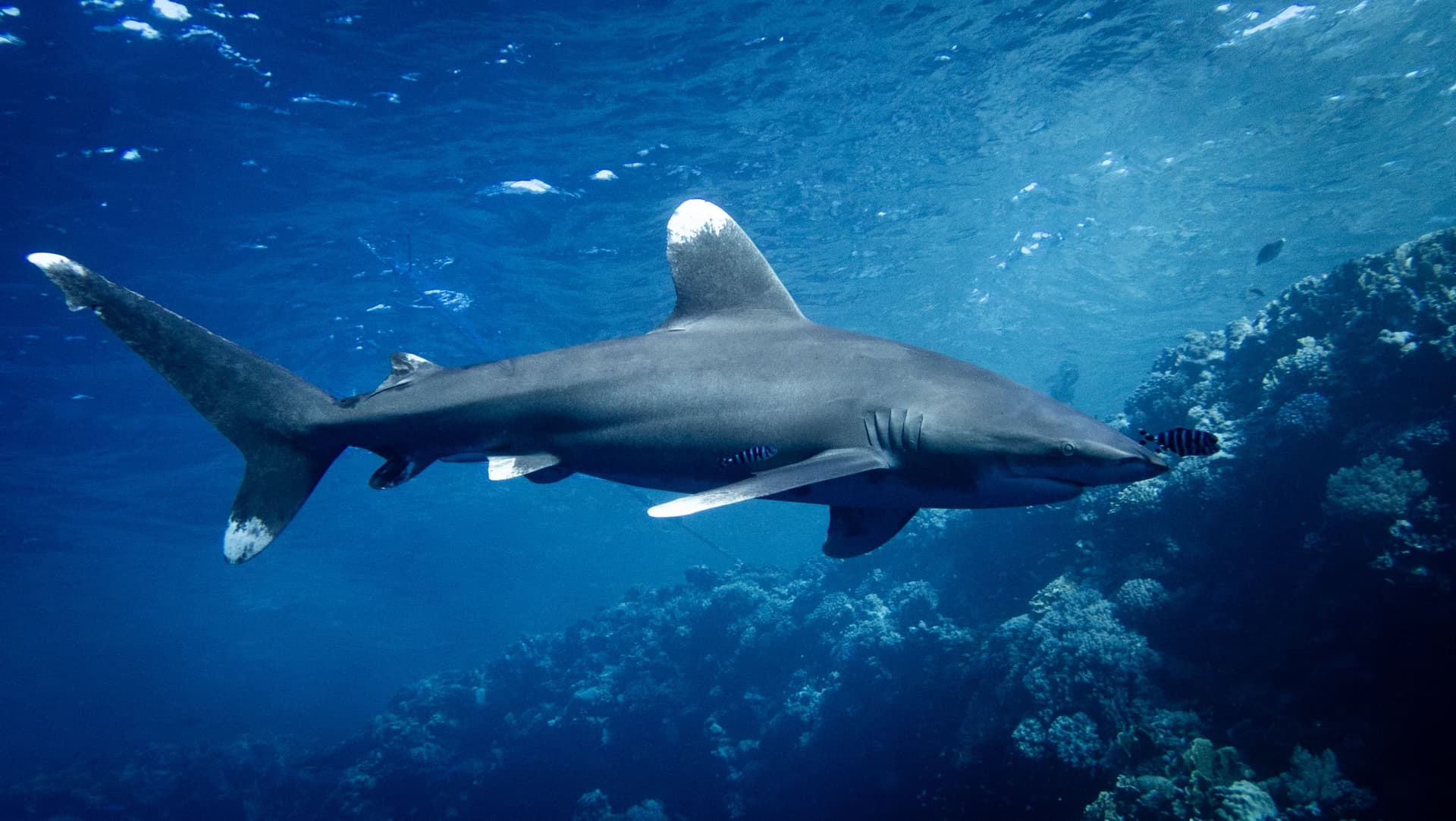
Photo: Polygonia c-album, CC BY-SA 4.0
The oceanic whitetip is a shark of the open sea. It spends most of its life far from any reef, working the upper layer of tropical oceans for whatever it can find. For a few weeks each autumn, a handful of offshore reefs in the Egyptian Red Sea become one of the few places where a diver can reliably share the water with one, very often at the end of the dive, a few metres below the boat.
This guide covers when the season runs, which reefs matter, how the encounters actually unfold and the conduct rules Egyptian guides now brief before every dive. It is written for divers who are already comfortable in blue water and current.
The short answer
- Peak months: October and November.
- Possible: June to September, and December.
- Where: Elphinstone Reef, the Brothers and Daedalus. All three are offshore reefs; the Brothers and Daedalus are liveaboard-only, while Elphinstone is also reached by day boat from the Marsa Alam coast.
- Water: roughly 25–28°C through the peak.
- Level: these are exposed, current-swept sites. Operators running them usually ask for an advanced certification and a minimum number of logged dives, and the exact requirement varies by boat.
The live odds for each month sit on our oceanic whitetip sightings page.
Month by month
| Month | Odds in our data | What to expect |
|---|---|---|
| January–May | Not a whitetip window | Offshore routes run, but whitetips are not the reason to book |
| June–August | Possible | Occasional early sharks; summer at Daedalus is better known for scalloped hammerheads |
| September | Possible | Warm water and usually settled seas; encounters can happen but are not the norm |
| October | Peak | The most reliable month for whitetips on the offshore reefs |
| November | Peak | Still prime; the first winter weather can start to close in late in the month |
| December | Possible | Cooler water (around 23–25°C) and more wind; some offshore itineraries do not run |
If you want the wider picture of the year, including wrecks, water temperature and prices, our month-by-month Red Sea guide covers it. For what else is in season across all our destinations at the height of whitetip time, see what to dive in November.
Why autumn
The honest answer is that nobody knows for certain. The IUCN Shark Specialist Group's factsheet for Elphinstone states plainly that the reason for these seasonal aggregations is not yet understood.
What is known comes largely from photo-identification work led by the Red Sea Sharks Trust, which matches individual sharks by their fin and body markings. At Elphinstone, 465 individual whitetips were identified between 2004 and 2019, with encounter rates peaking in October and November. Groups of up to 28 have been recorded there, although the average is closer to three or four, and a lone shark is common. Females outnumber males in the records by roughly two to one. At Daedalus, 330 individuals were identified between 2003 and 2019, again mainly in October and November.
One caveat worth knowing: far fewer divers visit the offshore reefs between December and March, so some of the winter quiet in the data reflects fewer observers as well as fewer sharks.
Where to find them
Elphinstone Reef
A long, narrow reef north of Marsa Alam, with a plateau at each end and walls dropping into very deep water. It is the best-studied whitetip site in the Red Sea and was recognised as an Important Shark and Ray Area in 2023 largely because of them. Because day boats reach it as well as liveaboards, it can be busy. Our Elphinstone Reef guide covers the plateaus, the currents and how the dives are run.
The Brothers
Two small islands far offshore, Big and Little Brother, with sheer walls and two wrecks on the bigger island. In autumn the whitetips patrol around the islands and under the moored boats. The Brothers were closed to divers in December 2018 after a series of bites and reopened in March 2019 under new conditions, including a daytime-only diving window, a cap on boat numbers and a ban on dumping organic waste within five nautical miles. See our Brothers Islands guide.
Daedalus
A single reef topped by a lighthouse, about 90 km offshore and the most remote of the three. It is an Important Shark and Ray Area for both oceanic whitetips and scalloped hammerheads, and the crossing out can be rough. Our Daedalus Reef guide has the detail.
How an encounter actually unfolds
Most whitetip encounters do not happen on the reef. They happen in the top few metres of open water, often around the boats.
A typical one goes like this. You finish a wall dive, drift up to your safety stop under the boat, and a shark arrives out of the blue. It moves slowly, with those long, rounded pectoral fins held wide and a few pilot fish riding in front of its snout. It comes close, turns away and comes back. It may look at the diver on the edge of the group, at a dangling fin or at a camera.
That curiosity is the whole appeal, and it is also why the encounter needs discipline. A whitetip is an open-ocean opportunist that investigates anything at the surface which might be food, including injured or struggling animals. A calm group of divers at five metres looks very little like that. A lone swimmer splashing at the surface looks a great deal more like it.
The conduct rules your guide will brief
Since January 2019 every dive guide working on liveaboards in the Egyptian Red Sea has had to attend a mandatory seminar on safe interactions with oceanic whitetips, written and presented by Elke Bojanowski of the Red Sea Sharks Trust. The points below reflect that training, the Red Sea Project's code of conduct and HEPCA's advice. Your guide's briefing for the specific site and boat always comes first.
- Get down quickly. Use a negative entry when asked and keep surface time to a minimum on the way in and the way out.
- Stay vertical when a shark is close. Upright, calm, fins still.
- Keep the shark in view. Turn to face it. Never turn your back and swim away.
- Stay together. Keep to buddy teams with the group close, ideally at the shark's depth. HEPCA's advice notes that sharks are generally more reluctant to approach groups closely than single divers.
- Move slowly. No sudden or jerky movements, no chasing and no touching.
- No snorkelling or swimming where whitetips are present. After a snorkeller died at St Johns in 2009, HEPCA called letting guests snorkel at the offshore islands when whitetips are around "highly unprofessional". The Red Sea Project code lists snorkelling, freediving and swimming in their area as don'ts.
- No feeding, ever. Feeding and baiting sharks is illegal in the Egyptian Red Sea. If you see it, get out of the water and tell your guide.
- Daylight only, and limit your time. The Red Sea Project code asks for daylight dives with whitetips and caps observation at around 30 minutes.
Exits: where the discipline matters most
The surface is where whitetips are most at home and where a diver is at their least controlled, so the end of the dive is the part to take most seriously.
On the safety stop, stay with your group at the depth your guide sets. Many guides have the group face outwards so that someone always has eyes on the shark. If a whitetip is circling close, the guide may hold everyone at the stop until it moves off rather than send divers up one by one.
At the surface, the rule is simple: do not hang there. No floating with legs dangling and fins kicking while you wait for the ladder or the RIB. Go straight to the exit and climb out, then clear the ladder for the next diver. How each boat runs its pick-ups varies, which is why the exit plan is part of every whitetip briefing.
Incidents, in proportion
Thousands of divers visit these reefs every season, and the great majority of whitetip encounters end with nothing more than a memorable dive. Incidents have happened, though, and it helps to know what they had in common.
In 2018 there were four bites at the Brothers, one in June and three in November, which led to the December closure. Investigators pointed to organic waste being dumped from boats, whether routinely or to attract sharks, and that is why the reopening conditions banned it. In December 2020 a diver at Elphinstone was bitten on the arm and treated with stitches. Earlier incidents, at St Johns in 2009 and off Sharm El Sheikh in 2010, involved snorkellers and swimmers at the surface.
The pattern is consistent: people at or near the surface, and often food or waste in the water. That is exactly what the rules above are designed to remove. More recent fatal incidents on Egypt's coast, near Hurghada in 2022 and Marsa Alam in late 2024, were not attributed to oceanic whitetips.
A Critically Endangered shark
The IUCN Red List moved the oceanic whitetip to Critically Endangered in 2019, up from Vulnerable, after steep declines in every ocean driven mainly by fishing. It has been listed on CITES Appendix II since 2013, which regulates international trade, and on Appendix I of the Convention on Migratory Species since 2020.
That context makes the Red Sea autumn aggregations unusually valuable. Both Elphinstone and Daedalus are recognised as Important Shark and Ray Areas, and the Red Sea Sharks Trust's photo-identification database is one of the largest for the species anywhere. Responsible behaviour in the water is part of keeping these encounters possible.
Photography tips
- Go wide. The shark will usually come close, so a wide-angle or fisheye set-up suits it far better than a mid-range zoom.
- Use the light near the surface. At five metres in clear water, ambient light does most of the work. Shoot in RAW and set a custom white balance if your camera allows. A fast shutter speed keeps the sun rays crisp.
- Let the shark come to you. Stay with your group and keep the camera close to your body. The Red Sea Project code also lists selfie sticks among its don'ts. Chasing the shark breaks the rules above and rarely gets the shot anyway.
- Look for the pilot fish. They give the frame scale and a story.
- Take one clean side-on shot. A clear view of the dorsal fin and flanks is the kind of image photo-identification projects use to tell individuals apart.
Which routes reach these reefs, and when ours run
The classic route is the BDE (Brothers, Daedalus and Elphinstone) week. Other routes combine Daedalus with southern reefs, or the northern wrecks with the Brothers. Our Red Sea destination page explains how the routes differ.
These are the departures on our calendar right now, between October and December, whose route takes in the Brothers, Daedalus or Elphinstone. The table updates itself from the live calendar:
| Date | Destination | Route | Nights | From |
|---|---|---|---|---|
| 17 Oct 2026 | Red Sea | Golden Mix — Daedalus, Sataya & St Johns | 7 | €780 |
| 29 Oct 2026 | Red Sea | Daedalus & Elba Reef | 7 | €1,349 |
| 14 Nov 2026 | Red Sea | Brothers, Daedalus & Elphinstone | 7 | €1,062 |
| 19 Nov 2026 | Red Sea | Daedalus & Elba Reef | 7 | €1,499 |
| 21 Nov 2026 | Red Sea | Northern Red Sea & Brothers | 7 | $1,400 |
| 26 Nov 2026 | Red Sea | Daedalus & Elba Reef | 7 | €1,349 |
| 26 Dec 2026 | Red Sea | Daedalus & Elba Reef | 7 | €1,349 |
For whitetips, the weeks that visit all three reefs inside the October–November peak are the ones to look at first. Prices are per person sharing, from the lowest cabin, and change with dates and availability.
If you would like help matching a date to the reefs you most want to dive, our concierge can talk it through with you.
Related Guides
Related Articles
When to Dive the Red Sea: Month-by-Month Guide
The Red Sea dives well every month of the year, but what you see and how much you pay changes dramatically. Here is the honest month-by-month breakdown — water temperatures, species windows, operator availability, and the two weeks most serious divers target.
How Much Is a Red Sea Liveaboard? Real Prices by Route
Real Egyptian Red Sea liveaboard fares from our own departures, route by route, with per-night maths and every extra you pay on top: park fees, visa, nitrox, tips, flights.
