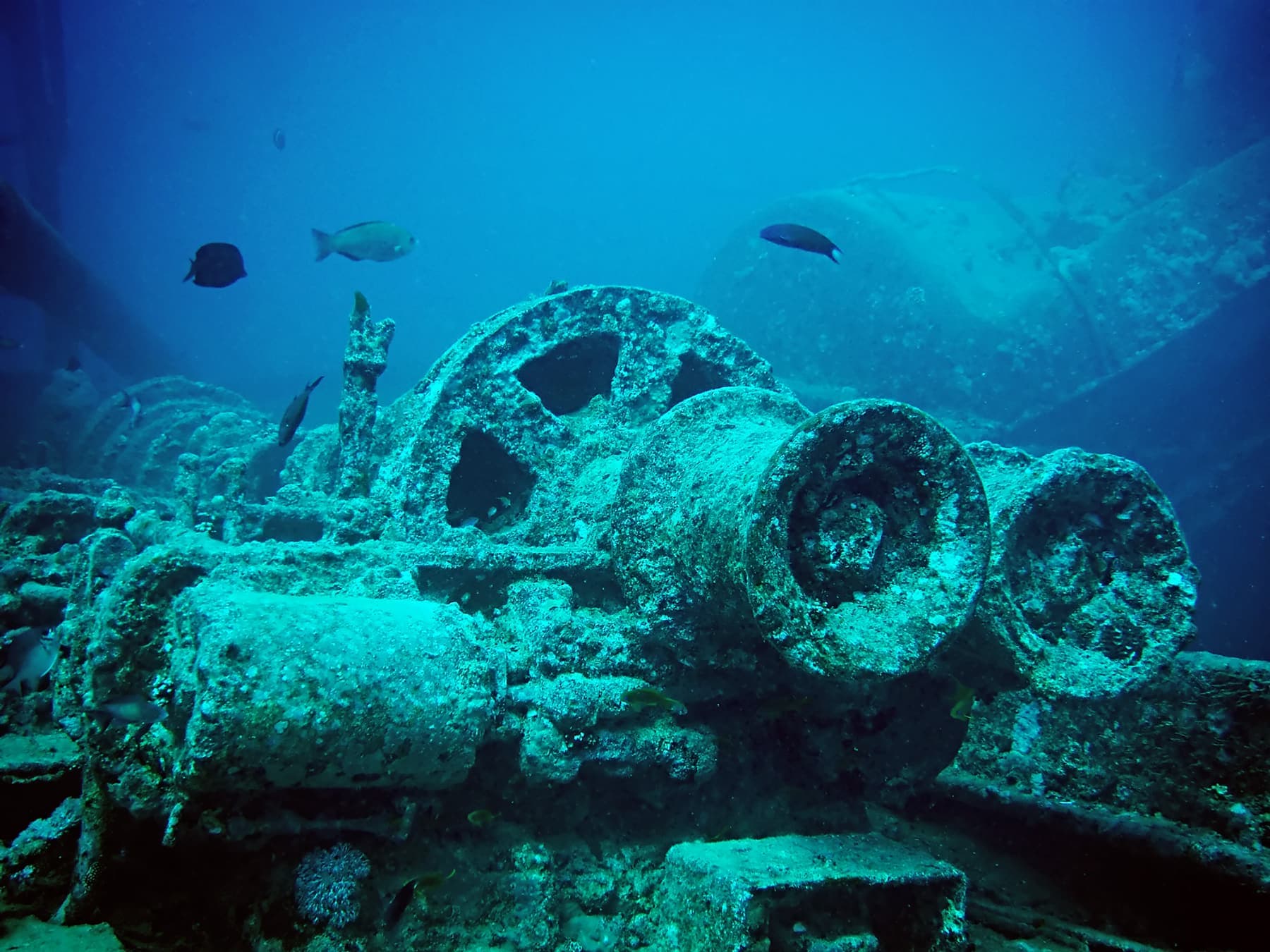
SS Thistlegorm
The most famous wreck dive in the world, and it earns every bit of the reputation.
Some dive sites are famous because the marketing is good. The SS Thistlegorm is famous because you drop down onto a 126-metre British merchant ship, sunk by German bombers in the war it was supplying, and find her holds still packed with Norton motorcycles, Bedford trucks and Lee-Enfield rifles exactly where they were stowed in 1941. Diving the Thistlegorm is part wreck dive, part underwater museum, part act of remembrance — and after decades in the water she remains one of the genuinely great dives on the planet. Here is what you actually get when you go, and how to dive her well.
Quick answer: SS Thistlegorm is a wreck (typically two dives — exterior/cargo and structure) in Red Sea. Best season: March-May and September-November; diveable most of the year. Level: Advanced — AOW plus current experience; Wreck Specialty for penetration. Depth: 16m (superstructure) to 32m (seabed and propeller); holds around 24-28m. Typical visibility: Typically 15-25m, occasionally more on a slack, clear day.
Facts verified September 2026
Why the Thistlegorm is the dive everyone talks about
The Thistlegorm was a British armed merchant ship built in Sunderland in 1940. On the night of 6 October 1941, anchored in the Strait of Gubal and waiting for a convoy passage to Suez, she was found by two German Heinkel He 111 bombers hunting a troop carrier. One bomb struck hold 4, packed with ammunition, and the explosion tore the ship apart and sent her to the bottom in minutes. Nine men died. She was carrying war materiel for the British Eighth Army in North Africa, and that cargo is precisely what makes the dive extraordinary.
Jacques Cousteau located and filmed her in the early 1950s, then she slipped back into obscurity until Sharm el-Sheikh's dive industry rediscovered her in the early 1990s. Today she sits largely upright on the sand, roughly 30 metres down, holds open to the light. Few wrecks anywhere combine this scale, this state of preservation, and this density of human history in water shallow enough for a recreational diver to reach.
What you'll see on the wreck
The Thistlegorm is really two dives in one. The cargo holds hold the story, and the exterior holds the drama. Penetration into holds 1 and 2 puts you face to face with rows of motorcycles and trucks stacked as cargo; the twisted stern, blown open by the blast, is a sobering piece of underwater sculpture. Around all of it, the wreck now works as a giant artificial reef.
Highlights you can reasonably expect:
- Norton 16H and BSA M20 motorcycles and Bedford trucks stowed in the forward holds
- Lee-Enfield rifles, ammunition, aircraft parts and Wellington boots deeper in the cargo
- The two Stanier 8F steam locomotives blown clear of the ship, resting on the sand either side
- Schooling batfish, barracuda, jacks and snapper hanging in the current around the structure
- Scorpionfish and crocodilefish tucked against the plating, plus the wreck's well-known resident turtle
Conditions and who the Thistlegorm dive is for
This is an honest one: the Thistlegorm is not a beginner's wreck. The depth is friendly, but the site sits in open water in the Strait of Gubal and the current has a mind of its own. It ranges from an easy drift to a genuine two-knot push, and it can run in different directions at different depths on the same dive. The standard entry is a negative descent straight down the shot line to the wreck, and if you dawdle on the surface the current will remind you why.
You want to be a comfortable Advanced Open Water diver with real experience managing current and buoyancy before you take this on. Good gas discipline matters, because it is easy to over-exert fighting the flow. Penetration into the holds is part of the appeal, but it is genuine overhead environment: do it with a guide who knows the layout, ideally with a Wreck Specialty and a light, and never push past your training. Treated with respect, she is one of the most rewarding dives you will ever do.
When to dive the Thistlegorm
The Red Sea is a year-round destination, and the Thistlegorm is diveable in every season, but spring and autumn are the sweet spots. March to May and September to November tend to bring the best mix of comfortable water, settled surface conditions and workable current.
Water sits around 22°C in winter and climbs to 28°C or so in late summer — a 5mm wetsuit is sensible for most of the year, and you will want the extra warmth on the deeper, longer second dive. Summer is hot topside and busy underwater; winter is quieter and can be a touch cooler and choppier on the crossing. Visibility usually runs 15 to 25 metres, opening up on a clear, slack day.
How you actually dive the Thistlegorm
There are two ways to reach her. Day boats run from Sharm el-Sheikh, but it is a long haul — a pre-dawn start, a three-hour crossing each way, and you arrive alongside a dozen other boats to dive a crowded wreck in the heat of the day. It works, but it is not how the Thistlegorm is meant to be experienced.
The liveaboard is the answer. Sleeping on a boat moored over or near the wreck means you dive her first thing, before the day-boat fleet arrives, with the holds to yourselves and the light coming down clean. Most northern Red Sea itineraries give you two or three dives on the Thistlegorm across a stay, so you can split the exterior and the cargo without rushing, and combine her with the region's other marquee sites. That flexibility — early starts, repeat dives, no crowds — is exactly what a wreck this good deserves.
Faneca dives the Thistlegorm aboard Blue Melody and Blue Horizon on our Northern Red Sea Wrecks & Reefs routes, timed so you're on the wreck early and often — which, on a site this busy, is the whole game, and the reason it's best experienced by liveaboard rather than a rushed day boat from Sharm.
SS Thistlegorm: common questions
What is the best season to dive SS Thistlegorm?
March-May and September-November; diveable most of the year
What experience level do I need for SS Thistlegorm?
Advanced — AOW plus current experience; Wreck Specialty for penetration
How deep is SS Thistlegorm?
16m (superstructure) to 32m (seabed and propeller); holds around 24-28m
What marine life will I see at SS Thistlegorm?
Batfish, barracuda, jacks, snapper, scorpionfish, crocodilefish, resident turtle, occasional trevally and tuna