Ras Mohammed National Park
The tip of the Sinai, where deep water meets the reef and summer brings the schools.
Ras Mohammed is where the Sinai Peninsula runs out of land and the Gulfs of Suez and Aqaba meet the open Red Sea. The result is a short stretch of coast with walls that fall into very deep water, currents that keep the coral fed, and a summer spectacle of schooling fish that most divers only half believe until they hang beside it. Protected since 1983 and Egypt's first national park, it is also the most dived corner of the northern Red Sea, so how and when you dive it matters as much as where. This is a practical guide to the park's best-known sites and how to get the most from them.
Quick answer: Ras Mohammed National Park is a wall and drift dives, reef plateaus, shallow coral gardens and the yolanda cargo field in Red Sea. Best season: Year-round; the big fish aggregations peak in summer, roughly June to August. Level: Open Water for the sheltered sites; Advanced with drift experience for Shark & Yolanda. Depth: Reef tops from 5 m; drift dives usually 10–30 m along walls that drop well past 100 m. Typical visibility: Typically 20–30 m, ranging from 10 m to 40 m.
Facts verified September 2026
Why Ras Mohammed matters
Geography does the work here. The peninsula ends in a headland surrounded by deep water on three sides, and the tidal exchange between the two gulfs and the main basin pushes nutrient-rich water along the walls. Coral grows thickly right to the drop-off, and the fish life is denser than almost anywhere else in the north. The park was declared a protected area in 1983 and has since grown to around 480 km² of land and sea, and the difference shows when you compare its reefs with the busier stretches of the Sharm coast.
The park holds more than a dozen recognised dive sites, from easy coral gardens to walls that suit only experienced divers. Most liveaboards and day boats focus on a handful: Shark and Yolanda Reef, Anemone City, Jackfish Alley and, conditions permitting, Shark Observatory and Ras Za'atar. Each has its own character, and a good guide will choose between them on the day according to the current.
Shark and Yolanda Reef
This is the dive the park is known for. Two coral pinnacles rise from deep water a short distance off the point, joined by a shallow sandy saddle. The usual plan is a drift that starts on the outer wall of Shark Reef, follows the current round to the saddle and finishes over Yolanda Reef. The wall itself drops into hundreds of metres of water, so the dive is about buoyancy and awareness rather than depth: most of it happens between 10 and 30 metres, with the blue on one side and the reef on the other.
Yolanda Reef takes its name from the Cypriot freighter Yolanda, which ran onto it on 1 April 1980. Her cargo of bathroom fittings and pipes spilled across the reef and is still there, toilets and bathtubs now overgrown with coral and used as shelter by fish. The ship itself stayed on the reef for several years before a storm in the mid-1980s pushed her off the edge. She was located again in 2005 at around 150 metres, far beyond recreational limits, so the cargo field is all you will see.
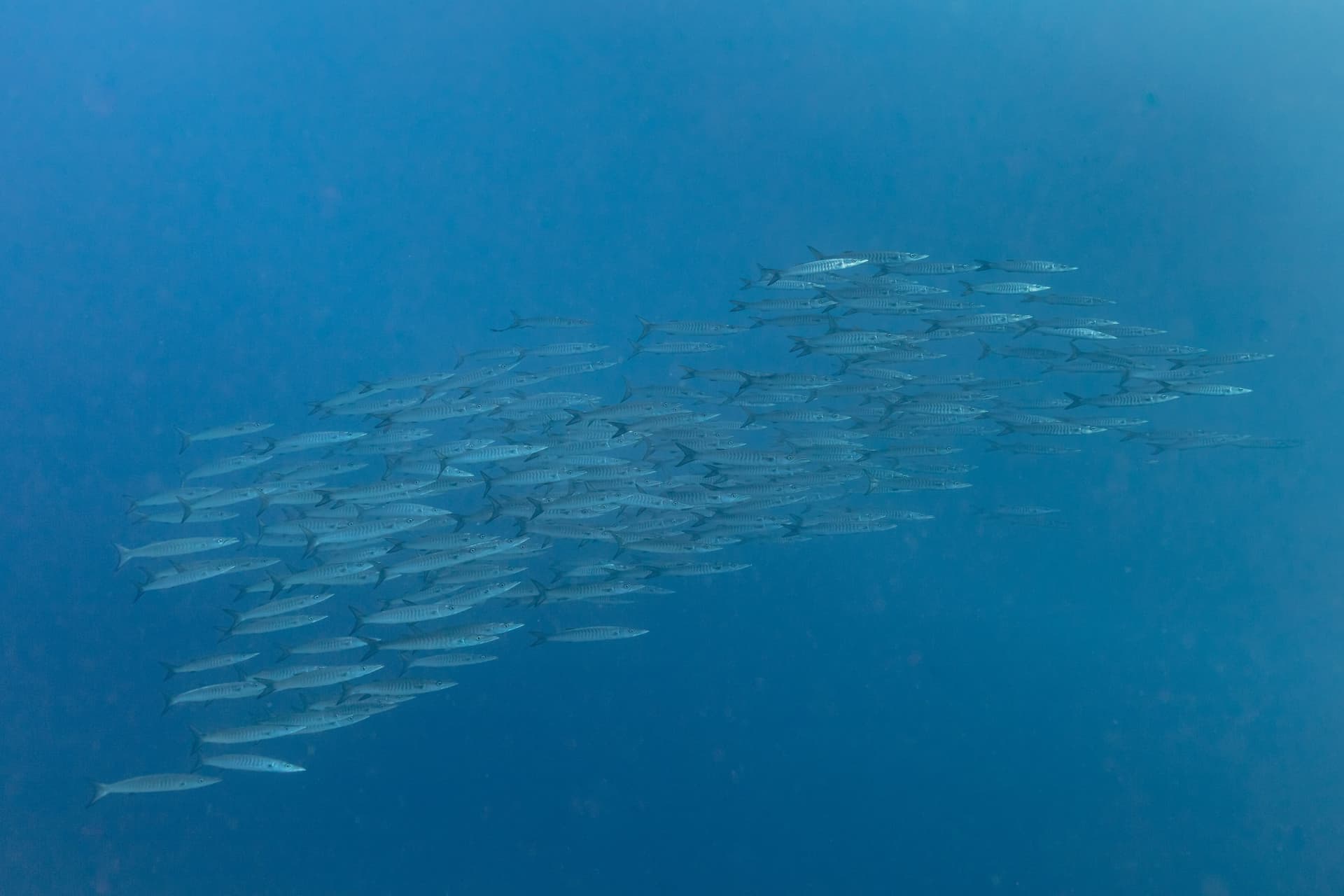
In summer, roughly June to August and often peaking around the full moon, the open water off Shark Reef fills with fish gathering to spawn. These are the sights that bring divers back:
- Large schools of barracuda hanging in the current off the wall
- Bohar snapper and bigeye trevally massed in their hundreds
- Circular batfish and unicornfish forming tight, shifting balls
- Grey reef and whitetip reef sharks patrolling the drop-off
- Napoleon wrasse, giant morays and turtles around the pinnacles and the cargo field
Anemone City, Jackfish Alley and the quieter sites
Anemone City lies just north of Shark Reef and is often the opening section of the same drift. It is a shallow slope carpeted with large anemones and their Red Sea anemonefish, and it is best in morning light. It makes a good second dive for photographers or for anyone who found the open-water section of Shark Reef a little lively.
Jackfish Alley is a gentler drift along a reef with a sandy channel and small caverns. The first cave sits at around 5 metres and is usually packed with glassfish, and whitetip reef sharks often rest on the sand further along. Shark Observatory, on the other hand, is a vertical wall with overhangs and large gorgonian fans, and it rewards divers who are comfortable hanging in the blue next to a sheer face.
Conditions and who it suits
Ras Mohammed covers a wide range. The sheltered sites are fine for newly qualified divers on a calm day, but Shark and Yolanda Reef deserves more respect. Current off the point is often moderate to strong and can change direction during a dive, and down-currents along the outer wall are not unknown. Advanced certification, real drift-diving experience and an SMB you can deploy without thinking are the sensible baseline.
Water ranges from the low 20s Celsius in winter to the high 20s in late summer, and a 5 mm suit is a reasonable choice for most of the year. Visibility is usually good, though summer plankton can soften it at exactly the time the fish schools are at their best. Snorkelling and diving inside the park are subject to the park's own rules and a daily park fee, which your crew arranges.
How you actually dive it
Day boats from Sharm el-Sheikh reach the park in about an hour, which makes Ras Mohammed busy by mid-morning. A liveaboard changes the timing: boats starting from Sharm or working south from the Strait of Gubal can put you on Shark and Yolanda early, before the day fleet arrives, and give you a second look if the first dive's current was against you.
The park sits naturally on northern Red Sea routes that also take in the Thistlegorm, Abu Nuhas and the Strait of Tiran, so it pairs well with a week of wrecks. If the summer aggregations are what you want, plan for June to August and accept that the reef will be busier and the water warmer.
Faneca dives Ras Mohammed on our Northern Red Sea Wrecks & Reefs and Red Sea Wrecks itineraries, timed where the schedule allows for an early drop on Shark and Yolanda Reef before the day boats arrive from Sharm.
Ras Mohammed National Park: common questions
What is the best season to dive Ras Mohammed National Park?
Year-round; the big fish aggregations peak in summer, roughly June to August
What experience level do I need for Ras Mohammed National Park?
Open Water for the sheltered sites; Advanced with drift experience for Shark & Yolanda
How deep is Ras Mohammed National Park?
Reef tops from 5 m; drift dives usually 10–30 m along walls that drop well past 100 m
What marine life will I see at Ras Mohammed National Park?
Summer schools of barracuda, bohar snapper, batfish and jacks; Napoleon wrasse, grey and whitetip reef sharks, turtles, giant morays, anemonefish
