Liveaboard Certification and Logged Dives Required, by Destination
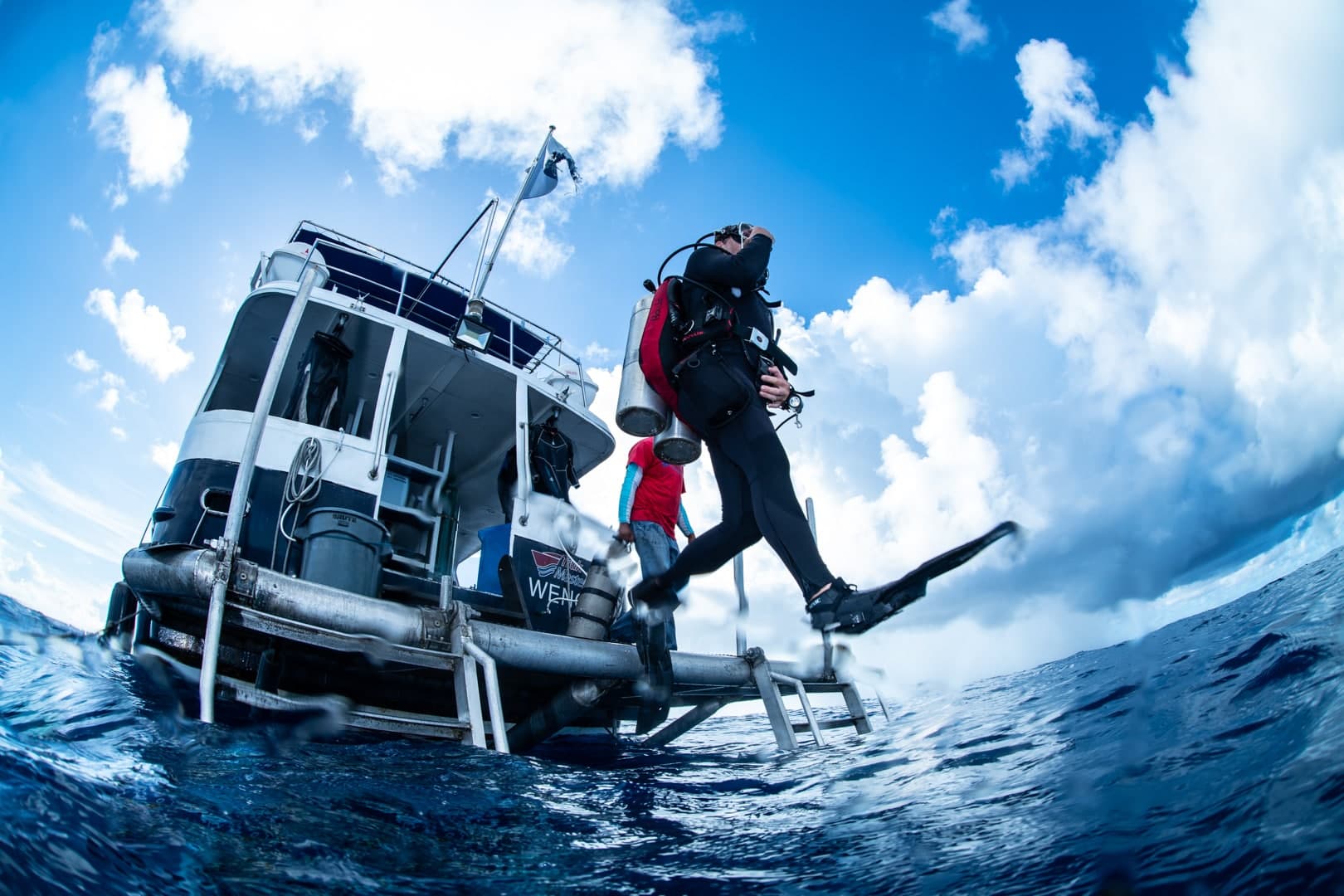
A common question before booking runs something like I have my Open Water and 22 dives, can I do the Galápagos? The honest answer depends on the route, the season and the boat, and it is rarely the answer people hope for. This guide sets out what operators typically ask for on each of the routes we book, why those rules exist, and how to close the gap if you are short.
One caveat runs through every line below. Requirements are set by each operator, sometimes by the itinerary, and they change. The figures here are typical ranges drawn from operator terms and published itineraries, not guarantees. Always confirm with the boat before you pay a deposit.
Why operators set minimums at all
A liveaboard is not a day boat with cabins. On the remote routes you are a day or more from the nearest recompression chamber, there is no shore team to send out, and the crew are running three or four dives a day for a whole group. A diver who struggles in current does not just have a bad dive; they pull a guide away from everyone else and, at worst, start an evacuation from a place where evacuations are slow.
The minimums track a handful of conditions:
- Current. Channel dives in the Maldives, Blue Corner in Palau and the Komodo straits can run hard, change direction and carry down-currents. You need to hold position, stay with the group and keep breathing slowly while it happens.
- Depth. Much of the action on offshore sites sits between 20 and 30 metres, beyond the Open Water training limit of 18 metres.
- Blue-water entries. At Darwin, Cocos, Roca Partida and the Brothers you often roll in with no reef beneath you and descend fast to get under the surface current. A negative entry is a skill, not a formality.
- Surface pick-ups. After a drift you surface away from the reef and wait for a tender. If you cannot deploy a delayed surface marker buoy mid-water, the crew cannot find you quickly in swell.
- Remoteness. The further from help, the less margin the operator will accept.
Most operators also write the same clause into their terms: guests who do not meet the minimums, or whom the crew judge to lack the experience for the conditions on the day, can be kept out of some or all dives. Take that clause at face value.
Certification, logged dives and recency are three different things
A certification card tells the crew what you were trained to do. Advanced Open Water (or your agency's equivalent) matters mainly because it qualifies you to 30 metres, and many routes plan dives to that depth.
Logged dives tell them how much you have practised. Fifty dives in moving water mean far more than fifty in a quarry, and a good cruise director reads the logbook, not just the total. Bring it, paper or app, and make sure the dives show depth, time and conditions.
Recency tells them whether the skills are still there. A common rule at dive centres is a refresher after twelve months out of the water, and at least one Galápagos operator asks for a dive within six months of departure. A diver with 200 dives and none in three years can be a bigger worry than a current diver with 60.
Typical requirements by destination
These are typical operator requirements as we found them in October 2026. Where we could not find a published figure we say so and give a conservative suggestion.
| Destination and route | Certification typically asked | Logged dives typically asked | Notes |
|---|---|---|---|
| Red Sea north (Thistlegorm, Abu Nuhas, Ras Mohammed) | Open Water | About 10–20 | One major operator asks for 20 to dive the Thistlegorm |
| Red Sea Brothers, Daedalus, Elphinstone | Advanced Open Water | 30–50, most often 50 | Many operators describe the 50-dive rule as a marine-park requirement |
| Maldives central atolls | Open Water to Advanced | About 30 | Advanced strongly recommended for channel dives |
| Maldives deep south | Advanced Open Water | 50–100 | Stronger current, deeper water |
| Raja Ampat | Advanced Open Water | About 50 (30 on some boats) | Operators cite Indonesian rules requiring a personal dive computer |
| Komodo | Advanced Open Water | 30–50 | Strong currents and down-currents; personal dive computer required |
| Thailand, Similans and Richelieu Rock | Open Water, certified to 30 m on some boats | 0–15 | One of the gentler liveaboard routes |
| Philippines, Visayas and Malapascua | Open Water | About 10–25 | Advanced can often be completed on board from Cebu |
| Philippines, Tubbataha | Advanced Open Water | 30–50 | One operator asks for logbook details ahead for park permits |
| Palau | Advanced Open Water | 30 minimum, about 50 for Blue Corner | Bring your own reef hook |
| Truk Lagoon (recreational) | Advanced Open Water, Deep preferred | About 50 | Wrecks from 18 to 40 m on recreational limits |
| Truk Lagoon (deep wrecks) | Technical decompression certification | Proof of experience at boarding | Wrecks below 40 m are for qualified technical divers |
| Bikini Atoll | Technical: decompression to 45 m minimum (Tec 45/Tec 50 or equivalent) | About 100, with wreck experience | No recreational diving on this route |
| Solomon Islands | Advanced Open Water | About 40; 75 on wreck-focused weeks | Figures from one operator's published terms |
| Galápagos, Darwin and Wolf | Advanced Open Water | 50–100 depending on boat | Some boats require a nitrox card |
| Cocos Island | Advanced Open Water | 30–50, most often 50 | Nitrox strongly recommended, mandatory on some boats |
| Socorro | Advanced Open Water | About 50 | Insurance, dive computer and SMB required on some boats |
| Sea of Cortez | Open Water | About 10 | Advanced and nitrox recommended |
| Seychelles | Open Water, with some sites restricted | No firm operator figure found; about 50 suggested | We would treat remote Aldabra trips as Advanced-level |
| Oman, Daymaniyat and Musandam | Open Water | No published liveaboard figure found | Musandam drifts suit Advanced divers |
| Saudi Arabia, northern reefs and Farasan Banks | Advanced Open Water | 50–100 | One Farasan Banks trip lists 100 dives |
A few of these deserve a closer look.
The Brothers. Several Egyptian operators state that the 50-dive minimum on the Brothers, Daedalus and Elphinstone routes is a marine-park rule. We could not find the regulation itself, and at least one large operator lists Open Water with 30 dives for the same itinerary, so treat 50 as the safe planning number rather than settled law. What is written down is Egypt's depth policy: the Chamber of Diving and Watersports caps recreational air and nitrox dives at 40 metres. Our Red Sea page sets out which routes suit which experience level.
Darwin and Wolf. This is where the range is widest, from 50 logged dives on some boats to 100 on others. Conditions at Darwin and Wolf are cold, surgy and current-swept, and the season matters: for the cool season, roughly June to November, some guides suggest 100 dives rather than 50. See our Galápagos destination page for timing.
Cocos and Socorro. Both are long open-ocean crossings with no chance to turn back for a missing skill. Advanced plus around 50 dives is the norm at Cocos and Socorro, and the dive guide has the final say on any given site.
Nitrox: why it keeps appearing
Nitrox does not let you go deeper. It lets you stay longer at 18 to 30 metres and finish a four-dive day with less nitrogen loading than air would give you. On routes where every dive sits in that band, operators either recommend it strongly or, as at least one Galápagos operator does for Darwin and Wolf, require the card. Some boats cannot teach the course on board, so do it before you fly; the theory is mostly online and the practical element is short. Our guide to whether nitrox is worth it covers the course and cost in more detail.
Deep training for Truk and Bikini
Truk Lagoon is the clearest case for a Deep speciality. Most of the famous wrecks sit within recreational no-decompression limits at 18 to 40 metres, and operators prefer divers trained to 40 metres. The deeper hulls and serious penetration are a technical-diving matter, with proof of qualification checked at boarding and an extra waiver to sign.
Bikini Atoll is technical diving from start to finish. Expect to show decompression certification to at least 45 metres, around 100 logged dives with real wreck experience, and overhead-environment training before you go inside anything. Our Bikini technical requirements guide sets out the pathway.
Insurance and the medical form
Many operators now make dive-specific insurance a condition of boarding, and the wording is specific: cover for scuba diving, emergency evacuation and recompression chamber treatment, to the depths you plan to dive. Technical routes require cover for technical diving. Standard travel insurance often excludes some or all of this, so read the policy. Our guide to dive insurance for liveaboards explains what to look for.
You will also complete a medical questionnaire. The current standard is the Diver Medical Participant Questionnaire, released in 2020 by the Diver Medical Screen Committee with input from the UHMS and DAN, and endorsed by the WRSTC. It replaced the older RSTC Medical Statement, which some agencies still accept. If you answer yes to any question you need a doctor's signature on the accompanying physician's evaluation form before you dive. Get that signature at home, weeks ahead. Nobody can sign it at sea.
Closing the gap
If you are short of a route's minimum, there are good ways to close it.
- Do a refresher if you have been out of the water. A pool session and an open-water dive before the trip costs a day and saves you being the diver the crew watches most closely.
- Take Advanced Open Water before you travel. Some boats can run it on board, but not all. One operator cannot teach it on Tubbataha departures from Puerto Princesa, and the Advanced dives use time you would rather spend on the itinerary.
- Log dives at a resort first. Thirty dives is about eight to ten days at three or four dives a day. A week of day-boat diving in the Red Sea or Komodo before a liveaboard builds the current experience that counts most.
- Do a gentler liveaboard first. The northern Red Sea, the Similans, the Visayas and the Sea of Cortez accept newer divers and teach the liveaboard rhythm of early starts, tender pick-ups and repeat dives. Our beginner liveaboard guide lists the best options.
- Practise the specific skills. Deploying a delayed SMB from mid-water, negative entries and holding position with a reef hook can all be practised with an instructor at home.
Some operators will take a diver who is slightly short with a private guide at extra cost. That is a workable fix for a borderline logbook, not a substitute for current experience.
If you are unsure where you stand for a particular trip, send us your certification level and dive count through the concierge and we will tell you straight which routes fit now and which to keep for later.
Related Guides
- Best Liveaboard Trips for Beginners: 5 Destinations Where You'll Thrive — Routes that suit a new certification
- How to Get Your Dive Certification Fast Before a Liveaboard Trip — Fitting training in before departure
- Rescue Diver or Advanced Nitrox First? A Liveaboard-Readiness Guide — Choosing your next course
- Deep Diving Considerations for Liveaboard Destinations — Planning repeat dives at depth
Related Articles
When to Dive the Red Sea: Month-by-Month Guide
The Red Sea dives well every month of the year, but what you see and how much you pay changes dramatically. Here is the honest month-by-month breakdown — water temperatures, species windows, operator availability, and the two weeks most serious divers target.
How Much Is a Red Sea Liveaboard? Real Prices by Route
Real Egyptian Red Sea liveaboard fares from our own departures, route by route, with per-night maths and every extra you pay on top: park fees, visa, nitrox, tips, flights.
