What It Takes to Dive Bikini Atoll: Certifications, Experience and Honest Prerequisites
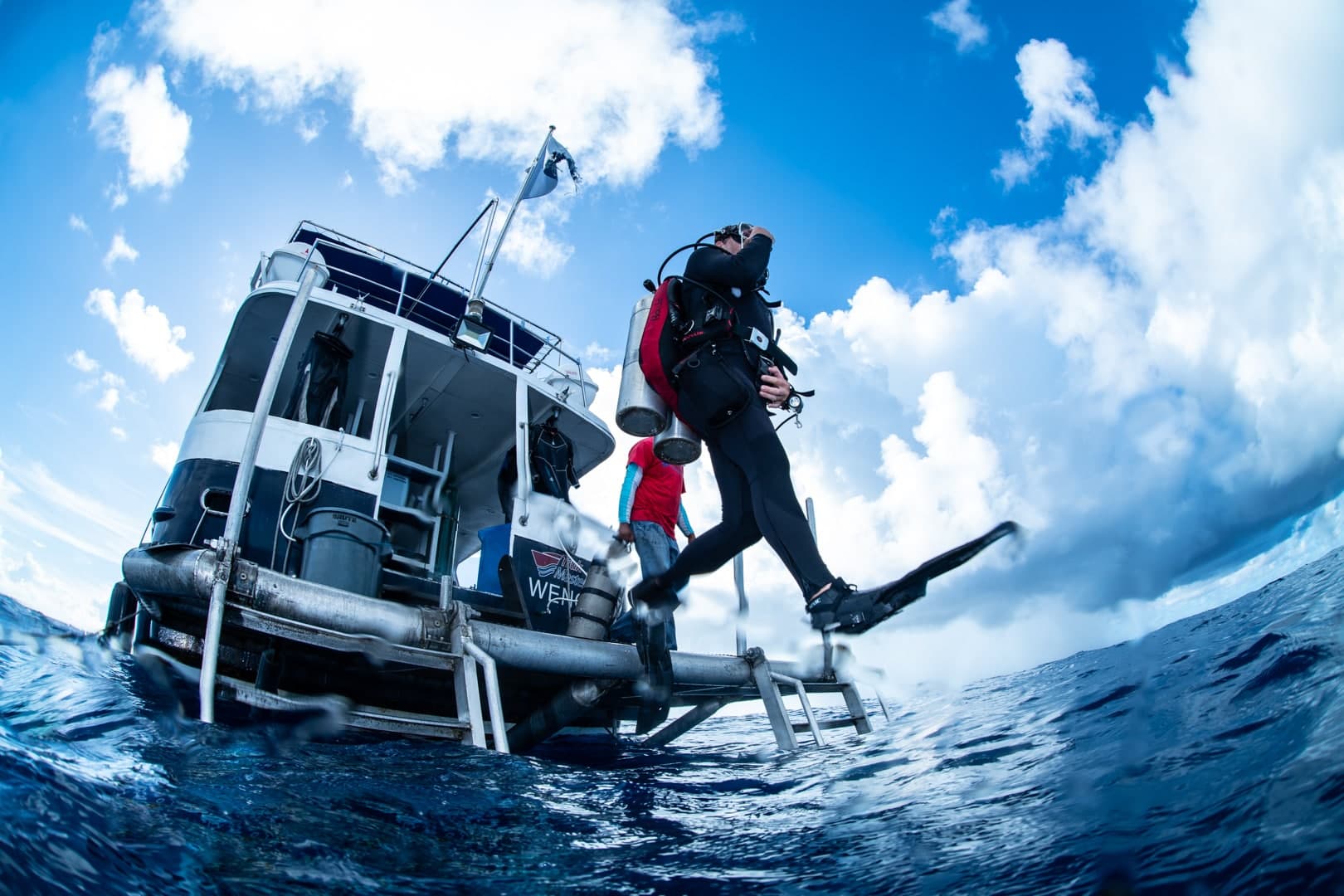
Let's start with the sentence that saves everyone time: Bikini Atoll is not a recreational dive destination, and no amount of enthusiasm changes that. The nuclear ghost fleet — the carrier USS Saratoga, the battleship Nagato from which Yamamoto ordered the Pearl Harbor attack, the USS Arkansas, the submarine Apogon — sits on a lagoon floor at 45 to 55 metres. Not "you can peek at it from 30 metres" deep. The wrecks themselves start around the 50-metre mark, average dive depths run close to 50 metres, and meaningful bottom time at that depth means mandatory decompression stops on every single dive.
If you're an Advanced Open Water diver dreaming about Bikini, this guide is for you — not to gatekeep, but to lay out exactly what stands between you and the Saratoga's flight deck, in certifications, logged dives, equipment, money and years. Some of you will read this and start planning. Some of you will read this and book Truk Lagoon instead, where world-class WWII wrecks sit at recreational depths. Both are correct outcomes.
The Certification Floor: What Operators Actually Require
There is effectively one operator running Bikini Atoll liveaboard trips, and their requirements are non-negotiable because the diving gives them no room to be flexible. Here is the real checklist, verified against current operator policy:
- Open-circuit divers: TDI Advanced Nitrox and Decompression Procedures, PADI Tec 45, or an equivalent certification from another technical agency. This is a full decompression-diving qualification rated to 45 metres — not a deep specialty, not "Tec 40".
- Rebreather divers: TDI Air Diluent Decompression Diver (45m) / Helitrox equivalent as a minimum, with your unit-specific certification. Trimix on board is only available for CCR divers — helium supply logistics mean open-circuit divers dive air or nitrox-based deco schedules.
- Logged dives: a minimum of 100 logged dives, and the operator checks. You'll present certification cards and your logbook at check-in. Divers who can't document their experience have been turned away at the boat.
- Deep wreck experience: demonstrable prior dives on deep wrecks, not just deep water. A 45-metre dive on a wall is not the same as a 45-metre dive alongside 270 metres of collapsing aircraft carrier.
- Penetration diving: entering the wrecks — the Saratoga's sick bay, the Nagato's engine spaces — requires technical overhead-environment training on top of everything above. No overhead cert, no penetration. You can still have an extraordinary trip diving the exteriors.
Notice what's missing: there's no "trust me, I'm experienced" clause. A 40-metre recreational deep certification does not qualify you. Two thousand recreational dives do not qualify you. The line is decompression training, and it's drawn exactly where it should be.
Why the Requirements Are What They Are
This isn't bureaucracy. Bikini sits in the middle of the Pacific, roughly 850 kilometres from the nearest thing resembling infrastructure. There is no civilian recompression chamber within useful range — a serious decompression incident means an emergency air evacuation across the Pacific. The operator limits diving to two dives per day with a mandatory four-hour surface interval, which is conservative by design: at these depths with these run times, your daily decompression obligation is substantial, and the margin for stacking mistakes is thin.
A typical Bikini dive profile looks like this: descend to 45-52 metres, spend 25-45 minutes on the wreck, then spend as long or longer again ascending through staged decompression stops on rich nitrox or pure oxygen. Total run times of 90-120 minutes are normal. That is a fundamentally different activity from recreational diving — you cannot go directly to the surface at any point in the working phase of the dive. If your regulator fails, if you're narced, if you're lost inside a hull, the surface is not an option. Your training and your redundant equipment are the plan. There is no plan B.
This is also why we'd gently push back on divers who technically hold the cards but earned them years ago and haven't done a deco dive since. The operator may let you board. The Saratoga doesn't care what's printed on your certification. If your skills are stale, do a refresher and a few build-up decompression dives at home before you fly.
The Radiation Question, Answered Honestly
Everyone asks, so let's deal with it properly. Bikini was ground zero for 23 nuclear tests between 1946 and 1958, including Castle Bravo, the largest device the United States ever detonated. The honest, current-science answer:
- Diving the wrecks is considered safe. The residual radiation dose divers receive on the wrecks is negligible — water is an excellent radiation shield, and decades of ocean circulation have dispersed contamination from the lagoon itself. The one firm rule: take nothing. Artefacts and marine growth on the wrecks can concentrate radionuclides, and souvenir-taking is both illegal and the only realistic way a diver ends up with a meaningful dose.
- The islands are a different story. Background radiation on Bikini Island itself remains above the threshold agreed for permanent resettlement — the contamination lives in the soil and, critically, in locally grown food like coconuts, where caesium-137 concentrates. Nobody lives there. Brief shore visits are fine provided you bring your own food and water; it's the long-term ingestion pathway that's dangerous, not an afternoon on the beach.
So: dive freely, touch nothing, pocket nothing, and don't eat the coconuts. The radiation is the least dangerous thing about diving Bikini. The 50 metres of seawater above your head deserve far more respect.
The Realistic Pathway from AOW to Bikini
Here's the part most articles skip: the actual road, with numbers. Assume you're an Advanced Open Water diver with 30-40 dives. A realistic pathway looks like this.
Stage 1 — Foundations (3-6 months, roughly €400-700)
Get your Enriched Air Nitrox certification if you don't have it (you'll breathe nitrox constantly in tec training — our guide on whether nitrox certification is worth it covers the recreational case too). Then fix your platform: buoyancy, trim, finning technique. An Intro to Tec programme or a fundamentals-style course is money well spent here, because technical instructors will hold you to a standard most recreational divers have never been asked to meet. Many candidates fail tec courses on buoyancy, not theory.
Stage 2 — Decompression Training (6-12 months, roughly €1,500-2,500)
The core qualification. Two common routes to the same destination:
- TDI Advanced Nitrox + Decompression Procedures, usually taught as a combined course: a minimum of 7 dives over 4-7 days, covering staged decompression to 45 metres with accelerated deco on up to 100% oxygen. Typical combined pricing runs €1,200-1,800 depending on region, plus gases and materials.
- PADI Tec 40 → Tec 45, the stepwise route. Tec 40 introduces limited decompression; Tec 45 (typically €800-1,000 per course) takes you to full staged deco at 45 metres. Slightly more expensive overall, but the gentler gradient suits some divers.
Either endpoint satisfies Bikini's requirement. What matters more than the agency is the instructor — train with someone who does real technical diving, not someone ticking a box.
Stage 3 — Wreck and Overhead Training (optional but strongly recommended, €800-1,200)
If you want to go inside the wrecks — and the interiors are where Bikini becomes transcendent — you need a technical wreck/overhead qualification (TDI Advanced Wreck or equivalent): line laying, lost-line drills, zero-visibility protocols, restriction management. If you're content with exteriors, you can skip this, and honestly, plenty of Bikini veterans never penetrate anything and don't feel shortchanged.
Stage 4 — Experience Building (12-24 months, budget varies)
This is the stage nobody can shortcut. You need to reach 100+ logged dives with a solid block of genuine decompression dives on deep wrecks — the kind of profile Bikini serves daily. Malta, the Red Sea's deeper wrecks, Scapa Flow, the South China Sea tec scene: all excellent build-up venues. Aim for 15-25 post-certification deco dives before Bikini, several in the 45-50 metre range. Our piece on what deep diving actually demands of liveaboard divers is worth reading alongside this.
The Equipment Bill
Bikini is a twinset-or-rebreather trip. Expect to own or commit to: doubles or sidemount cylinders with a manifold, a technical wing and harness, two independent regulator sets, a deco regulator, a technical dive computer (ideally two), reels, DSMBs, and redundant lighting for penetration. Buying new: €3,000-5,000. Buying used and sensible: roughly half that. Rental for training is normal; by the time you're boarding a flight to Kwajalein, most of this should be gear you know intimately.
Total realistic timeline from AOW: 2-3 years. Total training-and-gear investment: €6,000-9,000, before the trip itself — which runs five figures once flights via Honolulu and the United Island Hopper to Kwajalein are included. Bikini trips run roughly May through October and sell out well over a year out, so the training timeline and the booking timeline actually align rather neatly: book the boat, then train toward the date.
Who Should Not Book This Trip
We'd rather lose a commission than send the wrong diver to the middle of the Pacific. Do not book Bikini if:
- You hold the certifications but haven't done a decompression dive in the past year or two. Currency matters more than cards here.
- You're planning to rush the pathway — compressing three courses into a single month to make a departure date. Skills need soak time.
- You're uncomfortable with real remoteness: no chamber, no hospital, evacuation measured in many hours. If that risk profile doesn't sit well with you, that's self-awareness, not weakness.
- You mainly want big WWII wrecks and history. Truk Lagoon delivers exactly that at largely recreational depths — more wrecks, more artefacts, more penetration options for recreational-plus divers, at roughly half the cost.
- Your budget is under five figures all-in. Bikini punishes corner-cutting, and the corners people cut first — training quality, build-up dives, equipment redundancy — are precisely the ones that matter.
Is It Worth the Three-Year Road?
Ask anyone who has hung on the deco line above the Saratoga. There are perhaps a few hundred divers a year, worldwide, who see these wrecks. The Nagato is arguably the most historically consequential shipwreck a civilian can dive. And unlike almost every other bucket-list destination, Bikini can't be diluted — the depth is the velvet rope, and it isn't going anywhere.
If you're serious, the sequencing matters: confirm a departure window first, then build the training plan backwards from it. That's precisely the kind of puzzle our concierge exists for — we'll tell you honestly whether your logbook is Bikini-ready, and if it isn't yet, we'll tell you what to do about it and where to dive in the meantime. Start with the Bikini Atoll destination page, and give yourself the runway. The fleet has waited eighty years. It will wait until you're ready — and you should not arrive a single dive before you are.
Related Guides
Related Articles
%20-%20Large.jpg&w=828&q=75)
Best Time to Dive: A Season-by-Season Guide
When to visit the world's top liveaboard destinations for the best conditions and marine life encounters.
Galápagos Diving: What to Expect on Your First Trip
Hammerhead highways, curious sea lions, and currents that demand respect — here's what awaits in the enchanted islands.