Bikini Atoll Diving: The Full Cost of the World's Most Exclusive Wreck Trip
You can dive Sipadan for the cost of a decent laptop. Bikini Atoll is a different order of magnitude. A realistic all-in budget for one diver, from a European or North American doorstep back home again, runs $13,000 to $20,000. That is not a padded number, and it is not the operator gouging you. It is what happens when the world's best wreck diving sits inside a US Army missile range's neighbourhood, 24 hours by boat from the nearest airstrip, in a country most airlines do not serve.
This guide breaks the whole figure down line by line, explains why the trip costs what it costs, and tells you honestly whether you should be spending this money at all. If you want the background on what actually sits on the bottom of the lagoon — Saratoga, Nagato, and the rest of Operation Crossroads' ghost fleet — start with our full guide to diving Bikini's nuclear wrecks and come back.
The liveaboard fare: $7,700 to $9,000 before extras
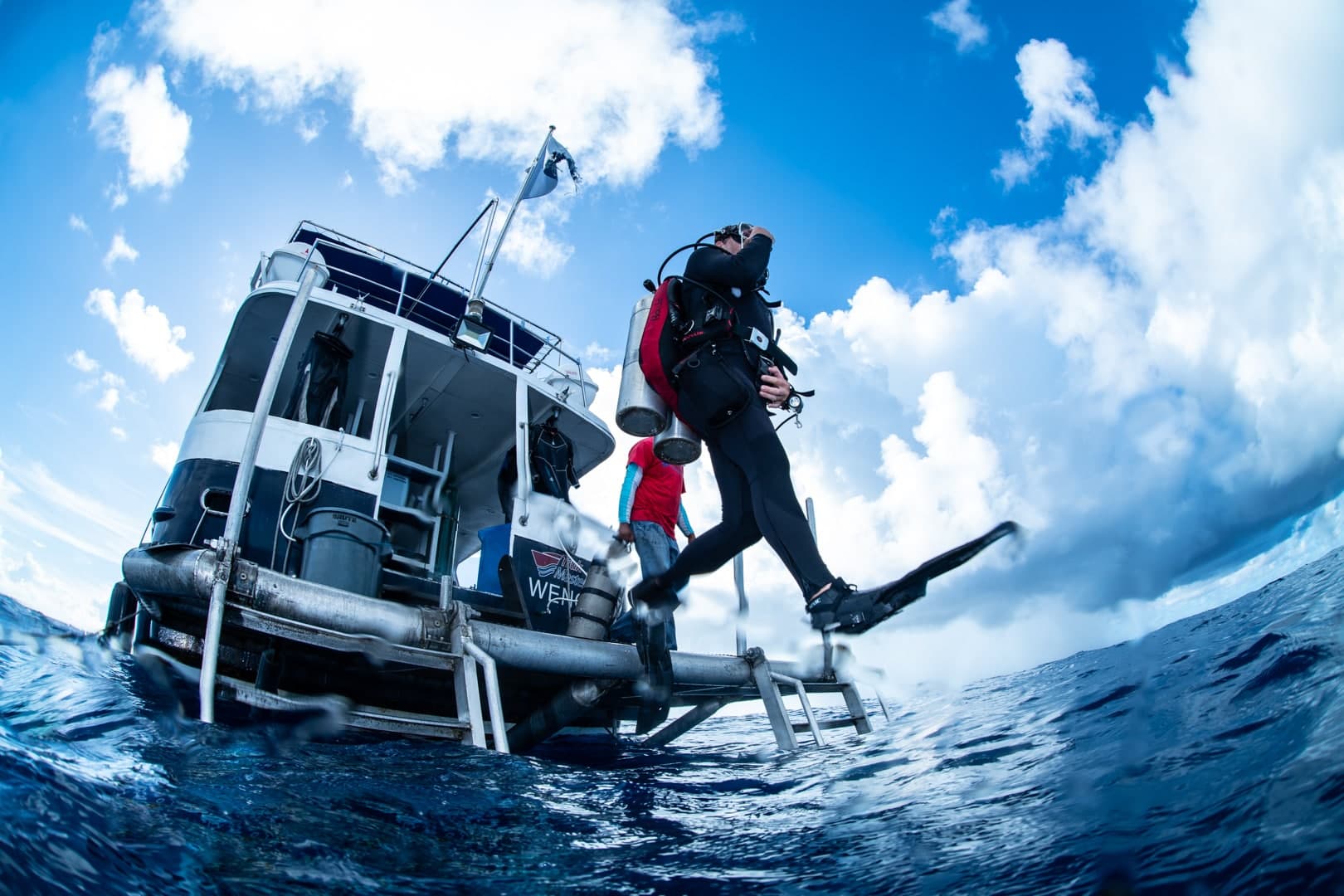
There is effectively one boat. Master Liveaboards' Pacific Master runs the Bikini season, and specialist outfits like The Dirty Dozen Expeditions charter that same vessel for their own dates. That is the entire market. No day boats, no land-based operation, no budget alternative.
- Standard 10-night itinerary, booked direct: around $7,700 per person in a standard cabin
- Chartered expedition departures (with a named tech instructor or training agency attached): from roughly $8,850 per person
- Marine park and port fees: about $500–650 per trip, mandatory, paid separately
- Fuel surcharge: around $38 per night on current-season departures, so figure another $400+
So the boat alone, before you have bought a single flight or breathed a single litre of gas, is $8,600 to $10,000. Cabin upgrades push higher.
Why so expensive per night? The boat carries a maximum of 18 divers across 12 cabins, staffs a full technical dive team, and operates a season-long supply chain that starts in Truk Lagoon or the Solomons. Every tank of oxygen, every tub of sofnolime, every spare part is loaded before the season begins, because there is no dive shop within a thousand kilometres of the lagoon. Small boat, short season, enormous overheads — the price is the price.
Getting there: the Island Hopper problem
Bikini's gateway is Kwajalein Atoll (KWA) in the Marshall Islands, and there is exactly one way in for a civilian diver: United's Island Hopper, flight UA154, which leaves Honolulu three mornings a week (currently Monday, Wednesday, Friday) and works its way west via Majuro — about seven hours from Honolulu to Kwajalein including the stop.
Budget the journey in three chunks:
- Home to Honolulu. From Europe, expect $900–1,800 return in economy; from the US mainland, $400–900. Lisbon to Honolulu is comfortably 24+ hours of travel on its own.
- Honolulu to Kwajalein return on the Island Hopper: realistically $1,500–1,800 in economy. This short list of weekly frequencies means fares rarely go on sale, and the flight fills with military contractors and returning islanders.
- Two mandatory Honolulu nights. The Hopper departs early morning, so you overnight in Honolulu on the way out — and smart divers add a buffer night on the return too, because if you misconnect there is no flight tomorrow. Waikiki hotel rooms are not cheap: budget $400–700 for the pair.
Total transport line: $2,800 to $4,300 in economy. Fly business on the long-haul legs and you can add $3,000–5,000 more.
One quirk worth knowing: Kwajalein is a restricted US Army Garrison. You need a confirmation letter from the liveaboard to be allowed off the plane, after which Army transport shuttles you to a ferry for the 20-minute crossing to Ebeye Island, where the boat picks you up. The Army transfers are free — possibly the only free thing on this entire trip. From Ebeye, the Pacific Master steams 24 to 30 hours to Bikini. That crossing is built into the itinerary, but it is why a "10-night trip" yields about seven days of diving.
Gas, gear, and the technical-diving surcharge
Bikini's wrecks average around 50 metres. This is decompression diving on every single dive, and the consumables bill reflects it. What our tec divers actually pay on board:
- Nitrox package: about $210 per trip at recreational level; the technical package (deco gases, larger volumes) runs meaningfully higher — budget $400–700
- CCR cylinder set rental: about $135 per trip, plus your sofnolime, which comes in 20 kg tubs, pre-ordered only — figure $200–400 depending on how much you scrub
- Twinset/stage rentals if you are not flying with your own: $200–500
Here is the detail that catches people out: there is no open-circuit trimix at Bikini. Helium supply to the middle of the Pacific is so constrained that the operator reserves it for rebreather divers only, and even CCR divers must order their helium and consumables at least six months in advance. If your plan was to dive the Nagato on OC trimix, that plan does not exist. You dive it on air-range OC with serious deco, or you bring a rebreather. Our Bikini technical requirements guide covers exactly which certifications the boat will accept.
Add excess baggage for a full tech setup — two airlines, four to six flights, 30–50 kg of gear — and the gas-and-gear line lands between $800 and $2,000.
The full budget, honestly totalled
For one diver, standard cabin, economy flights, own gear, OC with deco gases:
- Liveaboard fare: $7,700–8,850
- Park/port fees + fuel surcharge: $900–1,100
- Flights + Honolulu hotels: $2,800–4,300
- Gas, rentals, consumables, excess baggage: $800–2,000
- Dive and travel insurance with proper depth cover and evacuation: $300–500
- Crew gratuities (10% is customary on expedition boats): $770–900
- Visas, transfers, meals in transit, contingency: $300–500
Realistic total: $13,500–18,000. A CCR diver in an upgraded cabin with business-class long-haul is over $20,000 without trying. Anyone quoting you a "Bikini trip from $7,700" is quoting the boat, not the trip.
Why you must book 18 to 30 months out
The arithmetic is brutal: one vessel, roughly a May-to-October season (the lagoon is too exposed the rest of the year), 18 spaces per departure, perhaps 10–12 departures a season. That is fewer than 250 divers a year, worldwide, for a bucket-list destination every serious wreck diver wants. Named expedition charters for 2026 sold out more than a year in advance, and prime 2027 dates are already thinning.
Booking far ahead is not just about securing a bunk. Your helium, sofnolime, and cylinder configuration all have to be on the supply manifest before the boat leaves Truk for the season. Book late and even if a cabin opens up, your gas may simply not be aboard. Deposits are typically 20–25%, with balance due 90–120 days out — check our departure calendar for what is currently holding space.
Who should not book this trip
We would rather lose a booking than send the wrong diver to Kwajalein. Do not book Bikini if:
- You are not yet a comfortable decompression diver. "Advanced nitrox and deco procedures with real post-course experience" is the floor, not the target. Bikini is a terrible place to log your first serious deco dives — there is no chamber nearby and evacuation is measured in days, not hours.
- Your wreck experience is shallow-water only. These are penetration-capable wrecks at 45–55 metres with genuine overhead ambitions. If Truk's 30–40 metre fleet would still stretch you, do Truk first — our Truk versus Bikini comparison makes the case that Truk is not the consolation prize; for most divers it is the better trip, at roughly half the cost.
- You cannot absorb a delay. Three flights a week and a 24-hour crossing mean a single mechanical or weather event can cost you days. If your schedule or temperament cannot tolerate that, this destination will punish you.
- The budget requires stretching. If $15,000 means cutting the insurance, skipping the buffer night, or renting unfamiliar kit to save baggage fees, the trip is telling you to wait a year. Bikini rewards divers who arrive unhurried and over-prepared.
None of this is gatekeeping for its own sake. The wrecks have waited eighty years; they will wait until you are ready.
Making the money work
A few genuine savings, and one non-saving:
- Book direct-season rather than named charters if you do not need an instructor-led expedition — that is $1,000+ back
- Position through the US West Coast if fares align; HNL is dramatically cheaper to reach from LAX or SFO than from Europe
- Share the Island Hopper booking with your group — the operator can sometimes coordinate group fares and shared excess-baggage allowances
- Do not economise on insurance. Depth-rated cover with evacuation from the Marshall Islands is the one line where the cheap option is worthless
If you want the honest version of this arithmetic applied to your own certification level, dates, and departure city — including whether this is genuinely your year for Bikini or whether Truk serves you better first — talk to our concierge team. We plan a handful of Bikini seasons ahead at any given time, we know which departures still hold space and what the gas-order deadlines are, and we will tell you plainly if we think you should not go yet. The commission on a trip this size is real; so is our preference for sending you when you are ready.
Related Guides
Related Articles
%20-%20Large.jpg&w=828&q=75)
Best Time to Dive: A Season-by-Season Guide
When to visit the world's top liveaboard destinations for the best conditions and marine life encounters.
Galápagos Diving: What to Expect on Your First Trip
Hammerhead highways, curious sea lions, and currents that demand respect — here's what awaits in the enchanted islands.