Bikini Atoll: Diving the Nuclear Ghost Fleet
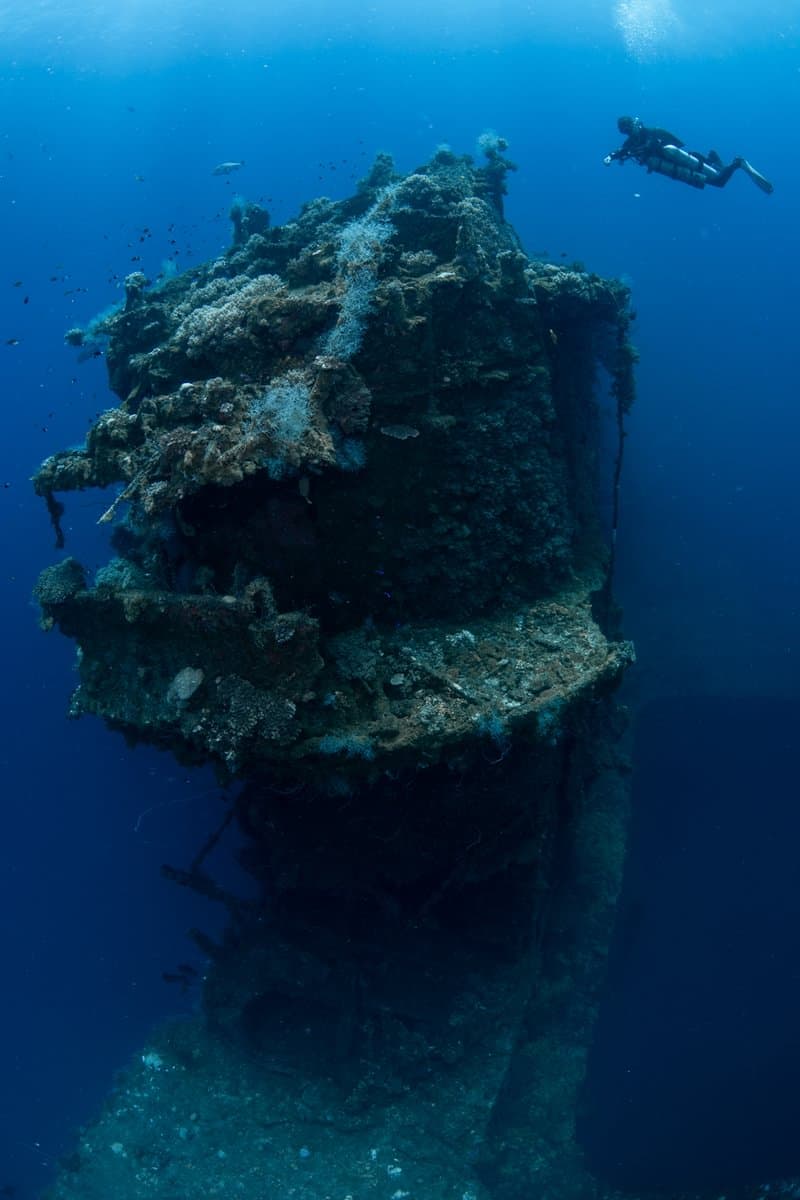
Some dive destinations sell themselves with tropical fish and turquoise water. Bikini Atoll sells itself with nuclear history, a fleet of ghost ships resting on the lagoon floor, and the unsettling knowledge that this beautiful place was once ground zero for the most destructive weapons ever created.
It's haunting. It's humbling. And it's some of the most extraordinary wreck diving you'll ever do.
A Very Brief History
Between 1946 and 1958, the United States conducted 23 nuclear weapons tests at Bikini Atoll in the Marshall Islands. For two of the most significant tests — Operation Crossroads in 1946 — the US assembled a target fleet of nearly 100 ships, including aircraft carriers, battleships, submarines, and transport vessels.
They parked them in the lagoon. And then they dropped nuclear bombs on them.
Some ships sank immediately. Others survived the first test only to be destroyed in the second. The ones that went down now rest on the lagoon floor at depths of 30 to 55+ metres, forming one of the most surreal underwater landscapes on Earth.
The Bikinian people were relocated before the tests and have never been able to permanently return home. Their lagoon, however, has healed in ways that nobody predicted — the reefs have recovered, marine life has returned, and the wrecks are now draped in 80 years of coral growth.
The Wrecks: What You'll Actually Dive
USS Saratoga (CV-3)
The crown jewel. The Saratoga is one of the largest diveable wrecks in the world — a 270-metre aircraft carrier resting upright on the lagoon floor at around 55 metres. She survived the first nuclear test (Able, an airburst) but sank after the second (Baker, an underwater detonation).
What makes her incredible:
- Sheer scale: At 270 metres long, you cannot see this ship in a single dive. You can't see it in five dives. She's enormous.
- Intact features: The flight deck, bridge, anti-aircraft guns, and even aircraft still sitting on deck
- Marine life: After 80 years underwater, the Saratoga is draped in coral, sponges, and schooling fish. Nature has reclaimed the warship.
- Depth: The flight deck sits at around 27 metres; the main deck at 40+. Bottom time is limited, and decompression is virtually guaranteed.
This is a technical dive, make no mistake. But for qualified divers, it's a once-in-a-lifetime experience.
USS Arkansas (BB-33)
A New York-class battleship lying upside down at about 55 metres. She capsized during the Baker test and now rests with her hull exposed, creating caves and overhangs that harbour marine life. The massive guns protrude from beneath the inverted hull, creating one of the most dramatic wreck images in diving.
HIJMS Nagato
The Japanese battleship Nagato — flagship of Admiral Yamamoto and the ship from which the order to attack Pearl Harbor was transmitted. She was captured after the war and used as a target ship at Bikini. Finding the Nagato upside down on the lagoon floor, her pagoda mast visible in the sand, is a moment that transcends diving. It's history you can touch.
Other Notable Wrecks
- USS Pilotfish (SS-386): A submarine at around 52 metres, remarkably intact
- USS Anderson (DD-411): A destroyer sitting upright at 55 metres
- USS Carlisle (APA-69): A transport ship in shallower water, good for longer bottom times
- USS Lamson (DD-367): Another destroyer, well-preserved
Is It Safe? (The Radiation Question)
Let's address the elephant in the lagoon: yes, there is residual radiation at Bikini Atoll. But here's the nuanced answer.
The external radiation levels at Bikini — both above and below water — have been extensively studied. Diving the wrecks exposes you to radiation levels that are well within safe limits for short-term exposure. The dose you receive during a week of diving at Bikini is comparable to a couple of dental X-rays or a long-haul flight.
However:
- The wrecks should not be penetrated recklessly — sediment inside hulls may contain higher concentrations
- You should not eat locally grown food from Bikini (the soil retains contamination — this is why residents haven't returned)
- Follow your operator's guidance precisely. They know which areas are safe and which to avoid.
The operators who run Bikini trips take safety extremely seriously. This isn't a cowboy operation.
Getting There
Bikini Atoll is in the Marshall Islands, roughly halfway between Hawaii and Australia. "Remote" doesn't begin to describe it.
The Route
- Fly to Honolulu (from anywhere)
- Fly from Honolulu to Majuro (capital of the Marshall Islands) — about 5 hours
- Fly from Majuro to Kwajalein — 1 hour
- Charter flight or boat transfer to Bikini — depends on the operator
The entire journey from Portugal can take 3+ days each way. This is not a long-weekend trip.
Operators
Only a couple of operators run diving trips to Bikini, and they operate on limited schedules (typically March through November, weather permitting). Trips book out 12-18 months in advance. Expect to pay USD $6,000-$8,000+ for the diving portion alone, not including flights. This is expedition-level diving with expedition-level pricing.
Requirements and Considerations
Diver Qualifications
This is not negotiable:
- Advanced Open Water as an absolute minimum; most operators require deeper qualifications
- Nitrox certification — essential for managing decompression on repetitive deep dives
- Decompression diving experience is strongly recommended; some operators require it
- 100+ logged dives, with significant deep diving experience
- Excellent buoyancy control — these are historically significant wrecks, and damaging them is unacceptable
Physical Requirements
- You'll be doing multiple deep dives daily, often with decompression obligations
- Surface intervals are spent on a remote atoll with limited facilities
- Medical evacuation would take hours, possibly days. Be honest about your fitness.
Insurance
DAN or equivalent is mandatory. Make sure your policy explicitly covers decompression diving and evacuation from remote locations. Standard policies won't cut it here.
When to Go
- Season: March to November, though specific windows depend on the operator
- Best conditions: April to September — calmer seas, better visibility (30-40+ metres in the lagoon)
- Water temperature: 28-30°C year-round
- Weather: The Marshall Islands have a tropical climate — warm and humid, with occasional squalls
Why Bikini Matters
Bikini isn't a dive trip. It's a reckoning. You're hovering over the flight deck of a nuclear target ship, watching reef fish dart between rusted anti-aircraft guns, and the contradiction hits you physically: something this alive growing from something that destructive.
It's also expensive, hard to reach, and requires serious diving chops. Most divers will never go. That's fine — it's not supposed to be easy. But if you're the kind of diver who's done the "greatest hits" and wants something that'll genuinely rewire how you think about the ocean and history, Bikini is the one.
Bikini trips book out a year in advance and only a couple of operators run them. If you're serious, start the conversation early. The Faneca team can connect you with the right operator and help you figure out the logistics — which are real.
- Truk Lagoon Wreck Diving: Complete Guide — The Pacific's other legendary wreck destination
- Technical Diving: Is It Right for You? — Tech skills open up deeper Bikini wrecks
- Red Sea Egypt: Wrecks, Reefs, and the Best Routes — World-class wreck diving closer to home
Related Articles
%20-%20Large.jpg&w=828&q=75)
Best Time to Dive: A Season-by-Season Guide
When to visit the world's top liveaboard destinations for the best conditions and marine life encounters.
Galápagos Diving: What to Expect on Your First Trip
Hammerhead highways, curious sea lions, and currents that demand respect — here's what awaits in the enchanted islands.