Cape Verde for Divers: Whales, Sharks, and the Atlantic Crossroads
Most European divers who book Cape Verde are booking a beach holiday that happens to include a couple of dives. That's a reasonable use of the islands — the beaches are real, the weather is consistent, the flight from Lisbon is four hours. What it's not, though, is the best use of the diving.
The actual reason divers should be flying to Cape Verde is that the archipelago sits on one of the most underestimated pelagic corridors in the Atlantic — a crossroads between African upwelling, European current patterns, and the westbound trade winds that carry animals all the way to the Caribbean. Humpback whales breed here. Lemon sharks haul out in water shallow enough to wade into. Loggerhead turtles nest in numbers that put Cape Verde among the top sites on the planet for the species.
We haven't sent clients here yet either. This piece is why that's going to change.
What Cape Verde is
Ten volcanic islands, 570 kilometres off the coast of Senegal. Historically Portuguese, now independent (since 1975), Portuguese-speaking, with a Creole-inflected culture that is genuinely nothing like any other dive destination in our region.
The islands divide into two groups:
- Barlavento (windward): Santo Antão, São Vicente, Santa Luzia, São Nicolau, Sal, Boa Vista.
- Sotavento (leeward): Maio, Santiago, Fogo, Brava.
For divers, three islands matter: Sal, Boa Vista, and São Vicente (with Santo Antão adjacent). The rest are more interesting for travellers than for divers.
The pelagic crossroads argument
A quick piece of geography that explains the rest of this piece:
Cape Verde sits at roughly 15–17° north, directly in the path of three overlapping systems — the Canary Current pushing cold, nutrient-rich water south down the African coast; the North Equatorial Current pushing west; and the seasonal migrations of animals moving between African coastal feeding grounds and mid-Atlantic breeding zones.
The practical effect for divers: large pelagic animals pass through here that you would normally have to travel to completely different parts of the world to see. And because the islands are small and the shelf drops off fast, you're often diving in genuinely oceanic water within a few hundred metres of shore.
The humpback whale window
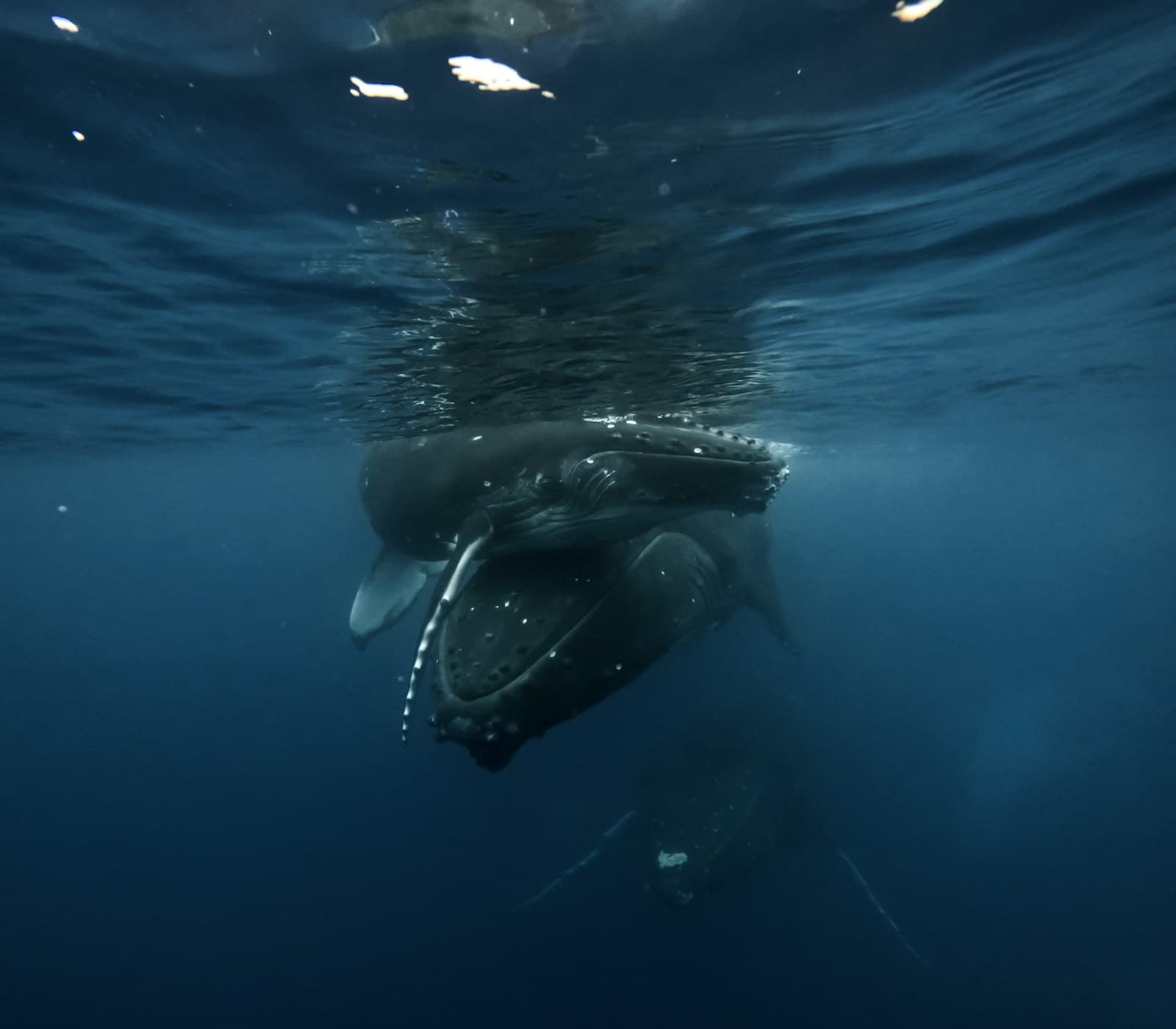
From roughly late February through early May, Cape Verde hosts one of the major breeding populations of North Atlantic humpback whales. These are the whales that spend summer feeding in Iceland, Norway, Greenland and Svalbard, then swim several thousand kilometres south to give birth and mate in warmer water.
You can snorkel with them legally on permitted trips from Boa Vista and São Vicente during the season. You cannot scuba dive with them — no country permits that — but in-water encounters in clear blue water with mother–calf pairs are among the most powerful marine experiences a human being can have, and Cape Verde is one of only four or five places in the world where a regulated version of this is even possible.
Peak window: second half of March through second half of April.
The Sal shark story
Sal has an experience that has become quietly famous in niche dive circles: a population of juvenile lemon sharks (Negaprion brevirostris) that use the shallow bays on the southwest coast as a nursery. At Shark Bay near Santa Maria, you can wade or snorkel in thigh-deep to chest-deep water and have lemon sharks swim past you at arm's length.
This is not a bait-attracted show. These are wild sharks using the site as they naturally would, and the experience is regulated — no feeding, limited group sizes, time windows based on tide. It is extraordinarily rare to find wild sharks this accessible anywhere else in the world.
Add to this, on the standard dive sites off Sal and Santa Maria: nurse sharks (cave dives), occasional tiger sharks (seasonal), mantas, whale sharks (late summer to autumn — not guaranteed but documented), and a normal cast of jacks, tuna, groupers, moray eels and rays.
The Boa Vista turtle story
Boa Vista is the third most important loggerhead turtle nesting site in the world, after Florida and Oman. The nesting season runs roughly July through October, with hatchings overlapping into October–November.
Dive sites off Boa Vista are less glamorous than off Sal — more about topography and resident fish than big-animal encounters — but if you time a trip in August or September, night beach-walks to observe nesting and hatching are experiences most people will remember far longer than any single dive.
The São Vicente / Santo Antão quieter option
For divers who want the Cape Verde diving without the tourism scale of Sal, São Vicente (specifically Mindelo) is the base. Diving here is more dramatic topographically — volcanic drop-offs, channels, decent wreck diving — with a genuinely authentic cultural experience on shore. Santo Antão, reached by ferry, has some of the most spectacular landscapes anywhere in the Atlantic islands, though the diving infrastructure is minimal.
Water, temperature, seasons
- Water temperature: 22°C in winter (January–March) to 26°C in late summer (September–October). Warmest water of any Atlantic dive destination at our latitude.
- Visibility: 20–30 m on good days, can drop to 10–15 m when the current brings in plankton-rich African water. Which — ironically — is usually when the pelagic action improves.
- Best diving: variable by goal. For humpback whales, March–April. For lemon shark interactions at Sal, year-round, best May–November. For loggerheads, July–October. For all-rounder diving, May–October.
What it costs
Published rates from Cape Verdean dive operators, as of early 2026:
- Single guided dive: €40–€70
- Two-dive boat package: €75–€120
- Lemon shark snorkel or wading experience (Sal): €50–€90
- Humpback whale snorkel trip (in season): €120–€250
- Week-long package (accommodation + daily diving): €700–€1,800
Flights from Lisbon run about €200–€450 return depending on season. Add €100–€200 from other European capitals.
Who it's for
Divers who prioritise big-animal encounters over dive-site variety. Cape Verde is not a destination you book for reef structure — it's a destination you book for the chance to swim alongside a humpback, stand in a metre of water next to a wild lemon shark, or time a trip to a loggerhead hatching.
European divers who want warm water without flying to the Red Sea. Cape Verde is genuinely tropical in feel, while still being in our region.
Couples and families where diving is one element of the trip. The islands work as vacation destinations, and the non-diving experiences — food, music, landscape — are substantial.
Who it's not for
Divers who need coral reefs and schooling tropical fish. Cape Verde is rocky-reef Atlantic, not Indo-Pacific. If "good diving" means a wall of purple and orange soft coral, you'll be disappointed.
Divers targeting specific guaranteed encounters on specific days. The pelagic action here is spectacular when it happens but genuinely wild — you bring the patience and the weather windows, the ocean brings what it brings. Anyone whose happiness depends on checklist certainty should go somewhere more predictable.
Why we think this belongs on our list
Two reasons that reinforce each other.
One: it is in our linguistic and cultural region. Cape Verde is Portuguese-speaking, with cultural and historical ties to Portugal that mean Lisbon-based divers can book this trip as easily as Madrid-based divers book the Canaries. That is an advantage we can actually lean into.
Two: it fills a gap in our current destination mix that matters. Our list is heavy on warm Indo-Pacific reef diving. Cape Verde is the warm-water Atlantic pelagic option that sits naturally between our Azores (cool, pelagic) and Red Sea (warm, reef+pelagic) recommendations. For clients who want sharks and whales but in cultural and logistical terms more familiar than Mexico or Costa Rica, this is the right answer.
How to start planning
Cape Verde trips reward commitment to a specific goal. A generalist "just wants to dive warm water" client will have a fine time and leave without a memorable story. A client who books March for humpbacks, August for turtles, or specifically books Sal for the lemon shark experience will come back talking about it for a decade.
Tell us which of those you are. We'll route the trip accordingly.
- A Boutique Liveaboard Agency, On Purpose — How we match clients to trips.
- Diving the Azores: Megafauna in Europe's Biggest Marine Reserve — The cooler, northern pelagic option.
- Diving Madeira: Monk Seals, Caves, and Year-Round Atlantic — The year-round option closer to Portugal.
- Europe's Best Liveaboard Destinations for 2026: Ranked and Compared — Where Cape Verde sits in the broader picture.
Related Articles
%20-%20Large.jpg&w=828&q=75)
Best Time to Dive: A Season-by-Season Guide
When to visit the world's top liveaboard destinations for the best conditions and marine life encounters.
Galápagos Diving: What to Expect on Your First Trip
Hammerhead highways, curious sea lions, and currents that demand respect — here's what awaits in the enchanted islands.