USS Saratoga
An entire aircraft carrier, upright on the lagoon floor, with her bombs still in the hangar.
Most wreck divers spend a career on freighters and the odd destroyer. At Bikini you drop down a mooring line onto the island of a 270-metre aircraft carrier. The USS Saratoga fought from the first weeks of the Pacific war to Iwo Jima, then was anchored in Bikini lagoon as a target for the 1946 atomic tests. She survived the first bomb and was sunk by the second. Today she sits upright on the sand at around 50 metres, and she is the dive most people cross the Pacific for. This guide covers her history, what you will see on and inside her, and what it takes to dive her properly.
Quick answer: USS Saratoga is an upright aircraft-carrier wreck: exterior, flight deck, island and guided penetration of the hangar deck in Bikini Atoll. Best season: May to October, the only months boats run to Bikini. Level: Technical only: decompression certification (PADI Tec 45, TDI Advanced Nitrox and Decompression Procedures or equivalent), at least 100 logged dives and deep-wreck experience. Depth: Top of the island about 12–18 m (40–60 ft), flight deck about 27–30 m (90–100 ft), seabed about 50–52 m (165–170 ft). Typical visibility: Often 30 m (100 ft) or more; less inside the wreck once silt is stirred.
Facts verified September 2026
From battlecruiser to atomic target
Saratoga was laid down as a Lexington-class battlecruiser and converted to an aircraft carrier under the 1922 Washington naval treaty. Commissioned in November 1927, she was in the Pacific war from the start: torpedoed by Japanese submarines in January and again in August 1942, her aircraft sank the light carrier Ryūjō at the Eastern Solomons, and in February 1945 kamikazes and bombs wrecked her forward flight deck off Iwo Jima, with 123 of her crew killed or missing. After the surrender she ferried 29,204 servicemen home under Operation Magic Carpet, more than any other ship.
At Operation Crossroads she came through the Able air burst of 1 July 1946 with little more than her flight-deck planking on fire. The underwater Baker shot on 25 July went off a few hundred metres away, lifted the carrier bodily, swept her flight deck clear and knocked much of her funnel down. Holed and leaking, with no crew aboard to save her, she settled slowly and slipped under nearly eight hours later.
What you'll see on the wreck
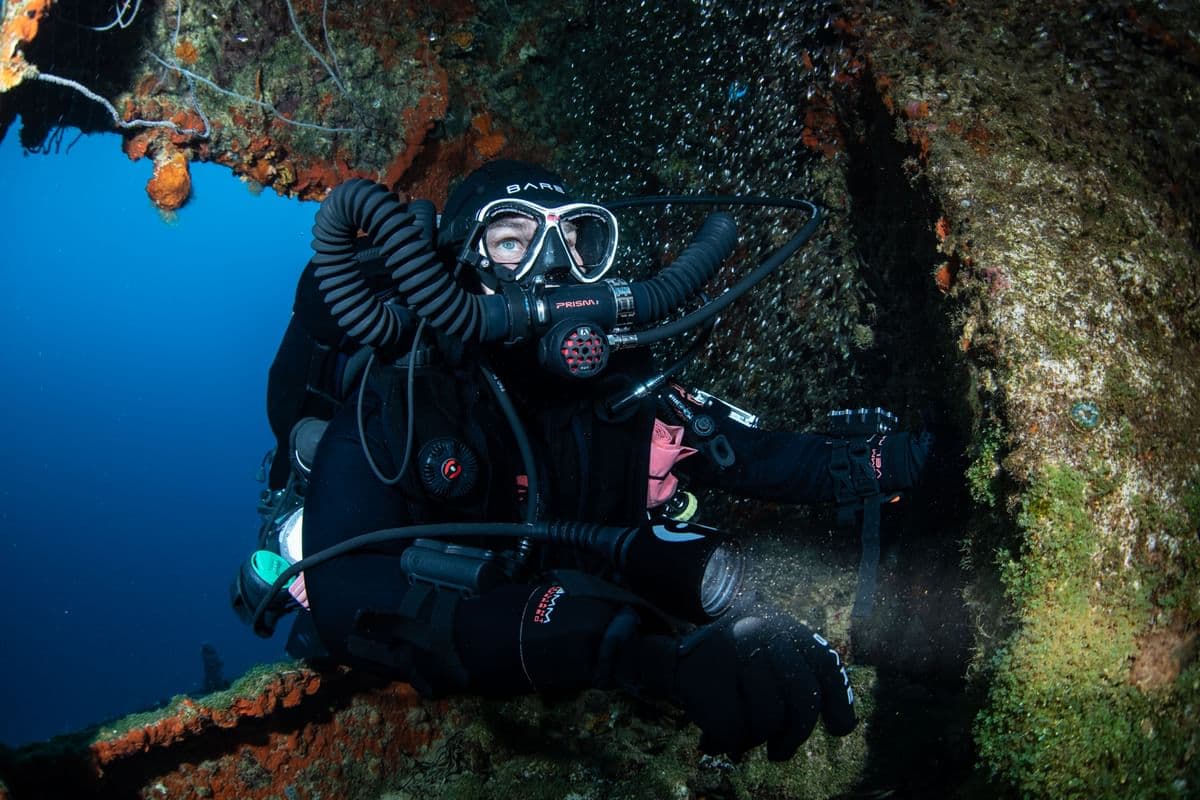
Saratoga is far too big for one dive, and good trips give her several. The first is usually an orientation along the island, the gun mounts and the flight deck; later dives work deeper along the hull or inside. The National Park Service survey of the fleet found her virtually intact and easy to read, although large parts of the flight deck have since sagged onto the hangar deck below. Highlights include:
- The island and mast, the shallowest part of the wreck and a natural place to finish a dive
- Twin and single 5-inch gun mounts, plus 40 mm Bofors and 20 mm Oerlikon anti-aircraft guns along the sides
- Aircraft swept off the flight deck by Baker, lying on the sand around the hull
- In the hangar: Helldiver dive bombers, an Avenger, 500 lb bombs and depth bombs, still where the Navy stowed them for the test
- A US Navy Mark V diving helmet, one of the wreck's best-known artefacts
Conditions and who it is for
Bikini is warm (27–29°C) and the lagoon is normally calm, with little or no current and visibility that is often 30 metres or more. The challenge is depth. The flight deck is at about 27–30 m and the seabed at about 50 m, so any dive that does justice to the wreck is a decompression dive. The operator's minimum is technical decompression certification (PADI Tec 45, TDI Advanced Nitrox and Decompression Procedures or equivalent), at least 100 logged dives and previous deep-wreck experience. Recreational divers, even with 40-metre cards, are not accepted.
Penetration is serious. The carrier has several decks of passageways, most watertight doors were shut when she sank, and the silt is very fine, so going inside is a guided, lined, planned dive, usually entered around the forward elevator shaft. Only a small part of her interior has been explored.
When to dive it
Boats only reach Bikini between May and October, when the north-east trade winds have dropped and the open-water crossing from Kwajalein is manageable. Water temperature and visibility hold steady through those months, so the real constraint is getting a place: there are few departures each year and they fill well ahead.
How the Saratoga is dived from the boat
Bikini is liveaboard-only, and the boat moors over the wrecks. Expect a maximum of two technical dives on most days with a four-hour surface interval between them. Nitrox is available; trimix is supplied only to closed-circuit rebreather divers, because helium is scarce this far out, so most open-circuit divers plan their Saratoga dives on nitrox and decompression gas, and a rebreather opens up the deeper parts of the wreck. Ask for cylinders and stages well in advance.
There is no recompression chamber open to civilians anywhere in the Marshall Islands. After a diving accident the trip ends and the boat heads back to Kwajalein for an air evacuation, so conservative profiles and dive insurance that covers technical diving, evacuation and chamber treatment are part of the plan. Residual radiation on the wrecks is considered negligible as long as nothing is taken away; removing anything from the wrecks is forbidden.
Faneca dives the USS Saratoga on our Bikini Atoll Wrecks liveaboards, 11- to 13-night round trips from Kwajalein that sail only in the May-to-October window. The carrier is the centrepiece of every itinerary and is usually dived more than once. Places are few, so talk to our concierge early about dates and whether your certification fits.
USS Saratoga: common questions
What is the best season to dive USS Saratoga?
May to October, the only months boats run to Bikini
What experience level do I need for USS Saratoga?
Technical only: decompression certification (PADI Tec 45, TDI Advanced Nitrox and Decompression Procedures or equivalent), at least 100 logged dives and deep-wreck experience
How deep is USS Saratoga?
Top of the island about 12–18 m (40–60 ft), flight deck about 27–30 m (90–100 ft), seabed about 50–52 m (165–170 ft)
What marine life will I see at USS Saratoga?
Grey reef sharks, jacks, rainbow runners, batfish and sponge-covered steel; tiger sharks are sometimes seen near the deco stop