USS Arkansas
A battleship from both world wars, flipped over and sunk by the Baker test.
The USS Arkansas served in both world wars. She joined the Grand Fleet in 1918, shelled the German defences behind Omaha Beach on D-Day, and supported the landings at Iwo Jima and Okinawa. At Bikini she was one of the ships moored closest to the Baker bomb, and the blast rolled her over and drove her to the bottom. She now lies upside down at around 55 metres. She gets fewer headlines than the Saratoga or the Nagato, and she is the deepest of the three. This guide covers her story, what is still recognisable on her crushed hull, and how to dive her well.
Quick answer: USS Arkansas is an inverted battleship wreck: hull, casemate guns, main turret barrels; limited penetration of the gun decks in Bikini Atoll. Best season: May to October, the only months boats run to Bikini. Level: Technical only: decompression certification (PADI Tec 45, TDI Advanced Nitrox and Decompression Procedures or equivalent), at least 100 logged dives and deep-wreck experience. Depth: Upturned keel from about 26–30 m (85–100 ft), weather deck about 49 m (160 ft), seabed about 55 m (180 ft). Typical visibility: Often 30 m (100 ft) or more; less inside the wreck once silt is stirred.
Facts verified September 2026
A veteran of two world wars
Arkansas was a Wyoming-class dreadnought, commissioned in September 1912 and armed with twelve 12-inch guns in six twin turrets. In 1918 she joined the US battleships attached to the British Grand Fleet and was present for the internment of the German High Seas Fleet. In the Second World War she fired on German positions behind Omaha Beach from 6 June 1944, shelled Cherbourg and supported the landings in southern France. By the time she reached the Pacific she was more than 30 years old, and she went on to bombard Iwo Jima and Okinawa.
At Bikini the Able air burst damaged her superstructure. For Baker she was moored about 230 metres from the bomb. The shock wave crushed her starboard hull and rolled her over, and the water column drove her down onto the lagoon floor, where she came to rest upside down.
What you'll see on the wreck
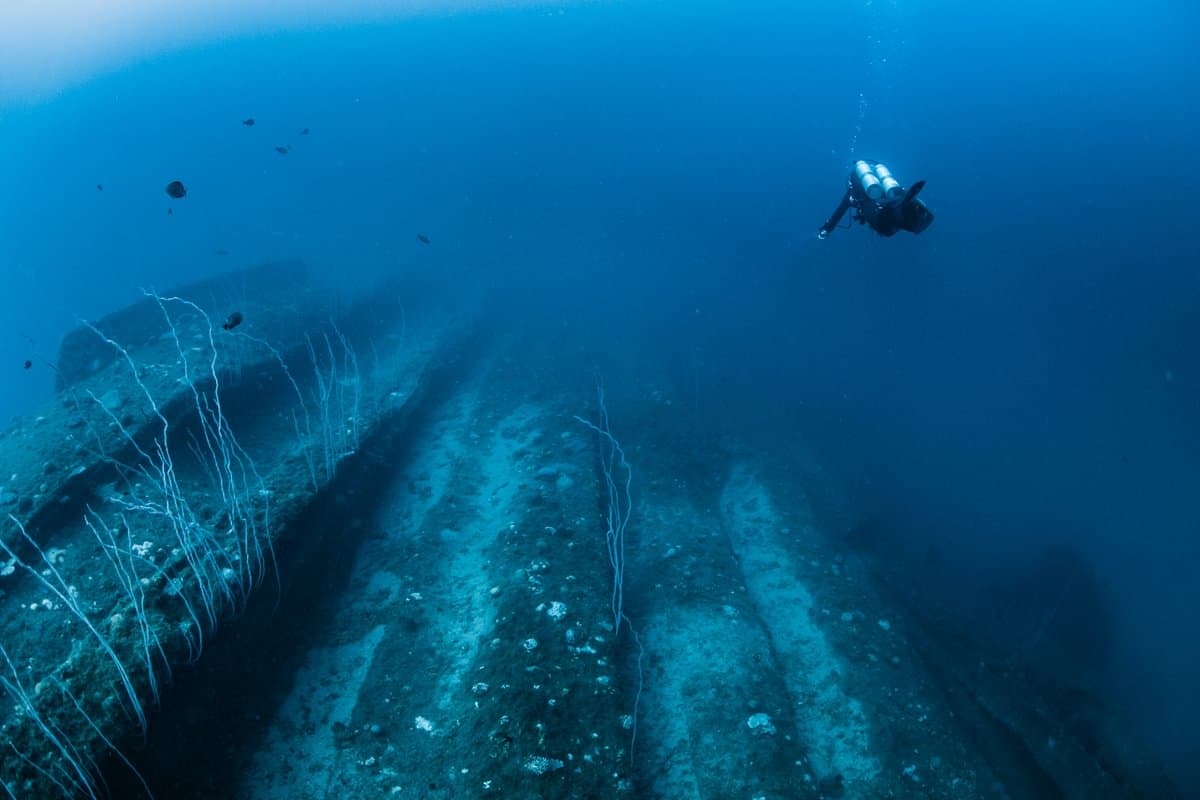
The Arkansas looks rough. The Baker shot crushed her from below, and the hull plating is buckled in over the frames along the keel. Look closer and the ship is still there. She lies roughly east to west, bow to the east, with a slight list to starboard: her port side is largely intact, while the starboard side is crushed against the bottom. The highlights:
- The upturned keel and bottom plating, the first thing you meet on the descent
- The intact port casemate, with three 5-inch/51 calibre guns still in place
- The barrels of the forward turret, which the wreck appears to rest on
- A remaining propeller at the stern, where the rudder and part of the stern have gone
- Fish crowding around the big guns in the shadow under the hull
Conditions and who it is for
The water is warm and the lagoon is usually calm with little or no current, but this is one of the deepest dives at Bikini. The keel can be reached in the high 20s and low 30s, but the guns and the deck edge are around 49–55 m, deep enough for narcosis to be strong on air. Divers who have done it on open circuit describe it as a dive for a clear head and a tight plan. The operator's minimum is decompression certification (PADI Tec 45, TDI Advanced Nitrox and Decompression Procedures or equivalent), 100 logged dives and deep-wreck experience, and a rebreather with trimix makes the deep end of this wreck much more comfortable.
Some of the gun decks can be entered, but with the ship upside down, crushed and at this depth, any penetration should be short, guided and lined.
When to dive it
Bikini trips run only between May and October, when the trade winds ease and the crossing from Kwajalein is practical. Conditions on the wrecks stay steady across that window.
How the Arkansas is dived from the boat
The Arkansas is one of the core wrecks on the Bikini itinerary. Plan on a maximum of two technical dives a day with a four-hour surface interval, nitrox for open-circuit divers and trimix for rebreather divers only.
Because there is no civilian recompression chamber in the Marshall Islands and an accident means a return to Kwajalein and an air evacuation, this is a wreck to dive with margin: keep the bottom phase short, keep the deco conservative and carry insurance that covers technical diving and evacuation. Removing anything from the wreck is forbidden.
Faneca dives the USS Arkansas on our Bikini Atoll Wrecks liveaboards, 11- to 13-night round trips from Kwajalein that sail only between May and October. If you are unsure whether your training covers a 55-metre wreck, ask our concierge before you book: we would rather say so up front.
USS Arkansas: common questions
What is the best season to dive USS Arkansas?
May to October, the only months boats run to Bikini
What experience level do I need for USS Arkansas?
Technical only: decompression certification (PADI Tec 45, TDI Advanced Nitrox and Decompression Procedures or equivalent), at least 100 logged dives and deep-wreck experience
How deep is USS Arkansas?
Upturned keel from about 26–30 m (85–100 ft), weather deck about 49 m (160 ft), seabed about 55 m (180 ft)
What marine life will I see at USS Arkansas?
Reef fish swarming around the big guns, whip corals and sponges on the hull