HIJMS Nagato
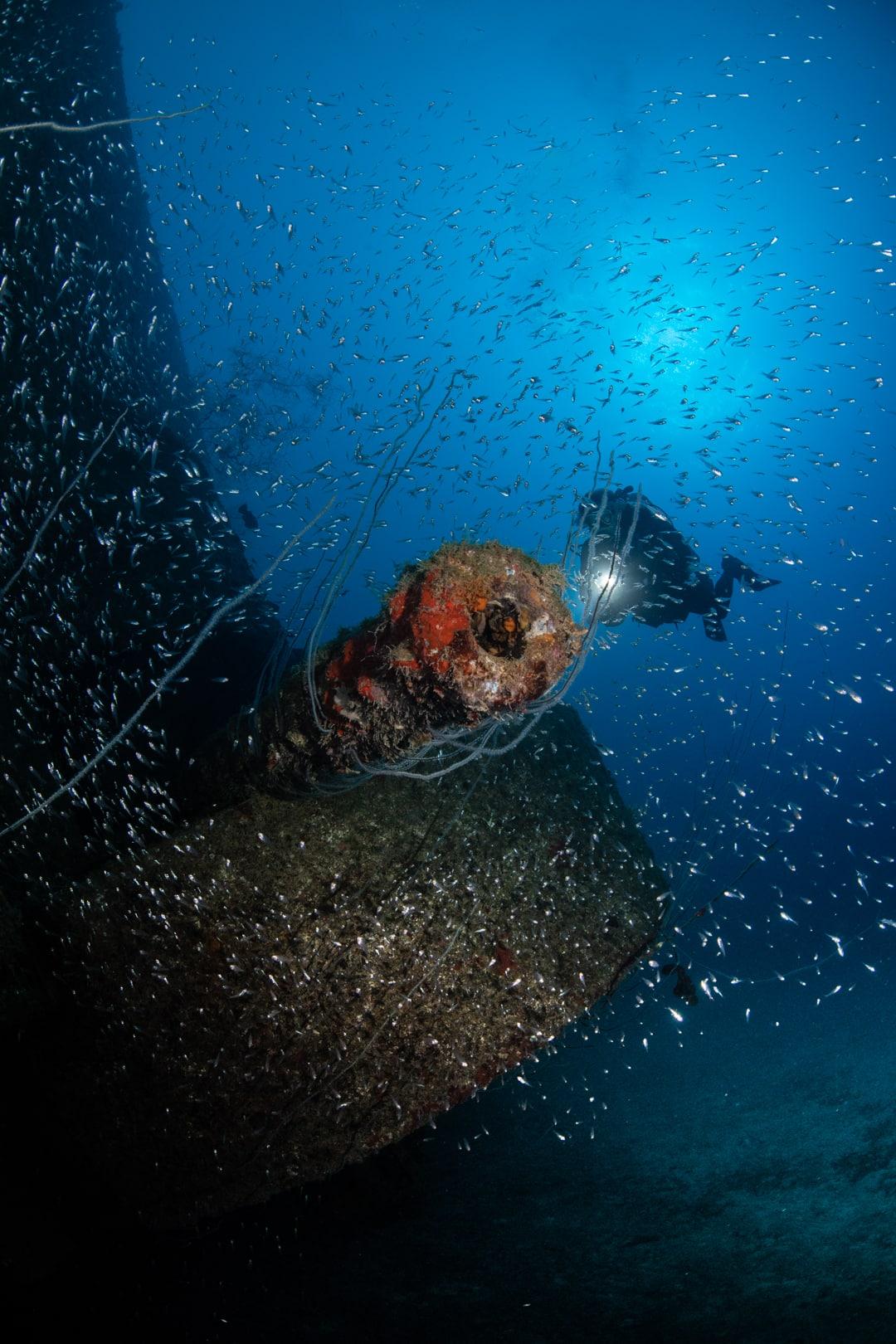
Yamamoto's flagship lies upside down, her four propellers reaching up towards you.
The Nagato is the wreck that links Bikini to Pearl Harbor. She was the flagship of Admiral Isoroku Yamamoto's Combined Fleet, the first battleship in the world armed with 16-inch guns, and the only Japanese battleship still afloat when the war ended. The US Navy took her to Bikini as a target, and she capsized after the second atomic test. Today she lies upside down on the lagoon floor, and the descent onto her four huge propellers is one of the great moments in wreck diving. Here is what the dive is like and what you need to do it.
Quick answer: HIJMS Nagato is an inverted battleship wreck: propellers, hull, 16-inch gun barrels and the fallen bridge; limited penetration in Bikini Atoll. Best season: May to October, the only months boats run to Bikini. Level: Technical only: decompression certification (PADI Tec 45, TDI Advanced Nitrox and Decompression Procedures or equivalent), at least 100 logged dives and deep-wreck experience; a rebreather suits it best. Depth: Propellers and rudder about 33 m (108 ft); bridge and gun barrels about 46–50 m (150–165 ft); seabed about 50–52 m (165–170 ft). Typical visibility: Often 30 m (100 ft) or more; less inside the wreck once silt is stirred.
Facts verified September 2026
The battleship behind Pearl Harbor
Nagato was commissioned in November 1920, the first battleship anywhere to mount 16-inch guns, eight of them in four twin turrets. A mid-1930s rebuild gave her the tall pagoda mast that dominated her silhouette. In 1941 she was Yamamoto's flagship, and on 2 December, at anchor in Japan, the signal "Climb Mount Niitaka" went out from her to the carrier force, the go-ahead for the attack on Pearl Harbor. She did not take part in the raid itself.
Bombed at Leyte Gulf in 1944 and again at Yokosuka in July 1945, she ended the war as a damaged floating anti-aircraft battery and was seized by US sailors at the end of August 1945. At Bikini she shrugged off the Able air burst. After Baker on 25 July 1946 she was left with a slight list that slowly grew, and she capsized and sank during the night of 29–30 July.
What you'll see on the wreck
Because she rolled over as she sank, the Nagato is a wreck you read upside down. Most dives start from the stern, and the first thing out of the blue is the running gear. From there divers work forward along the hull. The highlights:
- Four propellers and the rudder at about 33 m, pointing up at the surface and usually ringed with glassfish
- Her 16-inch gun barrels hanging from the turrets under the inverted hull, the stern pair pointing aft and the forward pair towards the bow
- The bridge, pushed out to one side as she rolled over, lying beside the hull with rangefinders, directors and voice tubes still recognisable
- A broken stern section resting on the sand at a steep angle
- Anchor chains still running out from the hawse pipes at the bow
Conditions and who it is for
Conditions are the Bikini norm: warm water at 27–29°C, little or no current and generally clear visibility. The depth is what makes the Nagato one of the harder dives on the trip. The propellers are within reach at 33 m, but the guns and the bridge are around 46–50 m and the seabed is around 50 m, where narcosis on air is significant. The operator calls it a dive for technical divers, ideally on a rebreather, and its minimum for the trip is decompression certification (PADI Tec 45, TDI Advanced Nitrox and Decompression Procedures or equivalent) with at least 100 logged dives and deep-wreck experience.
Penetration is possible in places at the stern, midships and bow, but parts of the wreck have collapsed and old lines lead into some of them. Anything beyond a look inside needs proper planning and a fresh line. The ship is more than 200 metres long, so watch your gas on the swim back to the mooring.
When to dive it
Like every Bikini wreck, the Nagato can only be dived between May and October, when the boats make the crossing from Kwajalein. Conditions inside the lagoon change little across those months; what decides your year is which departure still has space.
How the Nagato is dived from the boat
Itineraries normally give the Nagato at least one dive, and a second if you want the bow and bridge as well as the stern. Expect a maximum of two technical dives a day with a four-hour surface interval. Trimix is supplied only to rebreather divers, so open-circuit divers usually plan this one carefully on nitrox and decompression gas.
There is no civilian recompression chamber in the Marshall Islands: a diving accident means returning to Kwajalein for an air evacuation. Dive conservatively and carry insurance that covers technical diving, evacuation and chamber treatment. Leave everything where it lies; taking anything from the wrecks is forbidden.
Faneca dives the Nagato on our Bikini Atoll Wrecks liveaboards, 11- to 13-night round trips from Kwajalein that sail only between May and October. She is one of the core wrecks of the trip, alongside the Saratoga. Talk to our concierge early about dates and how your training fits a dive this deep.
HIJMS Nagato: common questions
What is the best season to dive HIJMS Nagato?
May to October, the only months boats run to Bikini
What experience level do I need for HIJMS Nagato?
Technical only: decompression certification (PADI Tec 45, TDI Advanced Nitrox and Decompression Procedures or equivalent), at least 100 logged dives and deep-wreck experience; a rebreather suits it best
How deep is HIJMS Nagato?
Propellers and rudder about 33 m (108 ft); bridge and gun barrels about 46–50 m (150–165 ft); seabed about 50–52 m (165–170 ft)
What marine life will I see at HIJMS Nagato?
Grey reef and blacktip sharks, turtles and schools of glassfish around the propellers; tiger sharks occasionally during deco