Darwin & Wolf
Two remote volcanic islands where the open Pacific delivers the greatest shark diving on Earth.
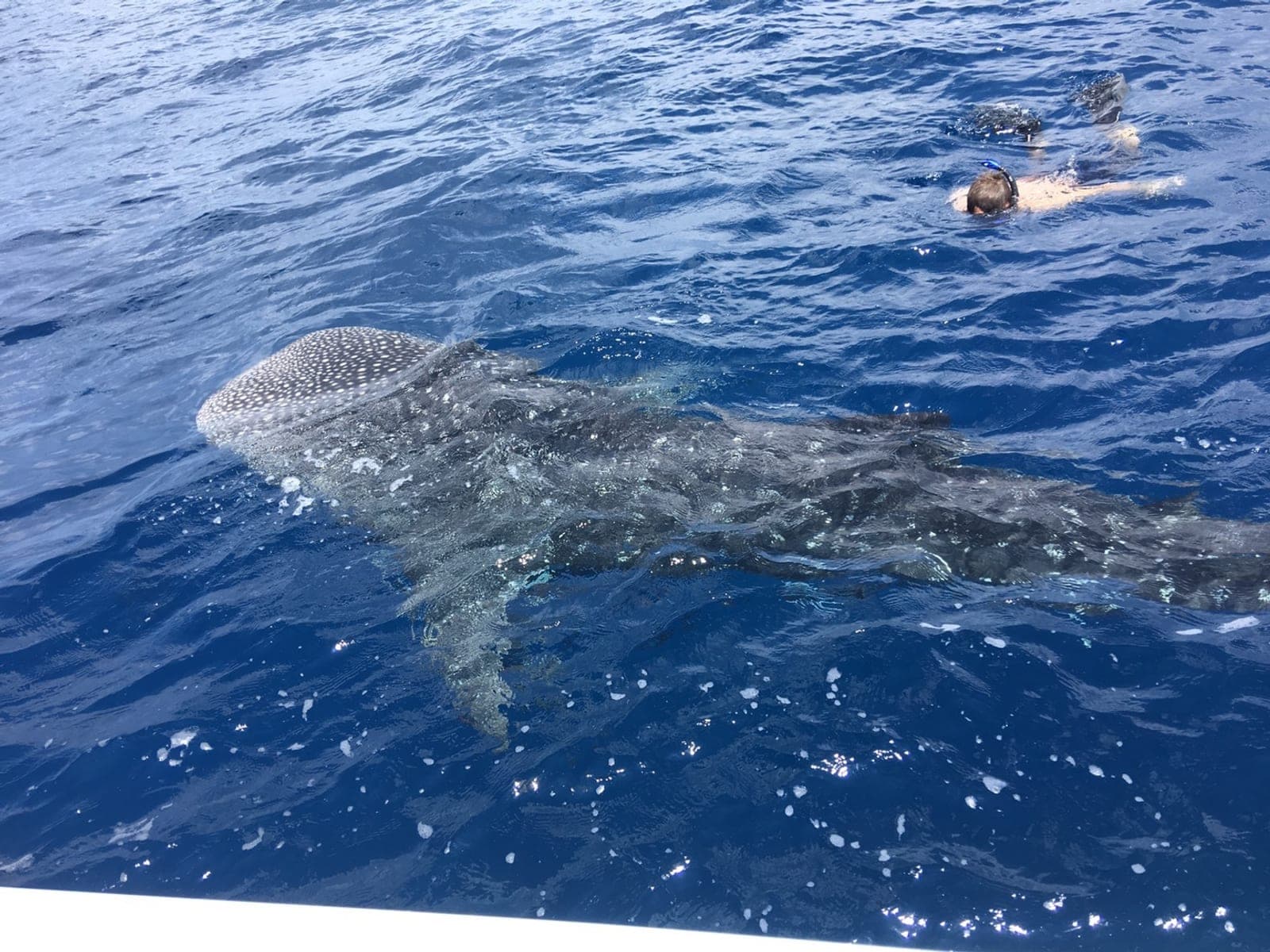
There is a moment at Darwin when you hook into the ledge, steady your breathing against the surge, and look up to see the water gone dark with hammerheads — a slow, wheeling wall of them, hundreds strong, filing past like weather. Then a shape the size of a bus glides in from the blue, and the whale shark you flew across the world for is simply there. Diving Darwin & Wolf is not a gentle affair, and it is not for everyone. It is, by broad consensus among people who have dived everywhere, the most concentrated big-animal encounter our planet offers. These two specks of rock in the far northwest of the Galápagos are reachable only by liveaboard, and once you have dived them, every other shark site is measured against them.
Quick answer: Darwin & Wolf is a drift and hook-in dives along volcanic walls, pinnacles and sloping rock shelves in Galápagos. Best season: June–November for pelagic peak; December–May for warmer, calmer, clearer water. Level: Advanced — AOW plus roughly 50 logged dives typically required. Depth: Hook-in ledges at 15–23 m; most action 18–30 m. Typical visibility: Variable, roughly 10–30 m; plankton can drop it in the cool season.
Facts verified September 2026
Why Darwin & Wolf is the world's benchmark dive site
Darwin and Wolf are the exposed tips of ancient, extinct volcanoes standing alone in the open Pacific, far north of the main Galápagos archipelago. Their isolation is the whole point. With no shallow shelf and no other land nearby, they act as a solitary oasis in blue water, and the ocean's nutrient-rich upwellings — chiefly the cold Cromwell (Equatorial Undercurrent) welling up from the deep — collide with these walls and set off an explosion of life that pulls in pelagics from every direction.
At Darwin, the signature site is El Arenal, sometimes called the Darwin Theatre: a sloping rock-and-sand shelf where you settle in and watch the show. This is where you'll hear about Darwin's Arch — the iconic natural bridge that stood just offshore until it collapsed through erosion in May 2021. The rock stacks that remain, now nicknamed the Pillars of Evolution, still mark the spot, but the diving was always about what passes in the current, not the arch itself. Wolf, a short overnight crossing to the south, is the other half of the pilgrimage and arguably delivers the single most staggering hammerhead spectacle in diving.
Put simply: this is a Galápagos liveaboard site that has earned its reputation honestly. The density and reliability of big animals here is not marketing — it is the reason serious divers save for years to come.
What you'll see underwater
The cast is world-class and, unusually, present year-round in some form. The core encounters:
- Scalloped hammerheads — the headline act, in schools of dozens to several hundred. Wolf's 'wall of hammerheads' is the quintessential Galápagos image.
- Whale sharks — Darwin is one of the only places on Earth where the visitors are predominantly large, often pregnant, adult females. Peak season is roughly June to November.
- Galápagos sharks and silky sharks — resident and abundant, often circling in numbers.
- Eagle rays, mobula rays and the occasional manta, plus green turtles resting on the ledges.
- Bottlenose dolphins that will sometimes join the dive, and dense bait balls worked by tuna and jacks.
- Wolf adds character close to the rock: moray eels, hogfish, red-lipped batfish and cleaning stations.
Conditions and who Darwin & Wolf diving is really for
Here is the honest read. These are among the most demanding conditions in recreational diving. The currents are strong, frequently surging, and can shift direction and pull down without much warning. Entries are often negative giant-strides straight into moving water, and much of your bottom time is spent hooked to bare rock in surge while the pelagics pass. It is exhilarating, and it can be genuinely intimidating on your first day.
For that reason, operators typically ask for Advanced Open Water certification and around 50 logged dives as a realistic minimum, and you should be comfortable, current-experienced, air-efficient and confident with a reef hook, an SMB and a good deep-water ascent. This is not a place to log your check-out dives. Water temperatures swing with the season and with thermoclines — anywhere from about 15°C in the cool months to the mid-20s°C in the warm season — so a 5–7 mm wetsuit with a hood, or even more, is standard. Visibility is variable: often superb, but the same plankton-rich water that draws the whale sharks can turn the blue green and cut the range.
If that sounds like a warning, it is only half of one. Divers who arrive prepared find it the dive of their lives. Those who arrive under-experienced spend the trip working too hard to enjoy it.
When to dive Darwin & Wolf
There are two distinct seasons and no genuinely bad time — only trade-offs. The cool, dry 'garúa' season, roughly June to November, is the pelagic peak: the largest hammerhead aggregations, the reliable whale sharks and the highest overall biomass. The cost is colder water, stronger currents and occasionally reduced visibility. This is the window most divers target, and it is when the site is at its most legendary.
The warm season, roughly December to May, brings calmer conditions, warmer water into the mid-20s°C, and the clearest, bluest visibility of the year, along with active manta and ray sightings and comfortable surface intervals. Whale shark encounters are much less likely in these months, but the hammerheads, Galápagos sharks and turtles remain. Choose the cool season if the whale shark is non-negotiable; choose the warm season if you want the best visibility and a slightly gentler ride.
How you actually dive it
Every Darwin & Wolf trip is a liveaboard trip — there is no other option. Boats depart from the central islands and steam overnight to reach Wolf, then continue to Darwin, giving you several days of repeat dives on both sites, which matters because the ocean here is different every dive and reliability comes from volume.
A typical dive follows a rhythm: a negative entry to get below the surface current quickly, a swift descent to the ledge, then you hook in, deflate, and hold position low against the rock to watch the parade at El Arenal or along Wolf's walls. Guides read the current and pick the day's site accordingly, and dives are generally kept in the 18–30 m range with conservative profiles because the action rarely requires going deeper. Nitrox is strongly recommended and widely used for the repetitive multi-day schedule. Between the marquee dives, the boat also visits gentler sites elsewhere in the archipelago, but make no mistake — you came for these two islands, and they deliver.
Faneca dives Darwin & Wolf aboard the Galapagos Master on its dedicated Darwin & Wolf itinerary — and because both islands are far offshore with no day-boat access, a liveaboard is genuinely the only way to reach them and the only way to bank the repeat dives that make the encounters pay off.
Darwin & Wolf: common questions
What is the best season to dive Darwin & Wolf?
June–November for pelagic peak; December–May for warmer, calmer, clearer water
What experience level do I need for Darwin & Wolf?
Advanced — AOW plus roughly 50 logged dives typically required
How deep is Darwin & Wolf?
Hook-in ledges at 15–23 m; most action 18–30 m
What marine life will I see at Darwin & Wolf?
Scalloped hammerhead schools, whale sharks, Galápagos & silky sharks, eagle rays, dolphins, turtles, tuna