Gordon Rocks
The site the locals call "the washing machine" — and the one where you finally meet the hammerheads.
Gordon Rocks is the dive that separates the Galápagos you read about from the Galápagos you actually feel in your chest. A drowned volcanic crater an hour off the coast of Santa Cruz, it is the central islands' most reliable hammerhead site and, in the same breath, one of its most demanding. This is a diving guide to what makes Gordon Rocks special, who it is for, when to come, and how you actually get in the water — honestly, from people who dive it.
Quick answer: Gordon Rocks is a drift dive around a submerged volcanic crater (tuff cone) in Galápagos. Best season: June–November (cool season) for hammerheads; December–May for calmer water and better visibility. Level: Advanced — 25+ logged dives strongly recommended. Depth: 8–30 m inside the crater; outer walls drop to ~60 m. Typical visibility: 10–25 m, highly season- and current-dependent.
Facts verified September 2026
What makes Gordon Rocks special
Gordon Rocks is the eroded remnant of an extinct tuff cone — a volcanic crater that the sea has half-drowned, leaving three jagged pillars breaking the surface in a rough horseshoe. You dive the inside of that crater, dropping down rocky walls and pinnacles to a sandy floor around 30 metres, while the outer walls fall away to roughly 60. It is a compact, dramatic piece of underwater architecture, and the shape is exactly why the marine life stacks up here.
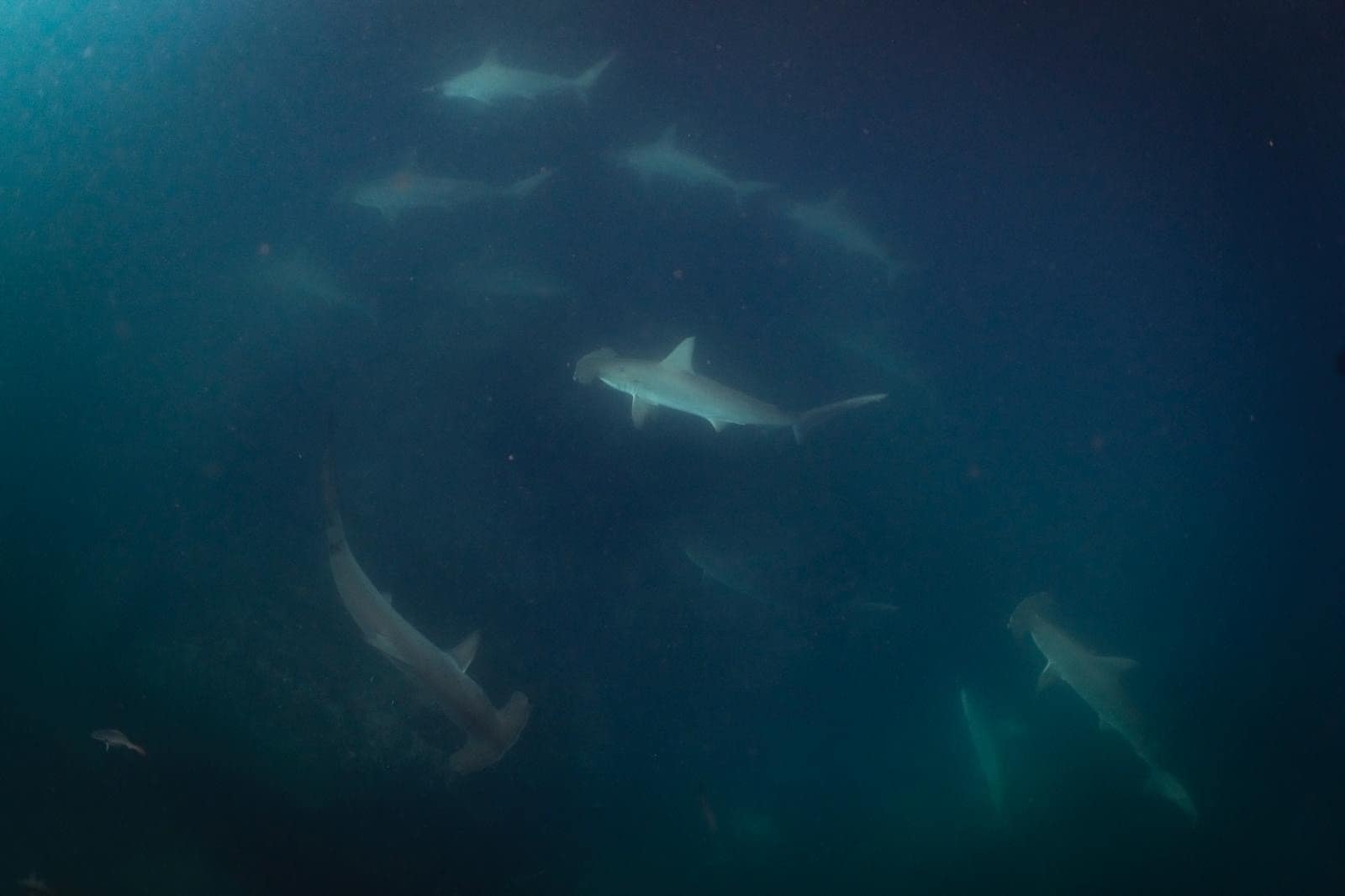
The crater funnels current, and current is what the Galápagos runs on. Cold, nutrient-rich water pushing through the site feeds cleaning stations on the pinnacles, and that is what draws the headline act: schools of scalloped hammerheads cruising in from the blue to hang over the rocks. For divers on the central-islands leg of a Galápagos liveaboard or a day trip out of Puerto Ayora, this is the site where the archipelago's big-animal reputation stops being a promise and starts being a wall of sharks.
What you'll see
Gordon Rocks is first and foremost a hammerhead site, but it is a genuinely rich dive across the board. Hold position near a pinnacle, keep your bubbles quiet, and let the animals come to the cleaning stations rather than chasing them into the blue.
- Scalloped hammerhead sharks — the main draw, in schools that can number dozens to hundreds, best in the cool season
- Galápagos sharks and white-tip reef sharks patrolling the walls and sandy bottom
- Eagle rays, mobula rays and stingrays, often gliding through in loose groups
- Green sea turtles, moray eels, barracuda and big schools of creolefish and jacks
- Playful Galápagos sea lions, particularly on the shallower rocks
- Seasonal specials with luck — mola (sunfish), manta rays, and the occasional passing whale shark in the cooler months
Conditions and who it's for
Be clear-eyed about this one. Gordon Rocks earns its "washing machine" nickname: strong, shifting currents, surge against the rocks, and sudden upwellings and down-currents that can push you around with very few visual references to orient against. It is not a beginner's dive, and it is not a place to log your first cold-water or first current dive.
Most reputable operators want to see at least 25 logged dives before they take you here, and will evaluate you at a gentler site first if you are closer to the 18–20 range. You need to be comfortable with negative entries, reef hooks or good reef-safe positioning, buoyancy in surge, and staying calm when the water decides to move. Water is cool — roughly 18–23°C in the cool season, with thermoclines that can bite colder near the bottom, and milder 23–27°C in the warm months — so a 5–7 mm wetsuit or more is standard. If your current-diving skills are rusty, do a couple of easier Galápagos dives first and come to Gordon Rocks ready.
When to dive it
There is a real trade-off by season, and it is worth choosing deliberately. The cool, nutrient-rich season from roughly June to November — peaking July to October — is hammerhead season. The Humboldt-driven cold water brings the big schools and the best odds of mola and manta, but it also means cooler temperatures, greener water and, often, punchier conditions.
The warm season from December to May flips the equation: warmer, calmer, clearer water with visibility toward the top of the 10–25 metre range, making for a more relaxed dive — but with less certainty on the big hammerhead aggregations. If sharks are the whole reason you are coming, dive it in the cool season and accept the conditions. If you want a smoother introduction to Galápagos current diving, the warm months are kinder.
How you actually dive it
Gordon Rocks sits about an hour by boat east of Santa Cruz, roughly 45 minutes from the Itabaca Channel and an hour from Puerto Ayora, and it is dived almost entirely as a two- or three-tank day trip or as an early stop on a Galápagos liveaboard itinerary. Access is by negative entry — you deflate and drop straight down as a group to get below the surface current fast, then work along the inside of the crater from pinnacle to pinnacle.
The plan is usually to find shelter on the up-current side of a rock, settle in at 18–25 metres, and watch the cleaning stations while the hammerheads pass, before drifting off the site to be picked up. Stay with your guide and your buddy, keep an eye on your computer and gas in the cool water, and resist the urge to swim out into the blue after a shark — the animals come closest to divers who stay low, still and calm on the rocks. The whole area lies inside the Galápagos Marine Reserve, so it is no-take, guided diving only: no gloves-on rock-grabbing beyond safe positioning, and nothing touched or taken.
Faneca dives Gordon Rocks aboard the Galapagos Master, typically as a central-islands site early in the week — a strong check-and-build dive before the liveaboard pushes north to Wolf and Darwin. It is conditions-dependent and suited to divers with solid current experience, so we are honest at booking about whether the week's itinerary and your logbook line up for it.
Gordon Rocks: common questions
What is the best season to dive Gordon Rocks?
June–November (cool season) for hammerheads; December–May for calmer water and better visibility
What experience level do I need for Gordon Rocks?
Advanced — 25+ logged dives strongly recommended
How deep is Gordon Rocks?
8–30 m inside the crater; outer walls drop to ~60 m
What marine life will I see at Gordon Rocks?
Scalloped hammerhead schools, Galápagos & white-tip sharks, eagle & mobula rays, green turtles, sea lions, mola sunfish
