Northern Red Sea Wrecks Liveaboards
The Thistlegorm, the wrecks of Abu Nuhas and the walls of Ras Mohammed, in one week from Hurghada.
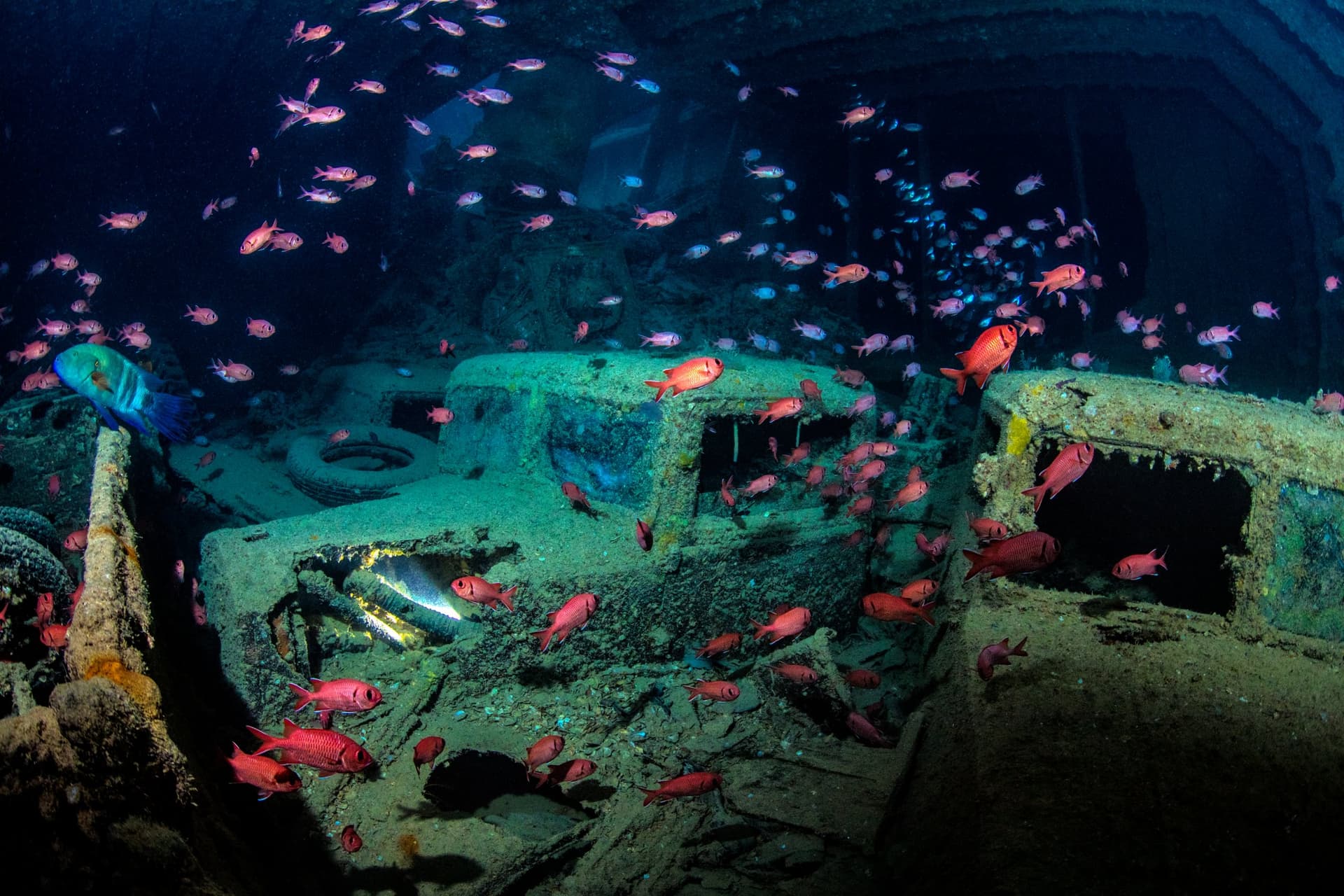
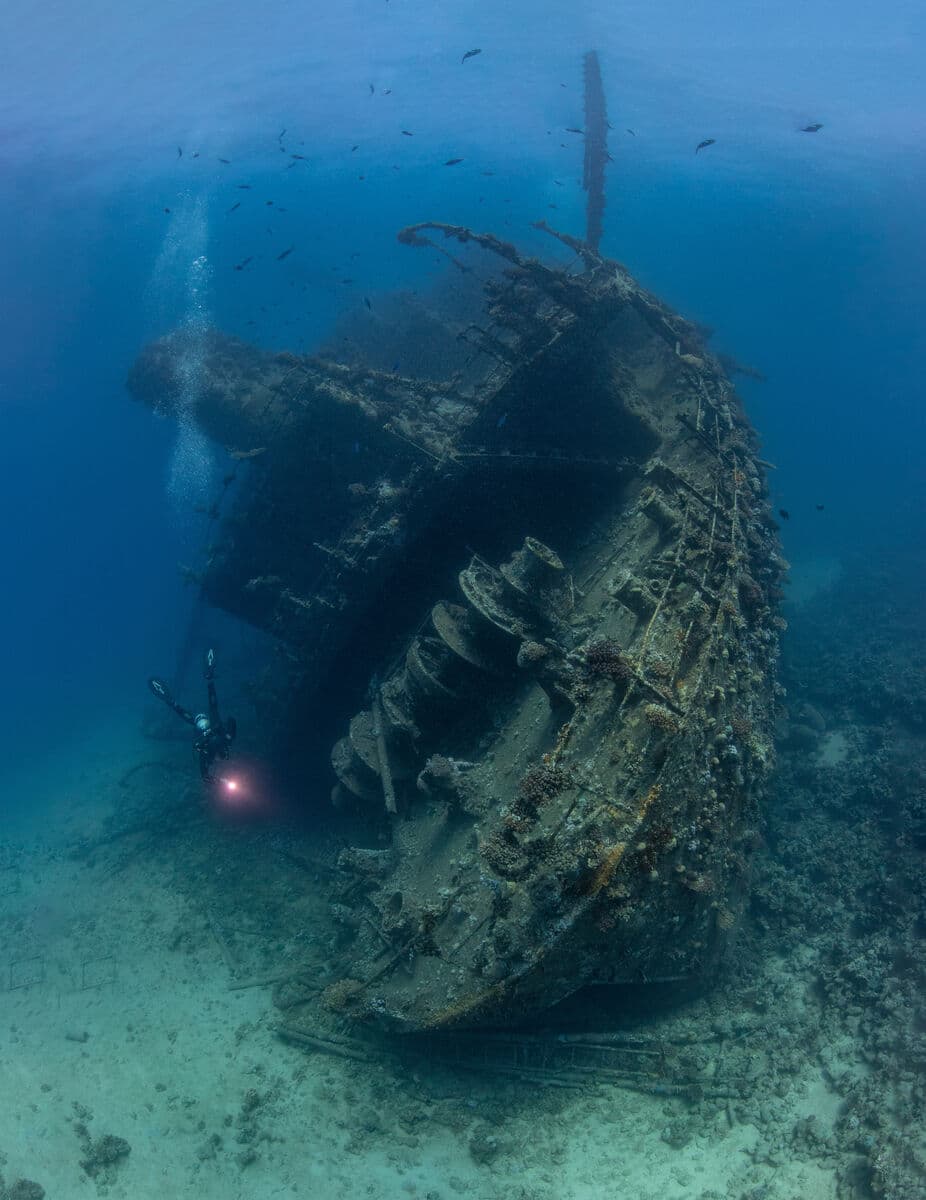
The northern Red Sea holds the densest cluster of diveable wrecks in the region, and a week from Hurghada reaches most of them. The Thistlegorm, a British supply ship sunk by German bombers in October 1941, still carries trucks, motorcycles and rifles in her holds. At Abu Nuhas, four merchant ships lie along the north side of a single reef. Between the wrecks sit the Straits of Gubal and the reefs of Ras Mohammed, Egypt's first national park, where the drift from Shark Reef to Yolanda Reef ends among the scattered cargo of a ship lost in 1980.
Operators sell this week as Red Sea Wrecks, North & Safaga or Northern Wrecks & Reefs, and the differences lie mostly at the southern end. Safaga variants add the reefs around Panorama and Abu Kafan, and the Salem Express, a ferry that sank in December 1991 with heavy loss of life and is dived as a memorial. The North & Brothers variant trades some of the northern sites for a day at the offshore Brothers, which raises the experience bar for that part of the week.
Of the classic Red Sea routes, this is the most forgiving. Crossings are short, most sites have a sheltered side, and the wrecks give natural reference points to divers still building confidence. That does not make it soft diving: the Thistlegorm can run a strong current, and the Straits of Gubal are rarely flat when the northerly is blowing.
Northern Wrecks & Reefs departures
Live from our calendar: per person sharing, from the lowest cabin. Hold any place free for 72 hours.
 Deal
DealBlue Melody
Red Sea Wrecks
Thistlegorm, Abu Nuhas & the northern wrecks
from $1,400 $980−30%
Blue Melody
Northern Red Sea & Brothers
Northern wrecks & the Brothers
from $1,400
 Deal
DealBlue Melody
Northern Red Sea Wrecks & Reefs
Winter Red Sea wrecks & reefs
from $1,155 $866−25%
DealDealBlue Melody
Northern Red Sea Wrecks & Reefs
35% off + free nitrox
from $1,155 $751−35%
DealBlue Melody
Red Sea Wrecks
30% off + free nitrox — winter wrecks
from $1,281 $897−30%
DealBlue Melody
Northern Red Sea Wrecks & Reefs
Spring wrecks & reefs
from $1,281 $897−30%
Blue Melody
Northern Red Sea & Brothers
Northern wrecks plus the Brothers
from $1,526
Where you'll dive
Also on many itineraries: Ulysses wreck (Gubal), Kingston wreck at Shag Rock, Dunraven wreck, Rosalie Moller (deep, experienced divers only), Panorama Reef and Abu Kafan (Safaga), Sha'ab El Erg.
Best time for Northern Wrecks & Reefs
This route runs all year, which is why it carries most of the winter Red Sea departures. From December to March the water is around 21 to 23°C and the air on deck feels cool after a dive, so a 7 mm wetsuit or a semi-dry makes sense; visibility is often at its best and the famous sites are quieter. By late spring the water is in the mid-twenties, and in summer it sits around 28 to 29°C, with more day boats on the big-name wrecks.
Spring (March to May) and autumn (September to November) are the comfortable middle: warm water, calmer seas than winter and good visibility. Wrecks do not keep seasons the way sharks do, so choose your dates around water temperature and wind. The northerly that funnels down the Gulf of Suez is the main variable. It can close the more exposed sites for a dive or two in any month, and the crew will move to the lee of a reef or a different wreck when it does. If the Brothers day on a North & Brothers week matters to you, the warmer months give the offshore crossing a better chance.
Experience you'll need
Requirements depend on the variant. Gentler North & Safaga weeks typically accept Open Water divers with a modest logbook, often asking for around 20 logged dives before the Thistlegorm. Dedicated wreck weeks usually ask for about 30 logged dives. Any week that includes the Brothers falls under the offshore marine-park rules, which generally means Advanced Open Water and around 50 logged dives. The minimum for each departure is shown on its listing.
The Thistlegorm's superstructure starts around 16 m and the seabed sits at roughly 30 to 32 m, so Advanced Open Water or a deep adventure dive gets you the whole wreck rather than the top of it. Going into the holds is overhead diving: do it only behind a guide, with good buoyancy and trim, and a wreck course is worth having. The Rosalie Moller, which some boats visit, lies at around 50 m and is for experienced deep or technical divers only. The Salem Express is dived from the outside, out of respect for the people who died on her.
For newer divers this is the best introduction to liveaboard life in the Red Sea: up to four dives a day, short hops between sites and a guide team that knows every mooring. For wreck divers it is a week worth repeating with different priorities.
How the trip works
Almost all northern weeks start and end in Hurghada, which has direct flights from much of Europe and a short transfer to the marina; a few leave from Sharm el-Sheikh. You usually board in the evening, spend the first night in port and make a check dive the next morning, often at Abu Nuhas or on a reef near Hurghada. Abu Nuhas is around two and a half hours north of Hurghada, the Thistlegorm a little further across the straits, and Ras Mohammed a few hours beyond that. Most boats time the Thistlegorm for first light so they are on the wreck before the day boats arrive.
A typical day has three dives plus a dusk or night dive where the site allows: a dawn dive, breakfast, a mid-morning dive, lunch, an afternoon dive, then the night dive before dinner. Expect up to around 20 dives over seven nights. The last morning usually brings one or two dives near Hurghada before an early-afternoon return to port, which leaves the usual no-fly interval before your flight home.
Government reef tax and port fees are usually paid on board and are generally lower than on the offshore routes; a fuel surcharge may be added, and your confirmation lists the amounts. Nitrox is widely offered as a weekly charge and pays off on repeated dives to the Thistlegorm and the deeper Abu Nuhas wrecks. A dive computer is required, and a torch is useful for the holds even in daylight.
Northern Wrecks & Reefs: common questions
Which wrecks does a northern Red Sea liveaboard visit?
The core list is the Thistlegorm, the four wrecks of Abu Nuhas (Giannis D, Carnatic, Chrisoula K and Kimon M) and wrecks in the Straits of Gubal such as the Ulysses and the Kingston. Safaga variants add the Salem Express, and some boats add the deep Rosalie Moller for experienced divers.
How many times will I dive the Thistlegorm?
Usually twice, on the same morning: one dive around the exterior, the stern and the scattered cargo, and one along the deck and into the holds. Current and the number of other boats decide the exact plan.
What is the difference between North & Safaga and Red Sea Wrecks?
Both start in Hurghada and include the Thistlegorm and Abu Nuhas. Safaga weeks spend more time on the reefs south of Hurghada and visit the Salem Express; wreck-focused weeks fit in more wrecks and tend to ask for more logged dives.
Is the northern Red Sea good for diving in winter?
Yes. It is the most sheltered classic route and runs through the winter, with water around 21 to 23°C from December to March. Bring a 7 mm suit or a semi-dry and a warm layer for the deck.
Can newer divers join a northern Red Sea wrecks liveaboard?
Open Water divers with some logged dives are accepted on many northern weeks, and it is a good first liveaboard. You will see more of the Thistlegorm with Advanced Open Water, and some variants set a higher minimum.
- Brothers, Daedalus & Elphinstone route
- Deep South: St John's, Rocky & Zabargad route
- Red Sea liveaboards: all routes and seasons
- Red Sea Route Deep Dive: Brothers Islands vs Northern Wrecks
- When to Dive the Red Sea: Month-by-Month Guide
- How Much Is a Red Sea Liveaboard? Real Prices by Route
- How to Choose the Best Red Sea Liveaboard Boat
Not sure this route is right for you?
Tell us your experience and dates and we'll match you to the right route, week and boat.
