Salem Express
A passenger ferry lost with hundreds of lives in 1991, dived as a memorial and nothing more.
The Salem Express is a different kind of wreck dive. She was a passenger ferry, and when she sank off Safaga on a stormy night in December 1991, hundreds of people died, many of them pilgrims returning home from Mecca. The wreck lies on its side in clear, shallow water within easy reach of recreational divers, and it is a powerful and sobering dive. It is also a grave. This guide covers the history, what you see on the outside of the ship, and how to dive her with the respect the site demands.
Quick answer: Salem Express is a wreck dive around the exterior of a sunken passenger ferry in Red Sea. Best season: Year-round; spring and autumn usually bring the calmest seas. Level: Advanced recommended because of the 30 m depth; exterior dive only. Depth: Shallowest parts of the hull around 10–12 m; seabed around 30 m. Typical visibility: Typically 20–30 m.
Facts verified September 2026
What happened
The ship was built in France in the 1960s as a passenger and vehicle ferry, originally named Fred Scamaroni, and was renamed Salem Express after a sale in 1988. She ran between Jeddah in Saudi Arabia and Safaga in Egypt. In mid-December 1991, on the return crossing and with many pilgrims on board, she approached Safaga late at night in a storm. Accounts agree that the route taken was closer to the reefs than the usual approach, and shortly before midnight she struck an outer pinnacle of the Hyndman reefs.
Water flooded in, the ship listed heavily and she sank within about 20 minutes, too quickly and at too steep an angle for most of the lifeboats to be launched. The official death toll was around 470, though published figures vary, passenger records were unreliable and many people believe the true number was higher. About 180 people survived, many of them by reaching the shore. After the recovery of bodies ended, openings into the ship were sealed, and much of the interior is regarded as a sealed grave.
What you see on the wreck
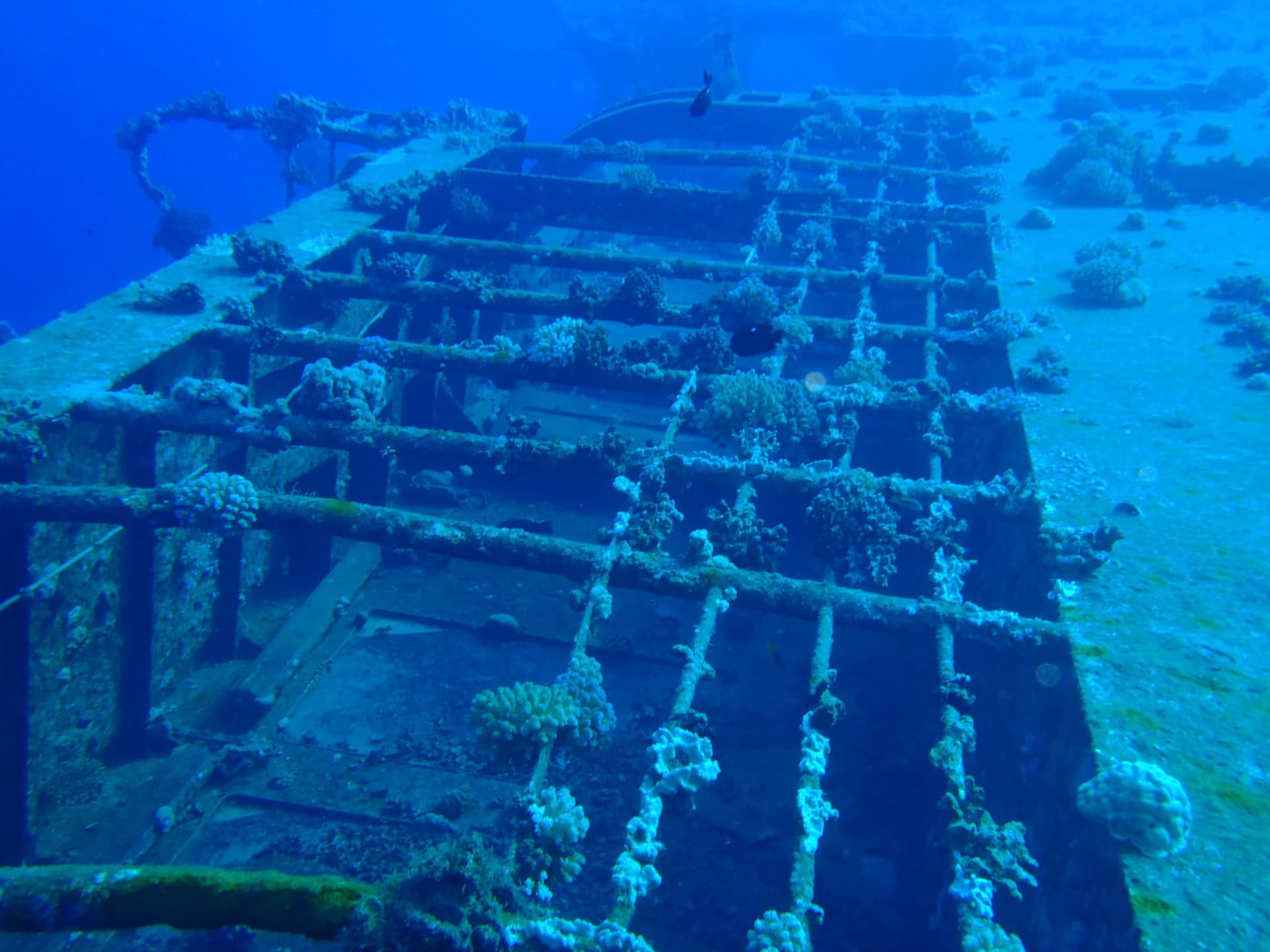
The Salem Express lies on her side on a sandy seabed at around 30 metres, with the shallowest parts of the hull at around 10 to 12 metres. Coral growth is still fairly light, so the ship's shape is easy to read, and the scale of a 115-metre ferry becomes clear as you swim its length. A typical dive follows the exterior:
- The stern, with the two large propellers and the rudder between them
- The upper decks and railings, now standing vertically because the ship lies on her side
- Lifeboats resting on the sand beside the hull
- The funnels, still carrying the company's 'S' emblem
- The bow and its vehicle loading door, central to most accounts of the sinking
Diving it with respect
This is the part of the briefing that matters most. Whatever you may read online, the Salem Express is not a penetration dive, and a responsible guide will keep the group outside the ship. Personal belongings are still visible in and around the wreck, from suitcases to children's things, and they should stay exactly where they are.
The etiquette is simple and should not need saying: no entering the wreck, no touching or moving belongings, no souvenirs of any kind, and no posed or joking photographs. Keep the group quiet and unhurried, and treat the dive as you would a visit to any memorial. Some divers decide not to dive the Salem Express at all, and that is a perfectly reasonable choice. A good crew will always offer an alternative dive on a nearby reef.
Conditions and who it suits
The site is relatively sheltered and the current is usually mild to moderate, which makes the dive technically straightforward. The depth is the main consideration: the deeper parts of the wreck and the lifeboats are close to 30 metres, so Advanced certification and good gas planning are sensible, and nitrox helps if you want more time on the shallower superstructure.
Visibility is usually good, at 20 to 30 metres. Water runs from about 22°C in winter to the high 20s in summer, so a 5 mm suit suits most of the year.
How you actually dive it
The wreck is a short boat ride from Safaga and is dived by day boats from there, and by some liveaboards whose routes pass that stretch of coast. The usual plan is a descent to the stern, a slow swim along the deck side towards the bow, and an ascent along the shallower side of the hull to finish the safety stop near the structure.
Most divers come up quieter than they went down. That is how it should be, and it is the reason to give this dive a place on a Red Sea trip only if you want to approach it in that spirit.
Faneca includes the Salem Express on some Red Sea itineraries that pass Safaga, always as an exterior-only dive and always optional. If you would rather not dive it, tell us when you book and we will check what alternative the crew offers that day.
Salem Express: common questions
What is the best season to dive Salem Express?
Year-round; spring and autumn usually bring the calmest seas
What experience level do I need for Salem Express?
Advanced recommended because of the 30 m depth; exterior dive only
How deep is Salem Express?
Shallowest parts of the hull around 10–12 m; seabed around 30 m
What marine life will I see at Salem Express?
Light coral growth on the hull, reef fish and schooling fish around the structure
