St John's Reefs
A maze of pinnacles, caves and walls near the Sudanese border, reached only by liveaboard.
St John's is not one dive site but a scatter of reefs spread across a wide stretch of sea in the far south of Egypt, close to the Sudanese border. Some are long coral ridges riddled with tunnels, some are steep-sided towers, and some are submerged pinnacles that stop a few metres short of the surface and catch every current going. Because it takes a long overnight passage to get there, the reefs see a fraction of the traffic of the northern sites, and the coral shows it. Here is how the main sites differ, and what to expect when you arrive.
Quick answer: St John's Reefs is a submerged pinnacles, walls, reef plateaus, and shallow cavern and tunnel systems in Red Sea. Best season: Diveable year-round; most departures run spring to autumn, and pelagic sightings are seasonal. Level: Advanced recommended; experienced Open Water divers for the sheltered caves and gardens. Depth: Reef tops from about 5 m; most dives 12–30 m; walls drop well beyond recreational limits. Typical visibility: Typically 20–35 m.
Facts verified September 2026
Why St John's is worth the long passage
The St John's system covers a few hundred square kilometres of Foul Bay, and operators list around 20 dive sites across it. That variety is the point. In a few days you can drift an exposed pinnacle at dawn, swim through sunlit tunnels after breakfast and finish on a sheltered reef in the afternoon, without repeating yourself.
Distance is what keeps it quiet. From Port Ghalib or Marsa Alam the reefs are a long overnight run south, so day boats do not reach them and only liveaboards on southern itineraries make the trip. Divers sometimes confuse St John's Reefs with Zabargad, which is also known as St John's Island; they are separate places, though many itineraries visit both.
The pinnacles: Habili Ali and Habili Gafaar
Habili is the local word for a reef that stops below the surface, and the two best known in St John's are the reason many divers book the trip. Habili Ali is a small, oval pinnacle at the eastern edge of the system. Its walls are cut with ridges and small caverns and dressed with large gorgonians and black coral in deeper water. Current is often strong and can change during the dive, which is exactly why grey reef sharks, jacks and, on good days, hammerheads and mantas pass through. The shallow reef top lets you drift through your safety stop with something to look at.
Habili Gafaar (also spelled Gaffar) is smaller still, a reef top only about 30 metres across with a ledge at roughly 20 to 35 metres and a deeper spur on its north side. It is small enough to circle more than once on a dive, and the shallows are thick with pink soft corals and anthias. Snapper, barracuda and tuna work the current, and grey reef sharks are regular visitors.
Gota Kebir, Gota Soraya and the caves
Gota Kebir is a large reef, more than 800 metres long, with several distinct dives along it. Its north end has two plateaus where whitetip reef sharks and bluespotted stingrays rest, and its south-east corner is broken by fissures and tunnels that let in shafts of light. The usual pattern is the eastern side in the morning and the western side in the afternoon, following the sun.
Gota Soraya (spelled Gota Soghayr by some operators) is the smaller, steeper sister, often rated among the best wall dives in the south. Overhangs and cracks hold glassfish and sweepers, the deeper wall has gorgonians and sea whips, and there is a cavern entrance at around 10 metres on the southern side. Nearby, the caves at Umm Kharalim are a shallow network of cracks and overhangs where sunlight filters down through the reef plate, an easy and photogenic dive between the more exposed sites. Highlights across the area:
- Grey reef and silvertip sharks on the exposed pinnacles
- Seasonal hammerheads and occasional mantas around Habili Ali
- Whitetip reef sharks and bluespotted stingrays on the Gota Kebir plateaus
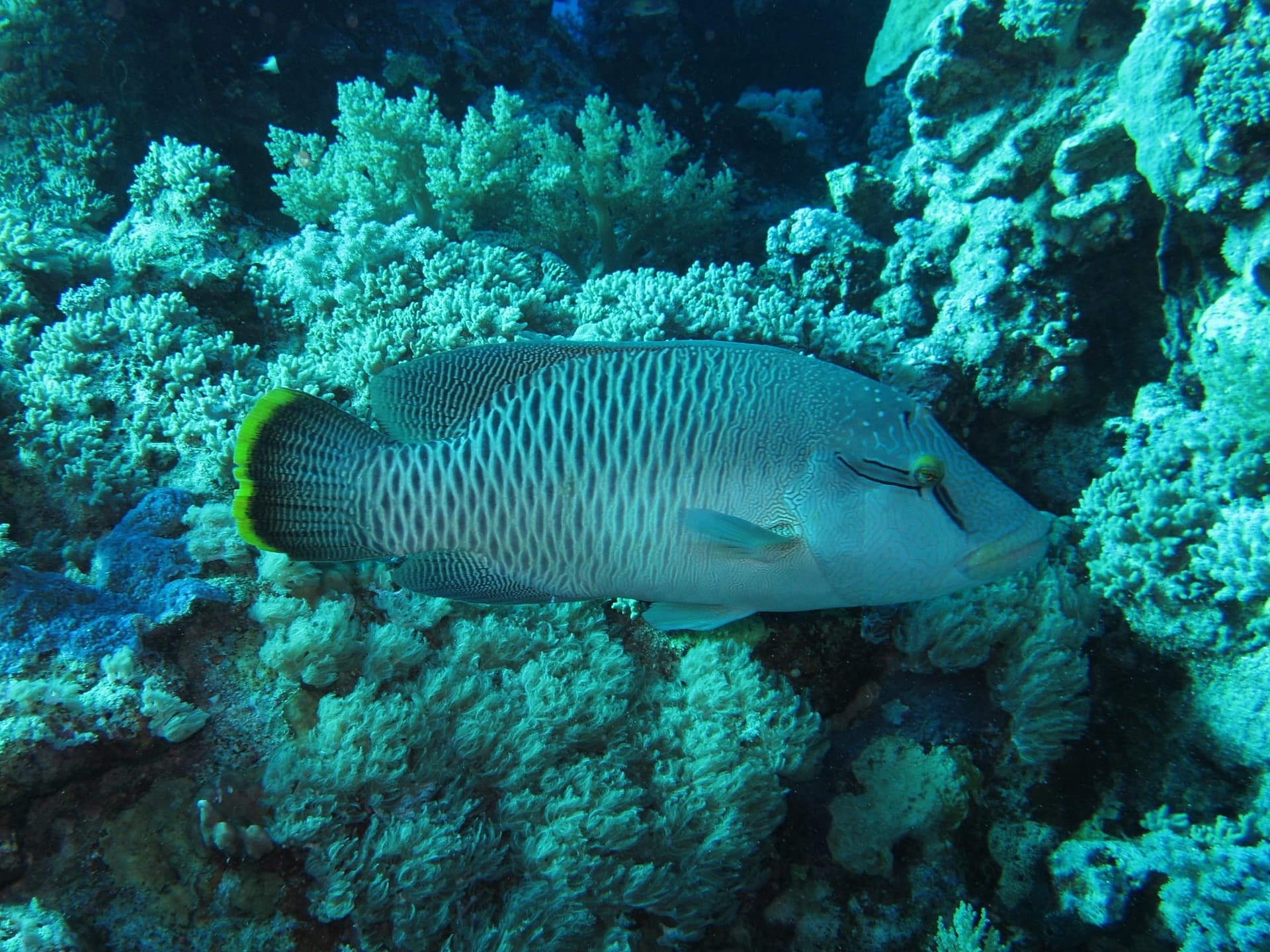
- Napoleon wrasse and groups of bumphead parrotfish
- Glassfish-filled tunnels, caverns and swim-throughs
Conditions, seasons and who it suits
The reef system gives some shelter, but the exposed pinnacles are open-water dives in every sense: deep water on all sides, current that can be strong and changeable, and pickups by zodiac. Most operators recommend Advanced certification and a good number of logged dives, and cruise directors will steer less experienced divers towards the caves and sheltered reefs when the pinnacles are running hard. Remember how far you are from help. The nearest chamber is many hours away, so conservative profiles are the norm.
Water runs from the low 20s Celsius in winter to the high 20s in late summer. Pelagic sightings follow the seasons and are never guaranteed: hammerheads are most likely in the warmer months, and oceanic whitetips are possible from early summer into autumn. Most southern departures run from spring to autumn, when crossings are more comfortable.
How you actually dive it
St John's is reached only by liveaboard, usually on a seven-night southern route from Port Ghalib that also takes in Fury Shoals, Sataya or the offshore reefs. Expect a long first night at sea, then two or three days among the reefs with up to four dives a day, most of them from zodiacs. Night dives are done where park rules allow, typically at a sheltered overnight mooring such as Dangerous Reef rather than on the exposed pinnacles.
Because there is so much choice, the plan is decided day by day. A good crew will put you on the habilis when the current is right and save the caves and gardens for the hours when it is not.
Faneca dives St John's on our Golden Mix (Daedalus, Sataya & St Johns) and Deep South itineraries from Port Ghalib, where the extra nights at sea buy you time on the pinnacles when the current is right.
St John's Reefs: common questions
What is the best season to dive St John's Reefs?
Diveable year-round; most departures run spring to autumn, and pelagic sightings are seasonal
What experience level do I need for St John's Reefs?
Advanced recommended; experienced Open Water divers for the sheltered caves and gardens
How deep is St John's Reefs?
Reef tops from about 5 m; most dives 12–30 m; walls drop well beyond recreational limits
What marine life will I see at St John's Reefs?
Grey reef and silvertip sharks, occasional hammerheads and mantas, whitetip reef sharks, Napoleon wrasse, bumphead parrotfish, giant morays, turtles, glassfish
