When to Dive Truk Lagoon: Seasons, Visibility and Booking Windows
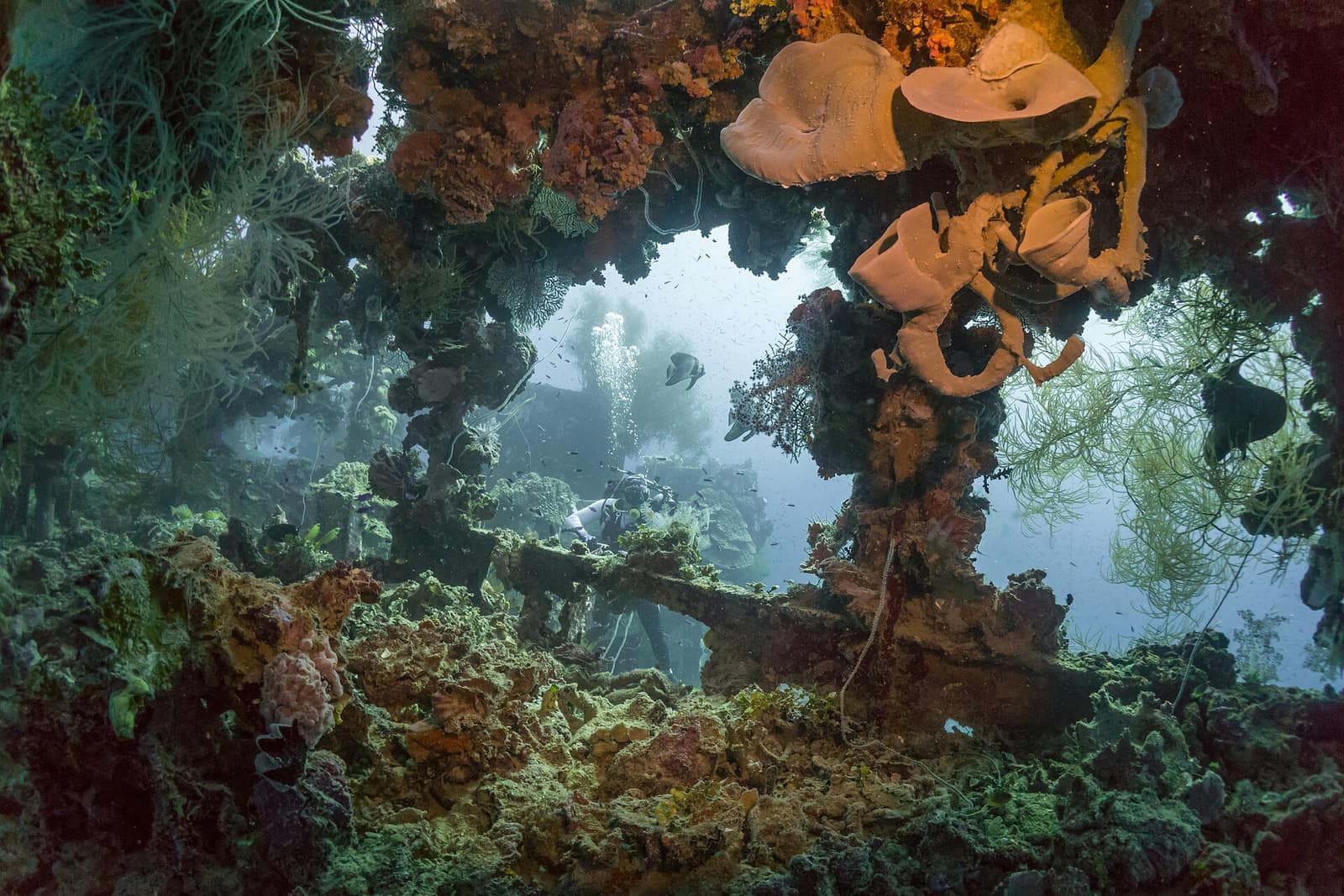
Truk Lagoon is one of the few world-class dive destinations where "when should I go?" has a genuinely reassuring answer: almost any time. The lagoon is enormous — roughly 70 km across, ringed by a barrier reef that flattens Pacific swell before it ever reaches the wrecks — and the water sits at 28–30°C every month of the year. You will not find a season where Truk is simply not diveable.
That does not mean every month is equal, and it definitely does not mean every departure is equally easy to book. Truk runs on a small number of liveaboard berths and a thin flight schedule, which produces a strange market: near-term departures sell out many months ahead while shoulder-season sailings a year out sit wide open at the same price. Understanding both halves — the weather and the booking mechanics — is what gets you the trip you actually want.
The short version
- Diveable: all 12 months. The lagoon is sheltered; wreck diving continues through the wet season.
- Best conditions: December to April — the northeast trade-wind season, driest months, calmest surface, best visibility (often 20–30 m on the outer wrecks).
- Wetter but workable: June to November — more rain and squalls, visibility more variable (15–20 m is typical), but dives rarely blow out because the reef does the sheltering for you.
- Typhoon risk: real but modest. Chuuk sits in the typhoon genesis zone — storms tend to form nearby and intensify as they track west toward the Philippines and Japan. Direct hits are rare, but August to November carries the most disruption risk.
- Water temp: 28–30°C year-round. A 3 mm suit is plenty; many divers wear less and add a hood for long deco hangs.
If your dates are flexible, aim for the dry season. If they are not, go anyway — Truk in September is still better wreck diving than almost anywhere else in January.
Why the lagoon changes the usual seasonal maths
Most Pacific dive destinations live and die by surface conditions: if the crossing is rough, you do not dive. Truk is different. The wrecks of Operation Hailstone — the February 1944 US carrier strike that sank more than 40 Japanese ships in two days — went down inside the lagoon, in anchorages chosen precisely because they were protected. Eighty years later, that protection works for divers instead of the Imperial Japanese Navy.
Practically, this means:
- Wet-season rain affects your surface interval more than your dive. Squalls pass through, the boat deck gets wet, and then you descend into 29°C water where nothing has changed at 30 m.
- Visibility is driven by runoff and plankton, not swell. Wrecks closer to the main islands (Dublon, Fefan) see more silt influence after heavy rain; wrecks toward the open lagoon hold their visibility better.
- The dive schedule almost never cancels. Liveaboards reposition inside the lagoon to find lee and cleaner water. A blown day in Truk is a genuine rarity, which is not something you can say about Socorro or the Brothers.
The one caveat is the typhoon season. Chuuk gets brushed more often than hit, but a developing system nearby can bring several days of wind, rain and stirred-up water even without a direct strike. If a week of guaranteed glass-calm conditions matters to you — say, you are shooting wide-angle on the Fujikawa Maru's bow gun and want that 30 m visibility — book December through April and remove the variable.
Month by month, honestly
December–February. Peak trade-wind season. Driest months, most consistent visibility, and the anniversary window of Operation Hailstone (17–18 February) — some divers deliberately time their trip to it. The trades can put chop on the surface in exposed parts of the lagoon, but the dive sites themselves stay calm. This is the most-booked window; plan furthest ahead.
March–May. Our favourite compromise. The trades ease, the rain has not fully arrived, and the lagoon goes glassy for days at a time. April and May regularly deliver the calmest surface conditions of the year. Availability is noticeably better than midwinter.
June–September. The wet season proper. Expect rain most days — often short, heavy bursts rather than all-day grey — and visibility that swings between 15 and 25 m depending on recent runoff. August and September carry the highest typhoon-formation risk. Prices soften and boats run emptier, which some repeat Truk divers consider the real insider season: same wrecks, same warm water, half the fins.
October–November. Transitional. Typhoon risk lingers into November, then the trades re-establish and conditions climb back toward dry-season quality. Late November can be superb and is usually easier to book than anything in Q1.
Depths and levels: who the wrecks are actually for
Truk has a reputation as a technical-diving mecca, and the deep wrecks earn it. But the spread of depths is wider than the reputation suggests, and a well-planned recreational week here is world-class in its own right.
- Fujikawa Maru — roughly 9–34 m, upright, with the famous fighter-fuselage hold and a coral-covered bow gun. Comfortably within Advanced Open Water range; arguably the best single recreational wreck dive on the planet.
- Shinkoku Maru — about 12–40 m. A fleet oiler turned reef, so thick with soft coral and anemones that night dives here feel like reef diving that happens to have an engine room. Recreational on the superstructure, deeper for the holds.
- Nippo Maru — deck around 24–38 m, seabed near 47 m. The tank on the deck and the bridge telegraph are the photographs everyone comes home with. This is the wreck where a deep certification, or better, nitrox and disciplined planning, starts to pay real dividends.
- San Francisco Maru — 45–63 m, the "Million Dollar Wreck," holds still packed with mines, trucks and light tanks. This one is genuinely technical territory: trimix, staged decompression, proper training. No exceptions worth making.
Who should not book Truk: freshly certified divers hoping to see the famous holds, and anyone uncomfortable with overhead environments — the best of Truk is inside the ships, and penetration with a guide is where the destination reveals itself. If your logbook is thin, either build experience first or come with realistic expectations (the exteriors alone are still magnificent). And if the San Francisco is your reason for coming, budget the technical training before the flights, not after.
Seasonally, depth matters more than you might think: dry-season visibility makes the deep wrecks dramatically better, because at 50 m you are spending your precious bottom time seeing the ship rather than searching for it. Technical divers have the strongest argument of anyone for booking December–April.
The booking-window problem
Here is the part the weather guides skip. Truk's liveaboard capacity is tiny — a handful of boats, each carrying a couple of dozen divers, in a destination that every serious wreck diver wants to tick. Flights compound it: most divers arrive via the United island-hopper through Guam, which runs a few times a week, so trips cluster around the same arrival days. The result is a market with almost no elasticity.
We checked live availability while writing this, and the pattern is textbook: departures inside the next six to nine months are sold out or down to last cabins, while April–May 2027 sailings sit wide open — 9- and 10-night itineraries from $3,240–4,050 USD, some with 15–20 spaces still unclaimed. Same boat, same wrecks, same dry-to-shoulder-season conditions. The only difference is that most divers do not plan 18 months ahead, so the far calendar is where the choice lives.
The practical rules:
- Booking 12–18 months out is normal for Truk, not excessive. Group charters (tech teams, dive clubs) block entire boats years ahead, which is why individual cabins evaporate in clusters.
- The dry season sells first. If you want January–March on a specific boat, you are shopping in next year's calendar, full stop.
- April–May is the value play: dry-season-grade conditions, materially better availability, and it dodges both the Christmas pricing and the typhoon window.
- Last-minute Truk barely exists. Cancellation cabins appear occasionally, but building a plan around them means flying 30+ hours on hope.
You can see exactly what is open right now on our live departures calendar filtered to Truk — spaces update as cabins are confirmed.
How to decide
Three honest profiles:
- You want the best possible week and can plan ahead: book December–April, 15+ months out, and prioritise a 9–10 night itinerary — Truk rewards time, and a 7-night trip leaves the deep wrecks under-dived.
- You have fixed dates in the wet season: go. Pack a light rain shell for the surface intervals, accept 15–20 m visibility as the baseline, and enjoy quieter wrecks. Avoid locking in flights during August–October if you have any flexibility at all.
- You are a technical diver building toward the San Francisco Maru: dry season, longest itinerary you can get, and confirm the boat's gas logistics (trimix and O₂ supply) at booking time — not all sailings carry the same capability.
However you slice it, Truk punishes improvisation and rewards planning more than any destination we sell. If you want a second pair of eyes on dates, flight routings through Guam, or which specific sailing fits your certification level, talk to our concierge — we watch this calendar weekly and will tell you plainly if the trip you are eyeing is the wrong one for your experience.
The wrecks have waited eighty years. They will wait another eighteen months for you to book the right week — but the cabin might not.
Related Guides
Related Articles
%20-%20Large.jpg&w=828&q=75)
Best Time to Dive: A Season-by-Season Guide
When to visit the world's top liveaboard destinations for the best conditions and marine life encounters.
Galápagos Diving: What to Expect on Your First Trip
Hammerhead highways, curious sea lions, and currents that demand respect — here's what awaits in the enchanted islands.