Shinkoku Maru
A 152-metre fleet tanker turned coral garden, and the most alive wreck in the Ghost Fleet.
If you dive only one wreck in Truk Lagoon, plenty of skippers will point you at the Shinkoku Maru. This Japanese naval oiler sits upright and intact on the sand, her superstructure shallow enough to loiter over and her hull so thickly encrusted with soft coral that you can forget, briefly, that you are diving a casualty of war. As Truk Lagoon liveaboard diving goes, few sites give you this much wreck, this much life, and this much room to move at recreational depths. Here is how to dive her well.
Quick answer: Shinkoku Maru is an upright shipwreck (wwii naval tanker), penetration and reef-style deck diving in Truk Lagoon. Best season: December to April (dry season) for calmest seas and best visibility; diveable year-round. Level: Advanced Open Water for the wreck; interior penetration needs wreck training and experience. Depth: 11-12m at the bridge to ~40m at the propeller; main decks 15-20m. Typical visibility: Typically 15-30m; can drop to 15-20m in the wet season with runoff and plankton.
Facts verified September 2026
Why the Shinkoku Maru is special
The Shinkoku Maru was a 152-metre fleet oiler of roughly 10,000 tons, built by Kawasaki and commissioned in late 1939. As a refuelling tanker she followed the Imperial Japanese fleet across the South Pacific, and she was present at Pearl Harbor. She should not have been in Truk at all on 17 February 1944, but engine work kept her anchored northwest of Fefan Island when Operation Hailstone opened. On the first day of the American assault a Yorktown dive-bomber hit her amidships; she stayed afloat until a night attack by USS Enterprise Avengers finished her early on 18 February, and she settled upright onto the sand.
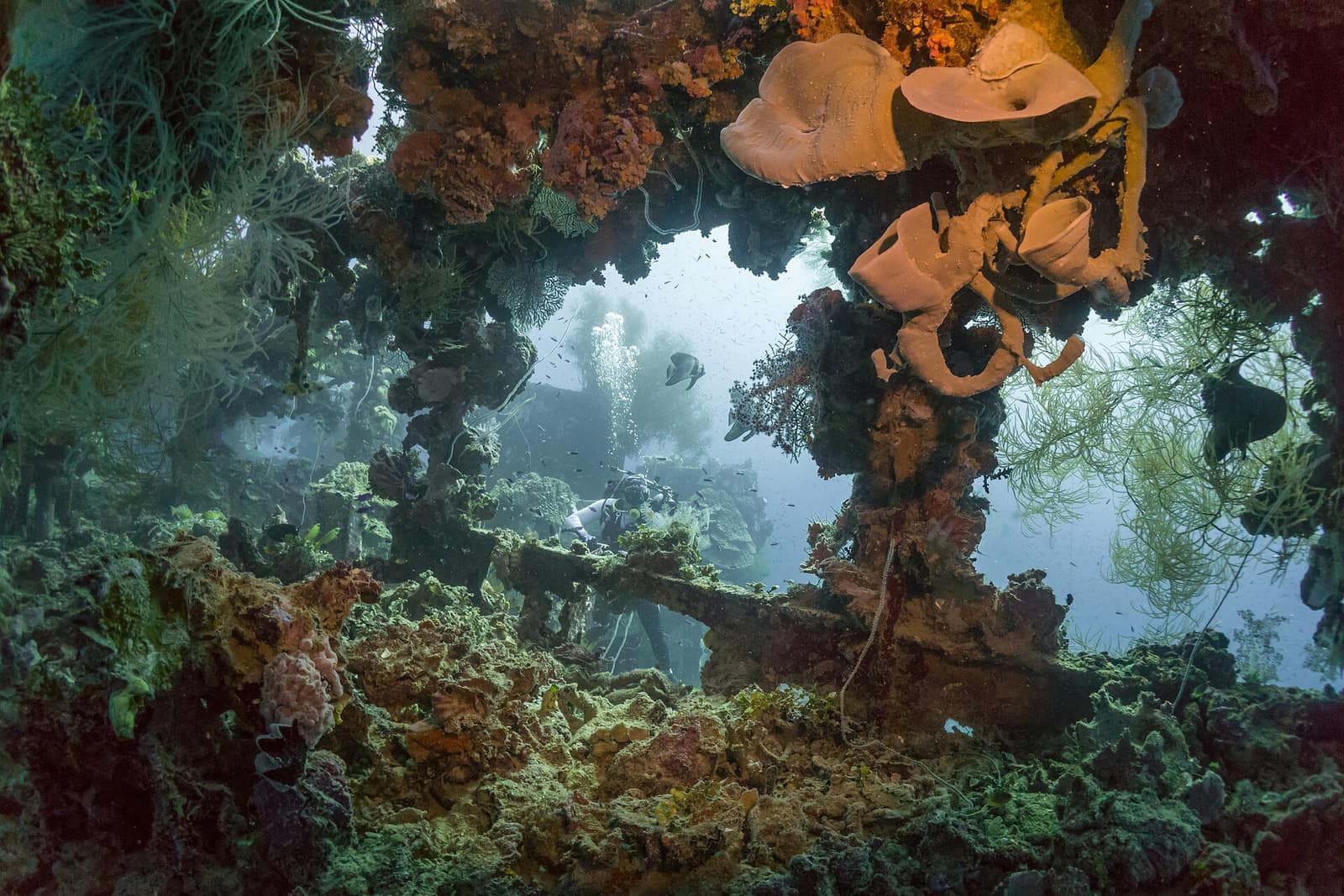
What sets her apart today is not the history alone, it is what the reef has done with her. Of all the wrecks in the Ghost Fleet, the Shinkoku Maru carries the most marine life. Her railings, masts and superstructure hang with pink, purple and orange soft coral, anemones sprawl across the plating, and gorgonian fans reach out from the shadows. You are diving a warship and a thriving artificial reef at the same time, and the contrast is the whole point of coming here.
What you will see
The Shinkoku is a photographer's wreck, generous with both wide scenes and macro detail. Move slowly and the superstructure reveals itself piece by piece.
The marine life is genuinely the draw here rather than a footnote, so give yourself time to hover and look.
- Dense soft-coral cover in pink, purple and orange across railings, masts and the bridge
- Large anemones with clownfish, plus giant clams set into the coral-crusted plating
- Gorgonian sea fans, sponges and clouds of reef fish over the decks
- Occasional spotted eagle rays and passing pelagics in open water off the hull
- The bridge: three telegraph annunciators, the compass binnacle and helm stand still in place
- The engine room, a multi-level maze of catwalks, ladders, generators and boilers
- A heavily coral-encrusted bow gun, almost unrecognisable under decades of growth
- Artefacts of daily life below decks, including a bathhouse, washrooms, and sake and beer bottles
A word on the medical room
The Shinkoku carries a somber, much-photographed feature: a medical space, often described as an operating theatre, with medical bottles and, by many accounts, human skeletal remains. Truk Lagoon is a designated war grave, and Chuuk law and diver etiquette are clear that remains and artefacts must be left exactly as they lie. Look, photograph respectfully if you choose to, and touch nothing. That respect is part of diving here properly, not an optional extra.
Conditions and who it is for
This is one of the more forgiving wrecks in the lagoon. She sits upright, currents are usually mild, and the shallow superstructure means a competent Advanced Open Water diver can enjoy the best of her without going deep. The bridge sits around 11 to 12 metres and the main decks between 15 and 20, so no-decompression bottom time is workable if you manage your depth.
Honesty matters on the deeper and interior sections. The propeller and lower hull run to around 40 metres, and the engine room is a true overhead environment entered through the bomb damage. Penetration here means silt, restrictions, tight multi-level navigation and, in places, unexploded ordnance to leave well alone. Reserve the interior for divers with proper wreck training, good buoyancy and a guide who knows the route. Nitrox is a real asset for extending your time in the 15 to 25 metre zone where most of the coral lives.
When to dive it
Truk Lagoon is diveable all year, with warm water sitting at 28 to 30 degrees Celsius no matter the month, so a 3mm suit and a hood for repetitive dives is usually plenty. The sweet spot is the dry season from roughly December to April, when the seas are calmest and visibility is at its best, commonly 20 to 30 metres.
In the wetter months, runoff and plankton can pull visibility back to 15 to 20 metres, though the trade-off is a more productive, food-rich lagoon. Currents on the Shinkoku are light year-round, so season is about clarity and surface comfort more than difficulty.
How you actually dive it
Truk Lagoon is remote, and the wrecks are scattered across a wide lagoon that day boats cannot cover efficiently. In practice this is liveaboard diving. You sleep over the wrecks, dive the Shinkoku across more than one visit, and fit in dawn or dusk slots when the soft corals are feeding and the light rakes across the superstructure.
Plan the Shinkoku as at least two dives. Spend the first working the exterior, the bridge and the coral gardens at 12 to 20 metres to build your orientation. Save the engine room and deeper hull for a second dive, ideally on nitrox with a guide, once you know the layout. She rewards a slow, repeat approach far more than a single rushed pass.
Faneca dives the Shinkoku Maru on our Truk Lagoon liveaboard itineraries, which sit over the Ghost Fleet so you can dive her more than once at the right light; enquire with our concierge for dates and cabin availability, and note that reaching Truk takes some planning, so book well ahead.
Shinkoku Maru: common questions
What is the best season to dive Shinkoku Maru?
December to April (dry season) for calmest seas and best visibility; diveable year-round
What experience level do I need for Shinkoku Maru?
Advanced Open Water for the wreck; interior penetration needs wreck training and experience
How deep is Shinkoku Maru?
11-12m at the bridge to ~40m at the propeller; main decks 15-20m
What marine life will I see at Shinkoku Maru?
Soft corals, anemones, gorgonian fans, sponges, giant clams, reef fish, occasional eagle rays and pelagics
