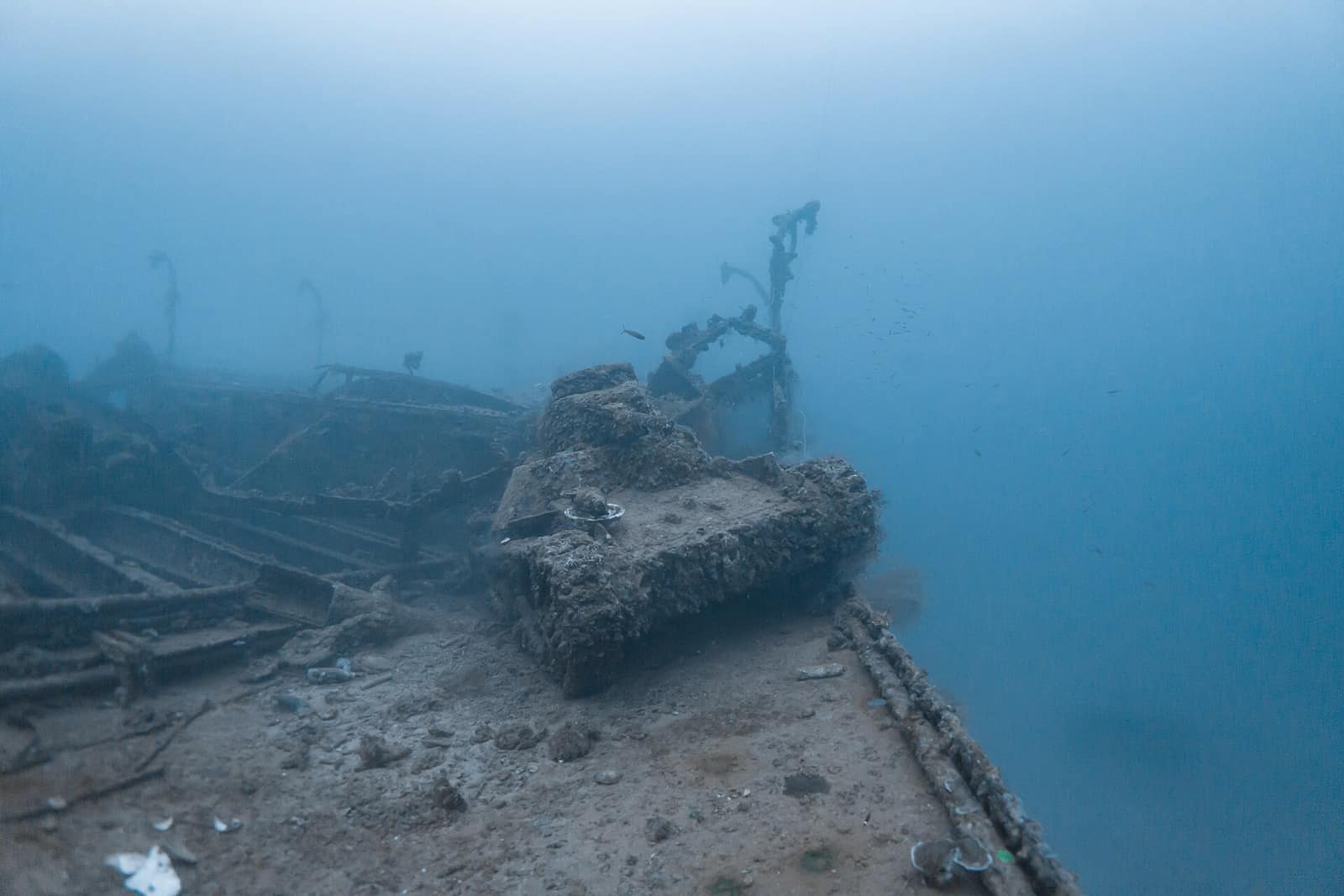
San Francisco Maru
Three battle tanks still stand on her foredeck, 50 metres down in the dark of Truk Lagoon.
The San Francisco Maru is the dive that pulls technical divers to the far side of the planet. She is the deepest of Truk Lagoon's great wrecks and the most heavily laden — a Japanese cargo ship sent to the bottom in February 1944 with tanks lashed to her deck and her holds packed with mines, torpedoes and aircraft bombs. Nicknamed the "million dollar wreck" for the value of her cargo and the "Ghost Ship" for the way she looms out of the gloom, she rewards the descent like no other wreck here. This is a deep, demanding trimix dive, usually done from a liveaboard, and it sits firmly on the short list of the finest wreck dives anywhere.
Quick answer: San Francisco Maru is a deep wwii cargo shipwreck in Truk Lagoon. Best season: December to April for the driest weather and clearest water. Level: Technical / trimix only — solid decompression experience essential. Depth: 34m at the masts, main deck around 50m, seabed 62-64m. Typical visibility: Typically 20-30m in the deep 4th Fleet Anchorage, occasionally more.
Facts verified September 2026
Why the San Francisco Maru is special
Most of Truk Lagoon's 50-odd wrecks sit within recreational range. The San Francisco Maru does not, and that is exactly why divers covet her. A 117-metre Kawasaki-built cargo ship of around 5,800 tons, she rests upright and largely intact on the sand at 62-64 metres, her main deck at about 50 and her masts reaching up to roughly 34. Everything worth seeing lies deep, in the low light of the lagoon's southern anchorage.
What sets her apart is the cargo. Where other wrecks were stripped or emptied, the San Francisco Maru went down fully loaded and stayed that way. She is a frozen supply dump: tanks on the foredeck, trucks and a steamroller in the sand, holds still stacked with the machinery of war. Jacques Cousteau filmed her in 1969 for his 'Lagoon of Lost Ships', and the wreck was formally identified in 1973 after divers recovered her bell. For a technical wreck diver, this is a pilgrimage.
What you'll see on the wreck
The signature sight comes early. On the foredeck sit three Mitsubishi Type 95 Ha-Go light tanks — two to starboard, tipped together by the blast, and a third off to port — with a truck chassis between them. Seeing armour still standing on a ship's deck at 50 metres is one of wreck diving's genuinely surreal moments. Below the port tank, out on the seabed, lies a large steamroller.
The holds are where the ship earns her 'million dollar' name. Move along the deck and you can look into cargo spaces still holding the tools of a Pacific war:
Every hold rewards a torch and a slow, deliberate look. Marine life here is honestly thin by Truk standards — this is a dive you make for the ship, not the fish — though you will find coral and sponge growth on the upper structure, clouds of glassfish, and the occasional grey reef shark or pelagic cruising the blue.
- Hold 1: hemispherical beach mines and boxed detonators
- Hold 2: tanker and flatbed trucks, aircraft parts and fuel drums
- Hold 3: a Type 94 truck
- Hold 4: depth charges, aircraft bombs, ammunition crates and Type 93 'Long Lance' torpedoes
The history: Operation Hailstone
The San Francisco Maru was built in 1919 and, by 1944, was working as a military transport moving supplies, ammunition and troops across Japan's Pacific holdings. In mid-February 1944 she lay at anchor in Truk, the Imperial Japanese Navy's great fortified lagoon base, loaded for the front.
On 17-18 February the US launched Operation Hailstone, a two-day carrier strike that gutted the anchorage. The San Francisco Maru was hit amidships by a 500lb bomb from a TBF Avenger off the USS Essex, took further hits to the starboard side and mast, and sank stern-first to settle upright on the sand, taking five of her crew with her. Diving her is a direct encounter with that morning — the reason to treat the wreck, and the ordnance still aboard, with respect.
Conditions and who it's for
Be clear-eyed about this one: the San Francisco Maru is a technical dive, full stop. With the deck at 50 metres and the best of the cargo deeper still, meaningful bottom time means trimix, staged decompression and the discipline to match. Narcosis and oxygen exposure at these depths are unforgiving, and the payload of live mines, bombs and torpedoes is a hard reminder to look and never touch. This is not a wreck to dive at the edge of your training.
The upside is that the environment itself is kind. Water sits at a steady 28-29°C from surface to seabed with no real thermocline, so a single exposure suit choice works top to bottom. The 4th Fleet Anchorage is sheltered, so current is usually light — an occasional gentle pull on descent rather than a fight. Visibility in this deeper southern part of the lagoon is generally the best Truk offers, commonly 20-30 metres. If you hold a sound technical certification and have real deep-deco experience, she is achievable and unforgettable; if you don't yet, she is the wreck to build towards.
When and how to dive her
Truk dives year-round, but the December-to-April dry season brings the calmest weather and clearest water, and that is when you want the deep 4th Fleet wrecks at their best. Even in the wetter months the lagoon is diveable — conditions are simply less predictable and rain can knock the visibility back.
Access is by boat only. Truk has no shore diving to speak of and the San Francisco Maru lies well out in the southern lagoon, so you reach her from a liveaboard or a day boat out of Weno. Because she is deep and best dived as part of a technical rotation, plan her into a multi-day trip rather than as a one-off. Most divers spend two or more dives on her — one to take in the tanks and forward holds, another for the stern cargo and seabed debris. Nitrogen and oxygen budgets, not curiosity, set the limit here, so pace the ship over several visits.
Faneca dives the San Francisco Maru on our Truk Lagoon liveaboard itineraries, which are built for divers qualified to run trimix on the lagoon's deep 4th Fleet wrecks; because this is a technical dive with real prerequisites and a seasonal weather window, talk to our concierge early about dates, gas and whether it fits your certification.
San Francisco Maru: common questions
What is the best season to dive San Francisco Maru?
December to April for the driest weather and clearest water
What experience level do I need for San Francisco Maru?
Technical / trimix only — solid decompression experience essential
How deep is San Francisco Maru?
34m at the masts, main deck around 50m, seabed 62-64m
What marine life will I see at San Francisco Maru?
Sparse for Truk — hard-coral encrustation, sponges, glassfish, reef fish, the odd grey reef shark passing
