Fujikawa Maru
The Fujikawa Maru is the wreck that turns first-time visitors into Truk Lagoon obsessives.
If you dive only one wreck in Truk Lagoon, most veterans will tell you to make it the Fujikawa Maru. She is the lagoon's most photographed and most loved shipwreck for good reason: a WWII aircraft transport sitting upright and largely intact, with dismantled Zero fighters still resting in her holds, a coral-encrusted bow gun, and soft-coral gardens draping her masts within easy reach of the surface. This guide covers what makes her special, what you will actually see, the conditions to expect, when to come, and how you dive her from a Truk Lagoon liveaboard.
Quick answer: Fujikawa Maru is a wwii shipwreck, sitting upright — reef-hook-free; combines easy exterior diving with optional overhead penetration in Truk Lagoon. Best season: December to April (dry season) for calmest seas and best visibility; diveable year-round, with lower prices in the wetter June–September months. Level: Advanced / experienced — deck and holds suit Advanced Open Water; engine room and deeper penetration need wreck/technical training. Depth: Masts/superstructure at 9m (30ft), main deck at 18m (60ft), seabed at 30–34m (100–112ft). Typical visibility: Typically 12–30m (40–100ft), best in the dry season; interior silt can drop it fast.
Facts verified September 2026
Why the Fujikawa Maru is Truk Lagoon's signature wreck
Both of the historians who comprehensively surveyed the lagoon — Dan E. Bailey and Klaus Lindemann — rated the Fujikawa Maru the finest dive in Truk, and eight decades of divers have agreed. She was a 6,938-ton refrigerated cargo ship built by Mitsubishi in Nagasaki in 1938, requisitioned by the Imperial Japanese Navy in 1940 and pressed into service as an armed aircraft transport. She survived a torpedo from the submarine USS Permit in September 1943, but during Operation Hailstone — the devastating US carrier raid of 17–18 February 1944 — she was hit repeatedly by bombers and torpedo planes and went down on the morning of the 18th.
What sets her apart is the combination of intactness, accessibility and life. She sits upright and proud on her keel, so orientation is intuitive. The most compelling features sit shallow enough that you get long, unhurried bottom time, and the marine growth is genuinely beautiful rather than an afterthought. She is a history dive and a photography dive at the same time, which is rare.
What you'll see on the wreck
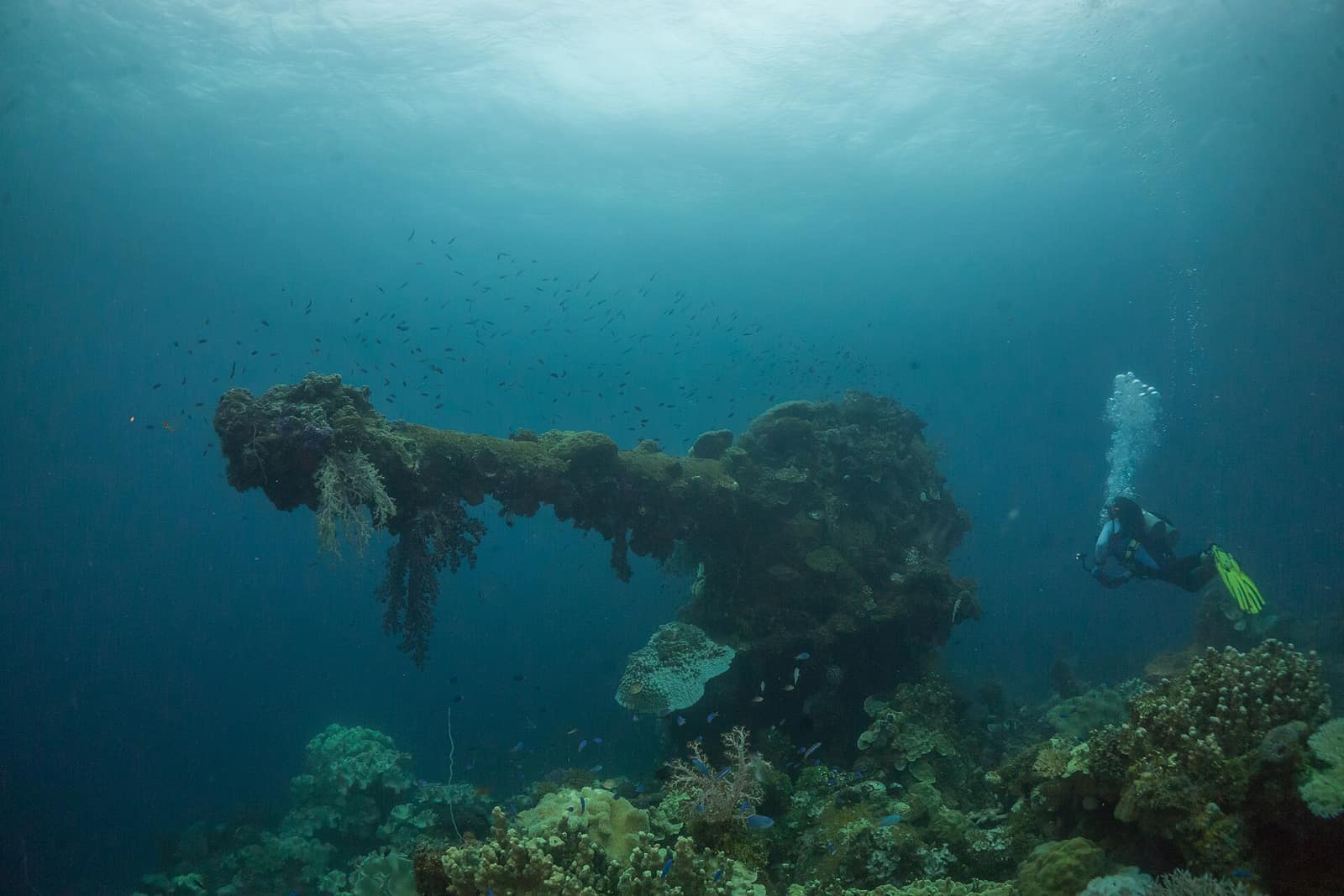
The headline attraction is Hold 2, where at least nine disassembled Mitsubishi fighters were being ferried when she sank — eight A6M Zeros and one A5M Claude, believed to be the only surviving example of its type anywhere. Fuselages, wings and radial engines lie stacked in the gloom, unmistakable once your eyes adjust. Forward, the coral-clad six-inch bow gun (an Elswick piece dating to 1899) points out over the reef and is one of the most photographed objects in the Pacific.
The wreck has become its own reef. Expect these encounters and features:
- Pink and white soft corals, sponges and anemones smothering the masts and kingposts near the surface
- A resident barracuda that often hangs over the bow gun, plus schooling baitfish, tuna, lionfish and the occasional turtle
- The famous 'R2D2' — an upright air compressor in the machine shop that genuinely resembles the droid
- The engine room's telegraph, gauges and catwalks, deeper in the hull
- Scattered wartime artifacts — bottles, plates, gas masks, boots and brass lamps — that should be looked at and left in place
Conditions and who it's for
Inside the sheltered lagoon the water is warm year-round, around 28–30°C (82–86°F), and current is usually light to negligible — a welcome change from the drift diving many wreck fans are used to. Visibility typically runs 12–30m (40–100ft), best in the dry season and worst after heavy rain or when a lot of fins have stirred the interior silt.
The exterior of the Fujikawa Maru is one of the more forgiving big wrecks anywhere: the coral-covered masts start around 9m and the main deck sits near 18m, so a competent Advanced Open Water diver enjoying good buoyancy will get a superb dive without going deep. The caveat is honest and important — the moment you move inside, this becomes overhead-environment diving. The holds, machine shop and especially the engine room involve penetration, restrictions and silt that can black out visibility instantly. Those deeper interior spaces are the domain of divers with wreck or technical training, proper lights and, ideally, a guide who knows the route. Nitrox is strongly recommended to extend your time in the 18–30m range.
When to dive it
Truk Lagoon is diveable all year, but the dry season from December to April brings the calmest seas, clearest skies and the most reliable visibility — the pick of the calendar. The wetter months from roughly June to September see frequent rain and slightly reduced clarity, though the diving stays good and liveaboard fares tend to soften, which suits budget-minded travellers who don't mind a passing squall.
Because conditions are stable and the water stays warm across the seasons, your choice is really about sea state, visibility and price rather than whether the wreck is worth diving. She always is.
How you actually dive the Fujikawa Maru
Truk Lagoon is a liveaboard destination first and foremost. The wrecks are scattered across a vast lagoon and the best way to dive the Fujikawa Maru properly — often two or three times across a trip, at different depths and light — is from a boat moored nearby rather than in a single rushed day-trip. A typical plan is a shallow exterior and mast dive to take in the coral and the bow gun, then a separate, better-briefed dive dedicated to Hold 2's aircraft and, for suitably qualified divers, the machine shop and engine room.
Come with solid buoyancy, a primary light and a backup even for daylight dives, and the discipline to hang back and let silt settle. Treat every artifact as a war grave marker — this is a protected site and nothing should be moved or removed. Plan conservative profiles: it is easy to spend the whole dive around 18–24m, so watch your no-deco time and gas, and build in a proper safety stop on the shallow, coral-rich rigging where the marine life is thickest anyway.
Faneca dives the Fujikawa Maru on our Truk Lagoon liveaboard itineraries, which are the practical way to reach and repeat-dive the Ghost Fleet; access is seasonal-friendly but the lagoon is remote, so talk to our concierge about dates and the best months before you plan flights.
Fujikawa Maru: common questions
What is the best season to dive Fujikawa Maru?
December to April (dry season) for calmest seas and best visibility; diveable year-round, with lower prices in the wetter June–September months
What experience level do I need for Fujikawa Maru?
Advanced / experienced — deck and holds suit Advanced Open Water; engine room and deeper penetration need wreck/technical training
How deep is Fujikawa Maru?
Masts/superstructure at 9m (30ft), main deck at 18m (60ft), seabed at 30–34m (100–112ft)
What marine life will I see at Fujikawa Maru?
Pink and white soft corals, sponges and anemones, hard coral on the masts, reef fish, schooling baitfish and tuna, a resident barracuda often over the bow gun, turtles and lionfish
