Nippo Maru
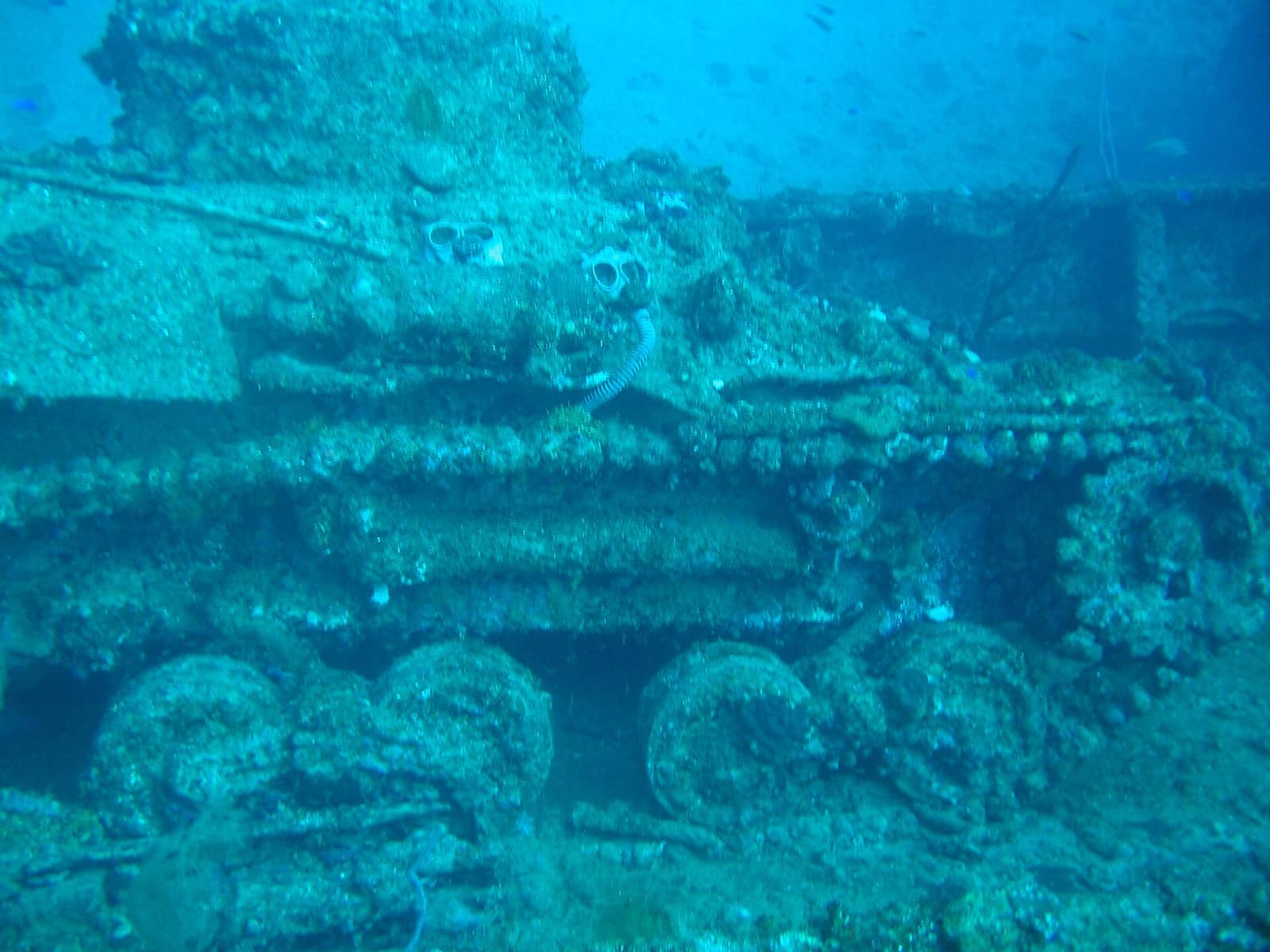
A Japanese light tank still sits on the deck, turret pointed into the blue.
Of all the ships resting in Truk Lagoon, the Nippo Maru is the one divers remember by a single image: a battle tank parked on the main deck at 30 metres, exactly where it was lashed down the day the bombs found her. This is deep, deliberate wreck diving on one of the best-preserved war graves in the Pacific, and it rewards patience over adrenaline. Here is what you need to know before you drop the line on the Nippo Maru.
Quick answer: Nippo Maru is a wreck (wwii shipwreck), decompression-friendly for suitably trained divers in Truk Lagoon. Best season: December to April (dry season) for the calmest seas and best visibility. Level: Advanced. Deep, and the signature features sit at 30m+; some overhead penetration. Depth: Shallowest structure ~21m, main deck ~30m, seabed 42–47m (upright, listing to port). Typical visibility: Typically 15–30m, occasionally more in the dry months.
Facts verified September 2026
Why the Nippo Maru is a Truk Lagoon standout
Truk Lagoon holds more than 40 diveable wrecks, the sunken remains of Japan's forward naval base destroyed over two days of Operation Hailstone in February 1944. On paper the Nippo Maru is one auxiliary vessel among many. In the water she is one of the most photographed wrecks in the lagoon, and for good reason.
She was a 108-metre steam-turbine ship, built at Kawasaki in Kobe and launched in 1936, requisitioned as an auxiliary water tanker and transport. On 17 February 1944, the first day of Hailstone, American carrier aircraft hit her with 500lb bombs; she sank in the early hours of 18 February. Today she sits upright with a pronounced list to port, her cargo of war frozen in place. The deck tank, the coastal-defence gun barrels, the mines and rangefinders in her holds, the intact wheelhouse — the Nippo Maru is a wreck that still reads clearly as a warship, not a collapsed pile of steel.
What you'll see on the wreck
The Nippo Maru is nicknamed the "tank wreck," and the tank earns it. A Japanese light tank (commonly identified as a Type 95 Ha-Go) sits on the main deck near Hold No. 2 at around 30 metres, turret and hull unmistakable despite decades of growth. It is the shot every diver comes for, and it deserves a full, unhurried pass.
Beyond the tank, the holds are an armoury. Hemispherical mines, artillery shells, gun mounts and cannon barrels, gas masks, small-arms ammunition and large bronze rangefinders are all still visible where they were stowed. Look for the rows of silt-covered beer and sake bottles in the aft holds — an oddly human detail among the ordnance.
The wheelhouse is a highlight in its own right. The ship's telegraph, helm and compass binnacle remain in place, and the bridge and crew areas offer good, relatively open penetration for divers with the training and light to do it properly.
- Type 95-class Japanese light tank on the main deck at ~30m — the signature feature
- Holds packed with mines, shells, gun barrels, gas masks and bronze rangefinders
- Intact wheelhouse: engine telegraph, helm and compass
- Aft holds full of beer and sake bottles
- Coral and sponge growth, glassfish and jacks sheltering in the structure
Marine life on a war grave
The wrecks of Truk have become artificial reefs, and the Nippo Maru is well colonised. Hard and soft corals, sponges and hydroids cover the railings and masts, with clouds of glassfish and schooling jacks moving through the holds and swim-throughs. You will find lionfish tucked into the shadows, nudibranchs on the coral-crusted steel, and the usual reef fish patrolling the decks.
Bigger animals are occasional rather than guaranteed. Grey reef sharks and eagle rays pass through the lagoon, and you may catch one cruising the blue off the wreck, but you come to the Nippo Maru for the ship and its cargo first — the marine life is the atmosphere, not the headline.
Conditions and who it's for
This is an advanced dive. The features that make the Nippo Maru special — the tank, the wheelhouse, the holds — all sit at 30 metres and deeper, with the seabed at 42 to 47 metres, so meaningful bottom time here means nitrox at minimum and often light decompression. If your Truk trip is your first taste of deep wreck diving, treat the shallower ships in the lagoon as your warm-up and build into this one.
The good news is that conditions are usually kind. Sheltered inside the lagoon, the Nippo Maru sees little to no current on most days, and the water is a comfortable 27–30°C year-round — a 3mm suit is plenty, though many divers add a hood and gloves for repetitive deep days. Penetration is genuinely rewarding here, but it is an overhead environment: proper wreck training, redundant gas and lights, and a guide who knows the ship are non-negotiable if you go inside.
When to dive it, and how you actually get there
Truk can be dived year-round, but the dry season from December to April brings the calmest surface conditions and the best visibility, typically 15–30 metres and sometimes more. The wet season still dives well; you simply trade a little visibility and comfort for fewer boats in the water.
Most visitors dive Truk by liveaboard, though land-based day boats from Weno also reach all the major wrecks. You fly into Chuuk International Airport on Weno, board the boat, and dive the ghost fleet across a week or more, with the Nippo Maru scheduled as one of the marquee stops. Because everything sits at depth, most operators run a nitrox-and-computer, multi-level rhythm with generous surface intervals rather than a punishing dive count.
Faneca dives the Nippo Maru as part of our Truk Lagoon liveaboard itineraries, the only practical way to reach the ghost fleet — dates are limited and the deep wrecks suit experienced divers, so speak with our concierge about seasons and the right trip for your certification.
Nippo Maru: common questions
What is the best season to dive Nippo Maru?
December to April (dry season) for the calmest seas and best visibility
What experience level do I need for Nippo Maru?
Advanced. Deep, and the signature features sit at 30m+; some overhead penetration
How deep is Nippo Maru?
Shallowest structure ~21m, main deck ~30m, seabed 42–47m (upright, listing to port)
What marine life will I see at Nippo Maru?
Glassfish and jacks in the holds, hard and soft coral growth, lionfish, nudibranchs, occasional grey reef sharks and eagle rays passing
