When to Dive Cocos Island: Wet Season, Dry Season and the Hammerhead Math
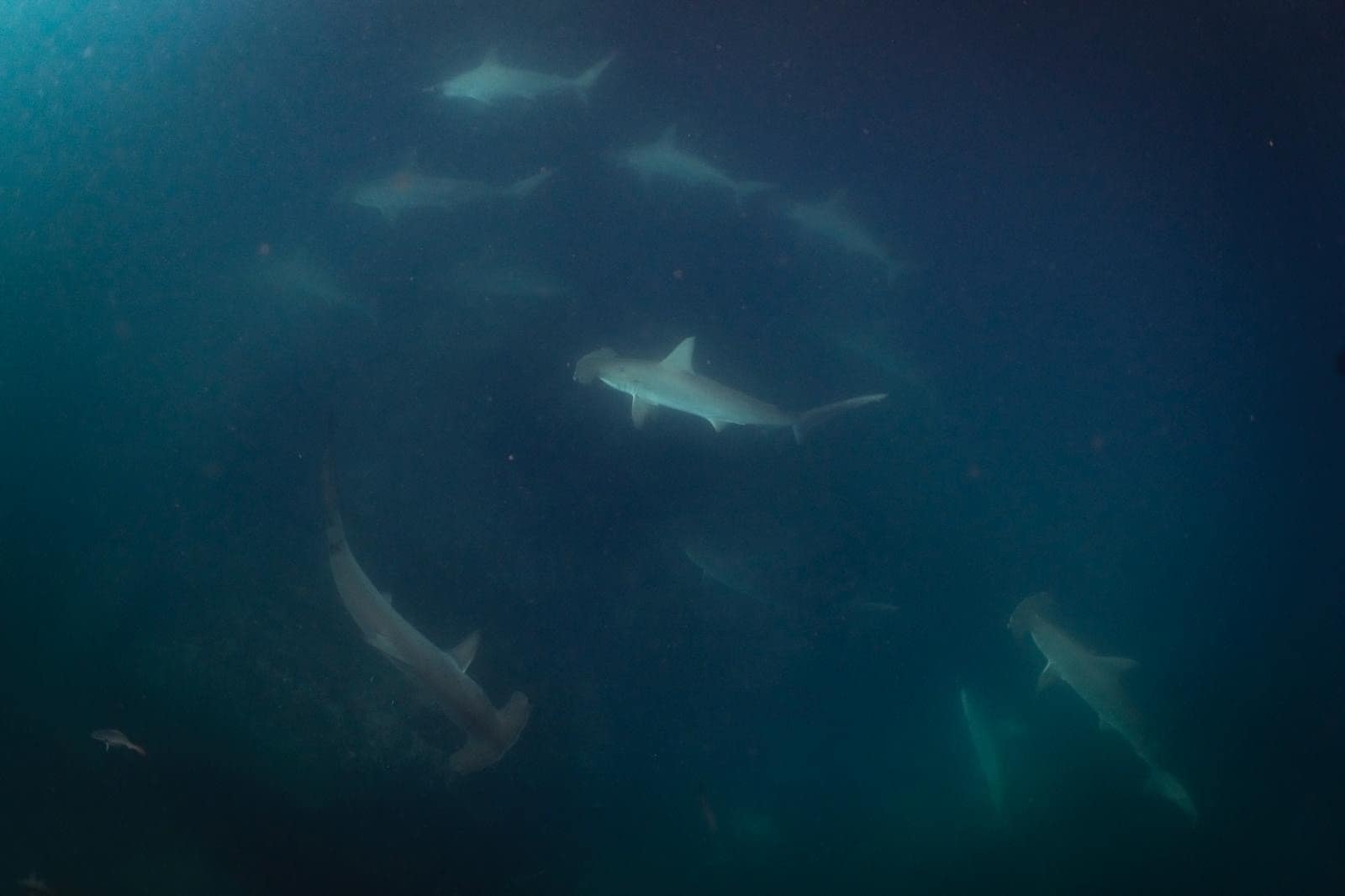
Every Cocos Island conversation eventually arrives at the same question: do you want the biggest hammerhead schools, or the most comfortable trip? You rarely get both. Cocos sits 550 km off the Pacific coast of Costa Rica, and the same weather systems that stack scalloped hammerheads hundreds-deep over its seamounts also churn up the crossing and drop the visibility. Understanding that trade-off — what we call the hammerhead math — is the whole game when picking your dates.
Here is the honest version, month by month, with the crossing described as it actually is.
The Two Seasons, in One Paragraph Each
Wet season (June–November). Rain, nutrient-rich upwellings, stronger currents, visibility that can drop to 10–15 m — and the largest scalloped hammerhead aggregations in the Eastern Pacific. This is when schools of 100–200+ animals stack up over Bajo Alcyone, when whale sharks pass through, and when Cocos earns its reputation. The price: a rougher 32–36 hour crossing and more demanding diving.
Dry season (December–May). Calmer seas, gentler currents, visibility stretching to 25–30 m, warmer water. Hammerheads are still present — this is a resident population, not a migration that leaves — but in smaller, steadier groups of a dozen to a few dozen rather than wet-season walls. Silky sharks and mobula rays are more prominent, tiger sharks appear year-round, and the crossing is far kinder.
Neither season is "wrong." They are different products at the same price, which is exactly why you should choose deliberately.
The Hammerhead Math
Scalloped hammerheads live at Cocos year-round. What changes with the seasons is aggregation behavior. During the wet season, upwellings push cold, nutrient-dense water up the flanks of the seamounts. That drives the food chain, and it drives the hammerheads to gather in enormous schools above cleaning stations at sites like Bajo Alcyone and Dirty Rock, where barberfish and king angelfish pick parasites off them.
So the math works like this:
- June–November: highest probability of the 100+ shark walls. Peak density typically July–September. Trade-off: visibility of 10–20 m, stronger currents, surge, and the roughest crossings of the year.
- December–May: near-certain hammerhead sightings on most dives, but in groups of 10–40 rather than uncountable schools. Trade-off in your favor: 20–30 m visibility, so you see the sharks you do get far more clearly.
There is a quiet irony worth stating plainly: in August you might hang in green 12 m visibility while 200 hammerheads pass just at the edge of sight, and in February you might watch 25 of them in crystal water from 30 m away. Some divers genuinely prefer the second experience. If you have already seen big schools elsewhere — or if underwater photography in clean water matters more to you than raw numbers — the dry season is arguably the better trip. Our hammerhead sightings page tracks what recent guests actually reported, season by season, and it backs this pattern up.
Month by Month
- December: transition month. Seas begin to calm, visibility improves, and early-December trips sometimes still catch large leftover schools from the wet season. A sleeper pick.
- January–March: classic dry season. Calmest crossings of the year, visibility at its best (25–30 m), water 26–29°C at the surface. Steady hammerheads, silkies in numbers, big mobula aggregations. Ideal for first-timers and photographers.
- April–May: late dry season sliding toward wet. Conditions still comfortable; hammerhead numbers begin building. May is a good-value compromise month.
- June–July: the wet season proper begins. Schools grow fast, whale shark odds climb, and the crossing gets noticeably lumpier. June often still offers reasonable seas — many experienced Cocos hands call June and early July the smart compromise between shark action and comfort.
- August–September: peak everything. The biggest hammerhead schools of the year, the best whale shark odds (June–October, peaking here), and the roughest, wettest crossings. These are also the most in-demand departures on the calendar.
- October–November: schools remain impressive while seas gradually settle. November in particular is underrated — still-large aggregations with improving conditions. If you want one trip with the best blended odds, November deserves a hard look.
What the Crossing Is Actually Like
No one flies to Cocos. Every trip starts in Puntarenas with a 32–36 hour open-ocean crossing each way, and any honest write-up has to spend a paragraph on it because it shapes the whole experience.
In the dry season, crossings are usually gentle — long Pacific swell, most guests reading on deck by hour six. In the wet season, especially July through September, you should expect real motion: beam swells, rain squalls, and stretches where the saloon empties out. The boats are large and seaworthy; this is about comfort, not safety.
Practical, non-negotiable advice for wet-season crossings:
- Start seasickness medication before departure, not after you feel ill. Whatever works for you on other boats, bring double.
- Book a midship or lower-deck cabin if you know you are susceptible — motion is meaningfully less there.
- Plan nothing for the evening you arrive back in port. Two 36-hour crossings inside a 10-day trip take something out of everyone.
If reading that paragraph made your stomach tighten, that is useful information: book December–May, or consider whether a land-based hammerhead destination suits you better. Cocos is a committed trip, and it should not be your first liveaboard if rough open water genuinely frightens you.
Water Temperature and What to Wear
Surface temperatures run roughly 26–29°C in the dry season and 24–27°C in the wet season — pleasant either way. The number that matters is below the surface. Thermoclines at the seamounts can drop the temperature to 20–23°C, occasionally lower, and you will spend long minutes hanging motionless at 25–30 m waiting on hammerheads, which is exactly when you get cold.
The standard Cocos kit, any month of the year:
- 5 mm full wetsuit minimum; many regulars add a hooded vest
- Gloves are required at most sites for holding position on barnacle-covered rock in current
- A reef hook is not used here — you brace by hand — so tough gloves matter more than usual
- Surface marker buoy and an electronic signalling device: non-negotiable on any Eastern Pacific seamount diving
Wet-season currents are stronger and less predictable. You should be genuinely comfortable with negative entries, blue-water descents, and holding position in 1–2 knot current. Most operators sensibly require Advanced certification and 50+ logged dives, and wet-season trips are not the place to round that number up optimistically.
How Far Ahead Each Season Sells Out
Cocos capacity is tiny — a small handful of liveaboards, each carrying roughly 18–22 guests, with the island's national park status capping any expansion. That scarcity shapes the booking timeline:
- August–September (peak wet season): the first departures to go. Realistically you are booking 12–18 months out for a choice of cabins; late availability is usually a single upper-deck twin someone released.
- June–July and October–November: 9–12 months ahead for good options.
- December–May (dry season): more forgiving — 6–9 months typically works, and shoulder-month gaps occasionally appear 3–4 months out, especially in April and May.
Trips run 8–10 nights and start around US$5,400–6,500 per person before the park fee (roughly US$490–550) and nitrox. There is no budget route to Cocos, and a suspiciously cheap offer is a reason to ask questions, not celebrate. Our live departure calendar shows which Cocos dates currently have space, which is the fastest way to sanity-check whether your preferred month is still realistic.
Who Should Book Which Season — and Who Should Skip Cocos
Book the wet season if: the giant schools are the whole point, you have 50+ dives with real current experience, and you can accept a rough crossing and 12–20 m visibility as the cost of admission.
Book the dry season if: this is your first Cocos trip or first big-animal liveaboard, you shoot photo or video and visibility matters, or anyone in your party is seasickness-prone. You will still see hammerheads on nearly every dive — just not in walls.
Skip Cocos entirely if: you have fewer than 50 dives, you dislike deep blue-water diving, you need warm easy conditions, or 72 hours of your holiday spent in transit at sea sounds unbearable. There are easier places to see your first hammerhead, and pretending otherwise would be doing you no favors. Read up on what diving Cocos demands before committing.
If you are weighing a specific month against your experience level, budget, or a partner's tolerance for swell, that judgment call is exactly what our concierge exists for — we have put divers on these boats in both seasons and will tell you straight which departure fits, including when the answer is "wait a year and build more current experience first."
The short version of the hammerhead math: wet season buys shark density with comfort, dry season buys comfort with density. Decide which currency you would rather spend, book early, and Cocos will hold up its end either way.
Related Guides
Related Articles
%20-%20Large.jpg&w=828&q=75)
Best Time to Dive: A Season-by-Season Guide
When to visit the world's top liveaboard destinations for the best conditions and marine life encounters.
Galápagos Diving: What to Expect on Your First Trip
Hammerhead highways, curious sea lions, and currents that demand respect — here's what awaits in the enchanted islands.