Bajo Alcyone
The submerged seamount where hammerheads gather by the hundred.
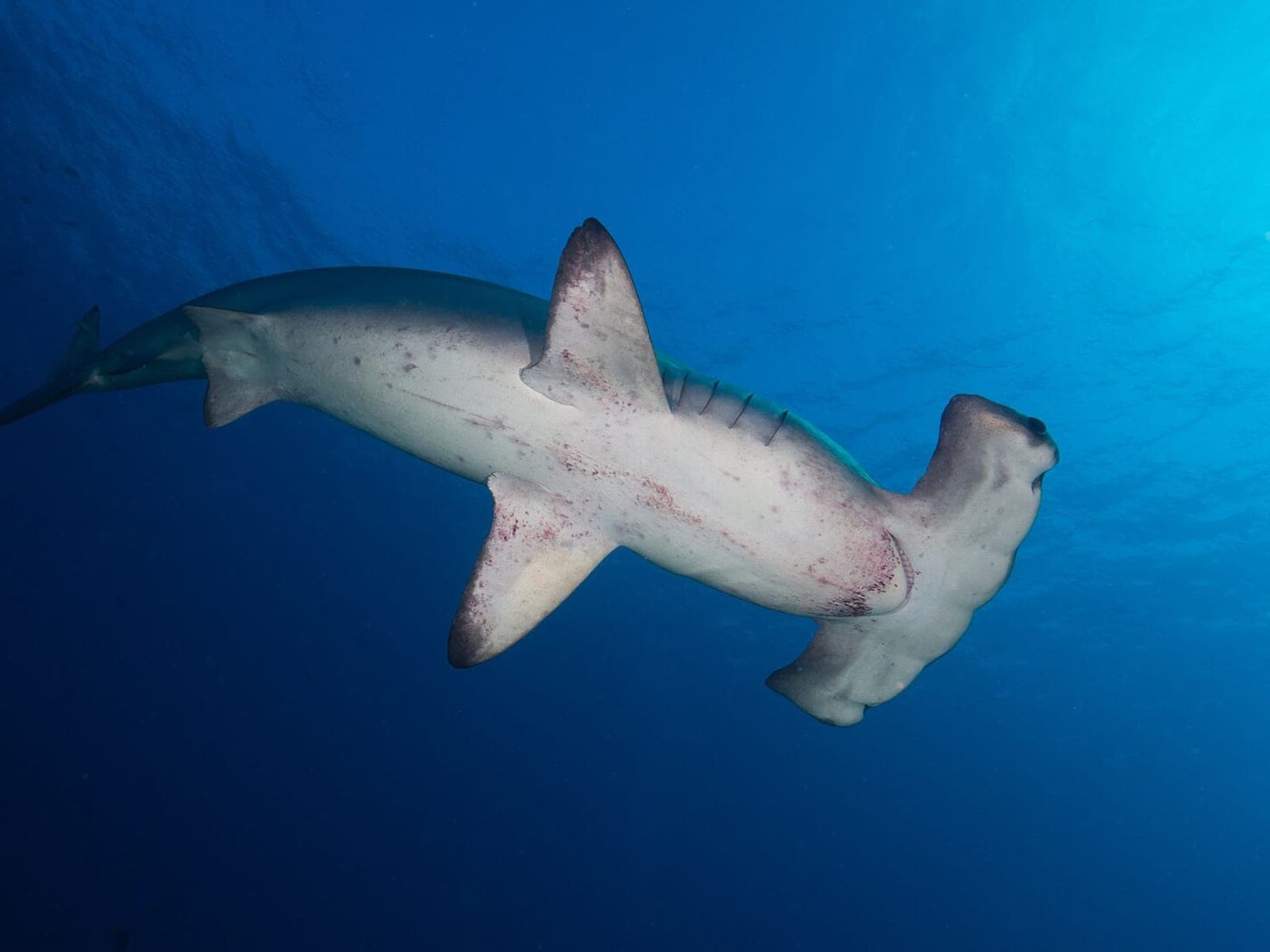
Ask any diver who has been to Cocos Island what they came for, and sooner or later the conversation lands on Bajo Alcyone. This is the site that made the island a pilgrimage. A seamount rising alone from deep blue water more than a kilometre off the coast, its summit somewhere around 25 to 27 metres, Bajo Alcyone is where scalloped hammerheads stack into schools so dense they blot out the surface. Diving Bajo Alcyone is not a gentle reef cruise, and it is not for everyone. But when the current runs and the sharks come in off the blue, there is very little in the ocean that compares.
Quick answer: Bajo Alcyone is an offshore pinnacle / submerged seamount (negative-entry, hook-and-hold) in Cocos Island. Best season: June–November (rainy season) for peak hammerhead schools; December–May for clearer water. Level: Advanced — logged experience in current and depth required. Depth: Summit ~25–27 m; working depth 30 m, seamount drops to 40 m+. Typical visibility: Roughly 15–25 m in the green wet season, occasionally 30 m+ in the dry season.
Facts verified September 2026
Why Bajo Alcyone is Cocos Island's most famous dive
Bajo Alcyone was found and named by the crew of Jacques Cousteau's expedition vessel Alcyone, and the name has carried the site's reputation ever since. It is a seamount — an underwater mountain that never breaks the surface — sitting alone in open water off the eastern flank of Cocos Island. That isolation is the whole point. With no shallow reef and nothing but blue on every side, the summit acts as a magnet and a cleaning station for big pelagic animals moving through the Eastern Tropical Pacific.
What draws divers back year after year is the hammerhead spectacle. On the right day, scalloped hammerheads gather here not in tens but in hundreds, hanging above the rock in a slow, wheeling wall that extends beyond visibility. You settle onto the reef, tuck in behind an outcrop out of the current, and watch the show unfold overhead. It is one of the defining big-animal dives on the planet, and it is the single biggest reason a Cocos Island liveaboard sells out a year ahead.
What you'll see at Bajo Alcyone
The headline act is the scalloped hammerhead, but Bajo Alcyone is a genuine pelagic crossroads and the supporting cast is enormous. The seamount's summit is carpeted in life, and the water column above it is rarely empty.
- Scalloped hammerhead sharks — the main event, in schools of hundreds during the wet season
- Whitetip reef sharks resting on and patrolling the rock, often in large numbers
- Silky sharks and the occasional oceanic blacktip cruising the blue
- Marble rays, eagle rays and mobula rays; mantas on the best days
- Big schools of jacks and yellowfin tuna balling up over the summit
- Green and hawksbill turtles, moray eels, octopus and the endemic Cocos barnacle blenny
- Seasonal whale sharks, plus bottlenose dolphins that sometimes buzz the site
Conditions and who Bajo Alcyone diving is for
Let's be honest about this one: Bajo Alcyone is an advanced dive and the conditions deserve respect. Because the seamount is fully exposed in open ocean, current is a constant — often mild to moderate, sometimes strong enough to make the descent a firm-grip affair. You almost always go down a shot or anchor line rather than free-descending into the blue, and once on the reef you use the rock and a reef hook to hold position rather than fighting the flow. Getting swept off the summit into open water is the real hazard here, so staying close to the line and to your guide matters.
Depth adds to the demand. The summit sits around 25 to 27 metres and most of the action plays out between there and 30 metres, which eats into your no-decompression time quickly and makes solid air management and buoyancy essential. Surface conditions can be lumpy, and the wet-season water is often green and cool with thermoclines. This is not a first-week-of-diving site. You want a comfortable stack of dives in current and at depth, ideally a nitrox certification, and the composure to stay calm when a lot is happening at once. For the right diver, none of that is a deterrent — it is simply the price of admission to one of the great shark dives.
When to dive Bajo Alcyone
Cocos has two faces. The rainy season, roughly June through November, is prime time for hammerheads: warmer, greener, plankton-rich water pulls the big schools in, and this is when the wall-of-sharks images are made. The trade-off is more surface weather, cooler thermoclines and visibility that typically runs 15 to 25 metres rather than gin-clear.
The dry season, December through May, brings calmer crossings and clearer water — visibility can push past 30 metres — along with a strong chance of whale sharks and mantas, though hammerhead numbers are often lower than at peak. There is no bad time to dive Bajo Alcyone, but pick your season around what you most want to see: raw hammerhead density in the green months, or clarity and a broader pelagic mix in the blue ones.
How you actually dive it
Every Bajo Alcyone dive is run from a liveaboard tender. You'll do a negative entry — deflate and go straight down — to get below the surface current fast, then follow the anchor line down to the summit. Once there, the pattern is to find a spot on or behind the reef, get low, minimise your profile and settle in to watch. Guides position groups to keep the hammerheads relaxed, so calm, still divers see far more than those swimming around chasing them. Reef hooks are commonly used to hold position hands-free while you watch the blue.
Dives are typically kept to a sensible time given the depth, with a blue-water ascent and safety stop that can itself deliver silky sharks or a passing manta. Expect to dive Bajo Alcyone more than once across a Cocos itinerary — conditions and shark activity vary day to day, and repeat dives are how you catch it on its best behaviour.
Faneca dives Bajo Alcyone as the centrepiece of our Cocos Island liveaboard expeditions — the site sits more than 550 km offshore and can only be reached by boat, so this is one to experience over a multi-day itinerary rather than a single dive; enquire with our concierge for dates and vessel options.
Bajo Alcyone: common questions
What is the best season to dive Bajo Alcyone?
June–November (rainy season) for peak hammerhead schools; December–May for clearer water
What experience level do I need for Bajo Alcyone?
Advanced — logged experience in current and depth required
How deep is Bajo Alcyone?
Summit ~25–27 m; working depth 30 m, seamount drops to 40 m+
What marine life will I see at Bajo Alcyone?
Scalloped hammerheads in the hundreds, whitetip reef sharks, silky sharks, marble & eagle rays, jacks, yellowfin tuna, dolphins; seasonal whale sharks & mantas