Dirty Rock
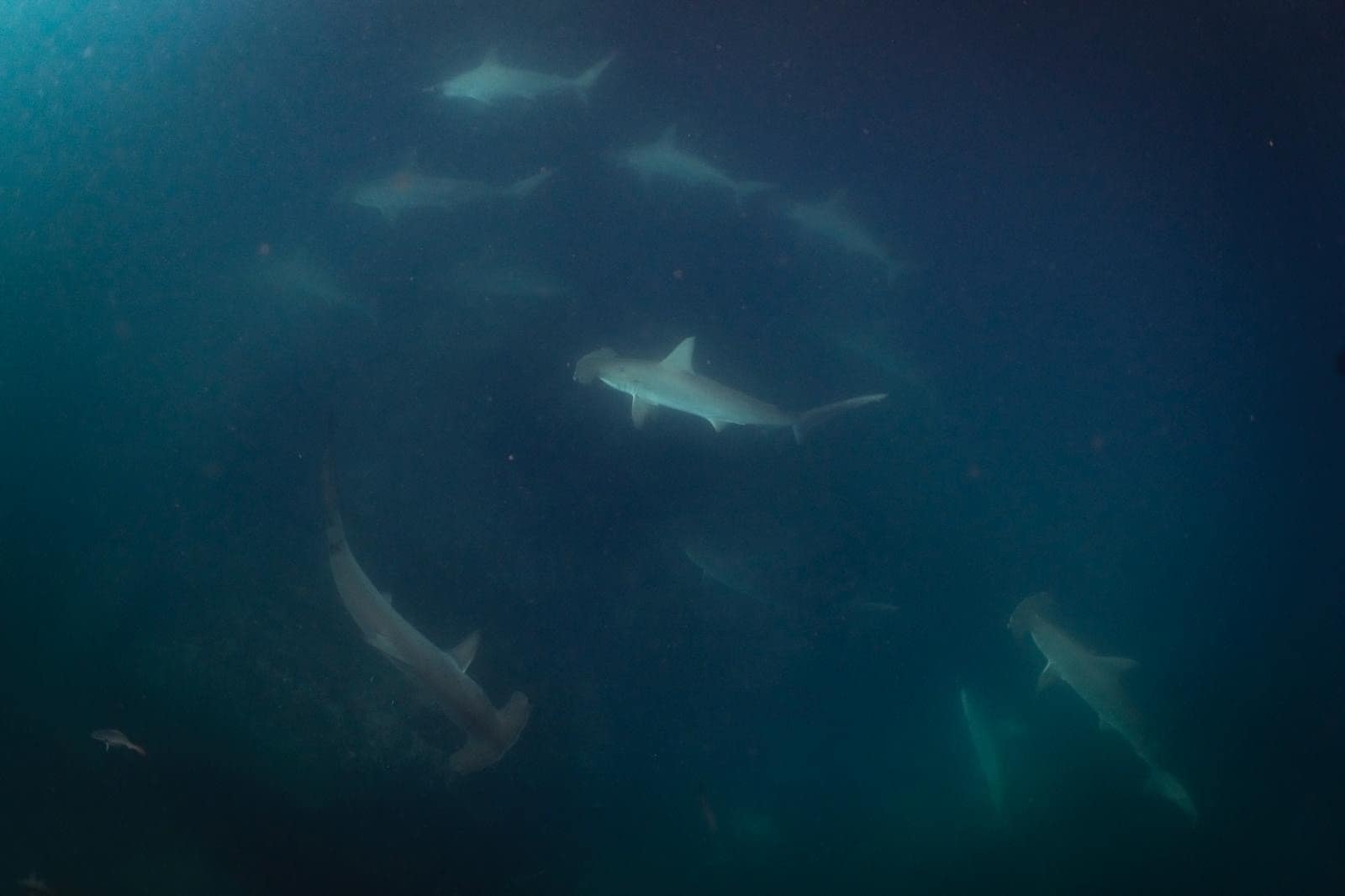
Get low, stay still, and wait for the wall of hammerheads to come to you.
Dirty Rock is the dive that put Cocos Island on the bucket list of every serious shark diver. A guano-streaked pinnacle rising off the island's northwest coast, it hosts one of the planet's great gatherings of scalloped hammerheads — schools that can number in the hundreds sweeping through the blue over the cleaning stations. This is remote, current-swept, big-animal diving reached only by liveaboard, and it rewards patience, good buoyancy and a cool head far more than it rewards effort.
Quick answer: Dirty Rock is an offshore pinnacle / rock formation with cleaning stations, a small cave and swim-through terrain in Cocos Island. Best season: June–November for the biggest hammerhead schools (peak August–October); December–April for best visibility and gentler current. Level: Advanced — logged experience in current and deep multilevel diving required; AOWD/Nitrox strongly recommended. Depth: 6 m at the top of the rock down to 30–39 m; most action sits around 27–30 m. Typical visibility: 20–30 m in the dry season; 10–25 m in the greener, nutrient-rich wet season.
Facts verified September 2026
Why Dirty Rock is the signature Cocos Island dive
Cocos Island has a handful of world-class sites, but Dirty Rock is the one most divers picture when they think of the place. The name is unglamorous and honest — the exposed rock is streaked brown and white from generations of seabirds — but what happens underneath it is anything but. This is a cleaning station on a grand scale, where scalloped hammerheads queue up to have parasites picked off by barberfish and king angelfish, and where you can genuinely find yourself surrounded by more sharks than you can count in a single glance.
The site is a cluster of rock rising from the northwest side of the island, with a main pinnacle, boulder fields, a small cave and enough structure to shelter behind while the current does its work overhead. On a good day a single dive here delivers hundreds of hammerheads passing within a few metres — the kind of encounter that has made this liveaboard-only outpost a pilgrimage for shark divers for decades.
What you'll see
Hammerheads are the headline, but Dirty Rock is one of the busiest sites at Cocos precisely because so much else moves through it. The cleaning stations and the boulder terrain hold life at every level of the water column.
- Scalloped hammerheads — the main event, schooling by the dozens to several hundred, densest in the wet season
- Whitetip reef sharks resting on the rocks and hunting in packs after dark
- Galapagos and silky sharks patrolling the blue and the outer edges
- Marble rays and eagle rays over the sand and cleaning stations
- Vast bait balls of bigeye jacks and snappers that swirl around the pinnacle
- Green turtles, octopus and lobster tucked into the small cave and ledges
- Seasonal bonuses — whale sharks and pods of bottlenose dolphins, most likely in the nutrient-rich wet-season months
Conditions and who it's for
Be honest with yourself before you book. Dirty Rock is advanced diving. It sits well offshore in open ocean, so current is the defining factor — usually moderate but capable of turning strong, with surge near the rock and the occasional downcurrent. Most of the shark action is at 27–30 m, so you are managing depth, gas, no-decompression limits and current all at once, often in reduced visibility during the best shark months.
You should arrive with solid experience in current and deep multilevel diving, rock-steady buoyancy, and comfort with negative or fast descents to get down before the current takes you. Advanced certification and Nitrox are strongly recommended, and Cocos operators typically require a minimum number of logged dives. Visibility swings with the season — clean and blue (20–30 m) in the dry months, greener and more variable (10–25 m) when the plankton that draws the sharks is thickest. This is not a place to log your first deep-current dives; it is a place to spend those you already have.
When to dive it
There is a genuine trade-off here, and it comes down to what you want most. The largest hammerhead aggregations build through the wet season, from roughly June to November, peaking August to October when nutrient surges pull the biggest schools onto the cleaning stations. That is when Dirty Rock lives up to the legend — but it comes with cooler water, more current and lower visibility.
The dry season, December to April, brings the clearest water and the gentlest conditions, better for photography and for divers who want a calmer introduction to the site, with a broad cast of rays, turtles and reef sharks still very much present. Hammerheads are around year-round; you are simply trading peak numbers against comfort and clarity. For most divers chasing the classic Cocos experience, the wet-season shoulder months strike the best balance.
How you actually dive it
Dives here are guided and briefed carefully. Expect a negative entry and a purposeful descent — you want to be down and behind cover before the current has its say. Guides lead you east and down toward a viewing area around 30 m, and the technique is counterintuitive for new big-animal divers: get low against the rocks, tuck in, minimise movement and bubbles, and let the sharks come to you. Chasing them guarantees you see tails; staying calm brings them overhead.
Work your gas and no-stop time conservatively at depth, then drift up through the boulder terrain and the shallower cave to off-gas among the jacks, turtles and resting whitetips before a blue-water safety stop. Cocos is reached only by multi-day liveaboard from Puntarenas — a crossing of around 36 hours each way — so you will dive Dirty Rock several times across a trip, which is a gift: conditions and shark numbers change dive to dive, and repeat visits are how you eventually hit the one where the whole horizon fills with hammerheads.
Faneca dives Dirty Rock on our Cocos Island liveaboard itineraries — the site is only reachable by boat on a multi-day crossing from Costa Rica, and departures are seasonal, so speak to our concierge about dates and which months best suit whether you're chasing peak hammerhead numbers or the clearest water.
Dirty Rock: common questions
What is the best season to dive Dirty Rock?
June–November for the biggest hammerhead schools (peak August–October); December–April for best visibility and gentler current
What experience level do I need for Dirty Rock?
Advanced — logged experience in current and deep multilevel diving required; AOWD/Nitrox strongly recommended
How deep is Dirty Rock?
6 m at the top of the rock down to 30–39 m; most action sits around 27–30 m
What marine life will I see at Dirty Rock?
Schooling scalloped hammerheads, whitetip reef sharks, Galapagos sharks, silky sharks, marble and eagle rays, bigeye jacks, occasional whale shark and dolphins
