Thresher Sharks at Malapascua: The Only Place on Earth to Plan One
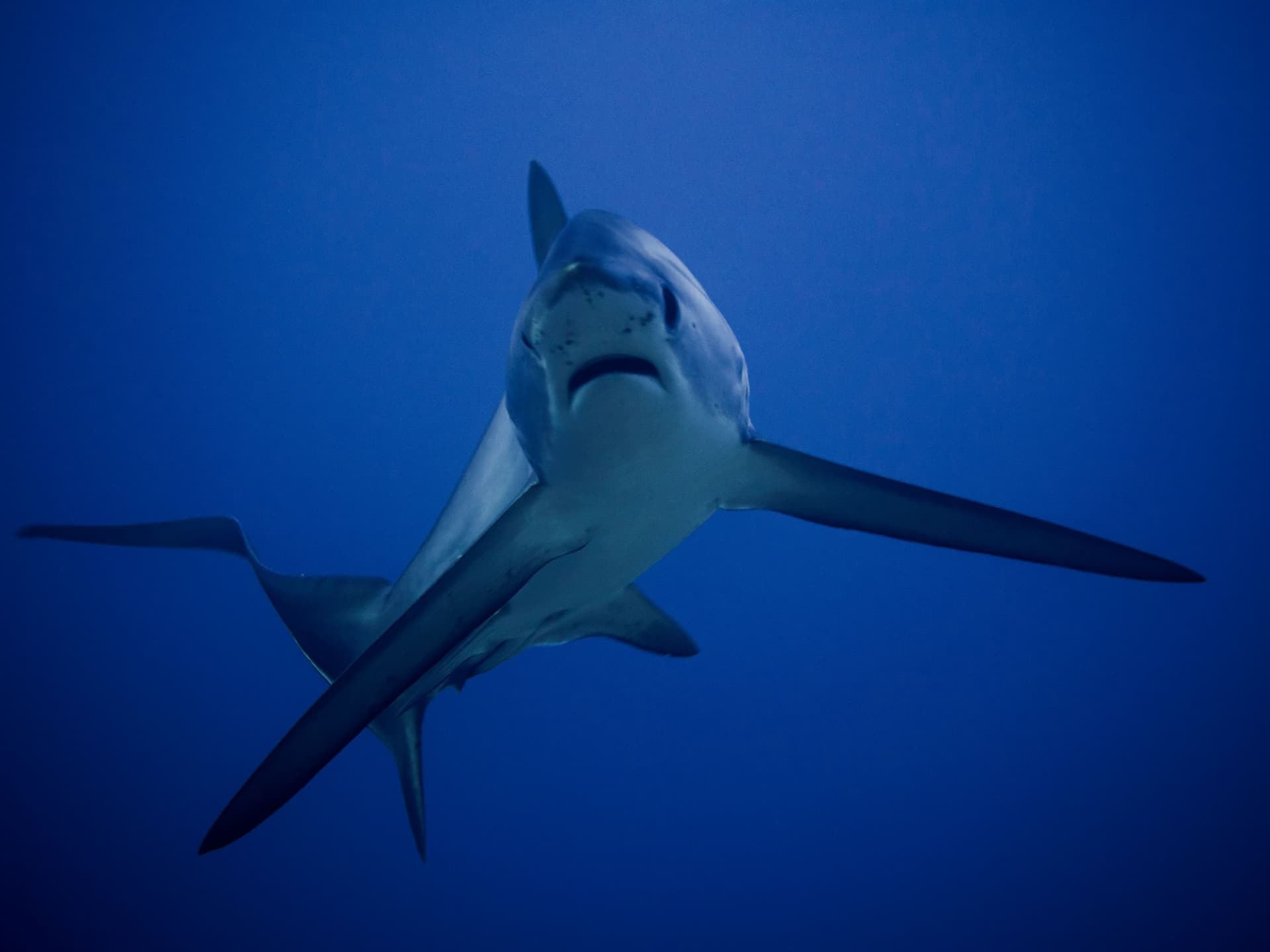
Most shark encounters in diving are a lottery. You pick the right destination, the right season, the right operator, and then you hope. Thresher sharks at Malapascua are the exception — the only place on the planet where you can put "dive with a thresher shark" in your calendar and expect it to happen. Sighting rates on the morning shark dives run at roughly 90 percent or better, and they hold year-round.
That reliability is the whole story here, and it deserves a proper explanation — because it also comes with a 4:30 am alarm, a strict rulebook, and one major recent change that most older guides still get wrong.
Why threshers surface here (and almost nowhere else)
The pelagic thresher (Alopias pelagicus) is a deep-water animal. It spends most of its life in open ocean, typically well below recreational depths, hunting with that improbable scythe of a tail — roughly half its total body length — which it whips through bait balls to stun sardines and mackerel. Its huge eyes are adapted for low light at depth, which matters later when we get to the camera rules.
What makes Malapascua unique is geography. A few kilometres off the island, two seamounts — Monad Shoal and Kimud Shoal — rise from a drop-off that falls away toward 200-plus metres. Their plateaus, sitting in recreational depths, host resident populations of cleaner wrasse. Every morning around first light, threshers rise from deep water to hover over these cleaning stations while the wrasse pick parasites from their skin, gills and mouths.
It is essentially a scheduled appointment. The sharks need the service, the stations are fixed, and the shallow seamount is the only place the two parties can meet. That is why this works nowhere else: plenty of oceans have threshers, but almost nowhere has a cleaning station this shallow, this close to shore, with this much daily traffic. You can read the full site breakdown in our Monad Shoal dive-site guide, and the species profile in our thresher shark sightings page.
The Kimud Shoal shift: what changed
Here is the part that outdated articles miss. For two decades, Monad Shoal was the thresher site. Around 2021–2022, tiger sharks began appearing at Monad — and the threshers, sensibly, relocated their morning routine to Kimud Shoal, a smaller seamount nearby. That is where the daily shark dives now run.
For divers, the move was mostly good news:
- Shallower encounters. Kimud's active cleaning stations sit around 14–20 m, versus 25–30 m at Monad's old viewing areas. More bottom time, less deco pressure, no real need for the nitrox that Monad's depth used to demand.
- Later and longer sightings. At Monad, the show was heavily dawn-weighted. At Kimud, sharks are seen throughout the morning, so operators run two-dive morning trips as standard rather than a single dawn sprint.
- Closer passes. Reports since the move are consistent: the sharks come in closer and linger longer.
Monad itself is still dived — it is now Malapascua's tiger shark site, though those sightings are genuinely unpredictable (think weekly, not daily). If a guide or an old blog post tells you the dawn dive goes to Monad, they are describing 2019.
The dawn routine, hour by hour
The thresher dive is a ritual, and it runs the same way across the island's dive shops:
- 4:30–5:00 am — wake up, coffee at the shop, briefing. Gear was usually set up the night before.
- 5:00–5:30 am — bancas (outrigger boats) motor out; the crossing takes 30–45 minutes. You watch the sun come up from the bow.
- First light — descend to the plateau. Guides position groups at designated viewing areas near the cleaning stations. You kneel or hover behind the line and wait.
- The encounter — a grey shape materialises out of the blue, circles the station in slow, wide loops, and hangs almost motionless while the wrasse work. Encounters last anywhere from thirty seconds to several minutes, and on a good morning you will see multiple sharks across the dive.
- Second dive — most operators now run a two-dive morning at Kimud, since sightings continue well past dawn. You are back on the island for a late breakfast.
Two honest caveats. First, this is a waiting dive — you hold position at a fixed spot in sometimes-milky visibility, and patience is the skill being tested, not finning. Second, that 90 percent number means roughly one morning in ten produces nothing. If you can only spare one morning, you are rolling a very favourable dice, but it is still a dice. Plan two mornings if the thresher is the reason you are flying to the Philippines.
The rules — and why they exist
Malapascua's operators enforce a shared code at the shark sites, and the local rules were formally tightened in late 2025 when Kimud was designated a protected marine area:
- No strobes, no flash, no video lights. This is absolute. Thresher eyes are built for near-darkness at 500 m; artificial light causes them visible distress and drives them off the station. You shoot ambient-light only — which, at 15–20 m in morning light, works better than you would expect.
- Stay behind the viewing lines. Chasing a shark ends the encounter for everyone and gets you a firm word back on the boat.
- No touching, no crowding, standard shark-diving discipline.
- Experience requirements. Since the site went shallower the old deep-cert barrier has softened, but newer divers (roughly under 50 logged dives) should expect to be paired with a dive professional and may be asked to do a buoyancy check or workshop first. Silt kicked up by a flailing diver ruins the station's visibility — the requirement is earned, not bureaucratic.
- Marine park fees apply per day (see costs below) and fund the wardens who patrol the site.
If you are a photographer whose portfolio depends on strobes, be honest with yourself before booking: this is a natural-light destination, full stop.
Getting there and what it costs
Malapascua is a small island off the northern tip of Cebu. There is no airport and no pier — you will get your feet wet stepping off the boat.
- Fly into Cebu City (CEB). Well connected via Manila, Singapore, Hong Kong and the Gulf hubs.
- Cebu City to Maya port: around 4–5 hours by bus from the North Bus Terminal (PHP 200–300, roughly €4–5) or about 3 hours by private car or arranged transfer (€90–130). If your flight lands after midday, plan an overnight in Cebu City — the last boats leave Maya around 4:30–5:00 pm.
- Maya to Malapascua: a public banca crossing of 30–40 minutes, about PHP 200 plus an environmental fee of roughly PHP 120.
Diving costs are some of the best value in world-class shark diving:
- Thresher shark dives: roughly PHP 2,000–2,500 per dive (about €33–42), with the two-dive morning trip the standard product.
- Equipment rental: around €6–8 per dive if you need it.
- Marine park fee: PHP 150–450 per person per day depending on the site.
- A three-night stay with two thresher mornings, a Gato Island day and mid-range accommodation lands comfortably under €500 excluding flights. There are very few apex-predator encounters on earth at that price.
Where it fits in a Visayas or liveaboard trip
Malapascua alone is a 3–4 night trip: two thresher mornings, plus Gato Island's caverns and sea snakes, and some genuinely good macro. But the smarter play is folding it into a wider Philippines itinerary.
Land-based, the classic Visayas circuit runs Malapascua → Moalboal (the sardine run) → Bohol or Dumaguete (macro and walls) over 10–14 days. On the liveaboard side, several Visayas itineraries — typically 7 to 10 nights, 25–33 dives — include a Malapascua leg with the Kimud Shoal thresher dive alongside Cabilao's walls, Sumilon's reefs and Southern Leyte's whale-shark grounds. A liveaboard solves the logistics problem elegantly: the boat repositions overnight while you sleep, and the thresher morning happens from the mothership instead of a 4:30 am land start.
The trade-off is honest: the Visayas is not a big-animal liveaboard destination in the Tubbataha or Socorro sense. It is a variety trip — one guaranteed pelagic ritual stitched into a week of reefs, walls and world-class macro. If you want wall-to-wall sharks, this is not that trip.
Season notes: threshers are resident, so the encounter itself is year-round. Surface conditions are best roughly December through May; June to November brings rain and the occasional typhoon disruption to boat schedules, though diving continues most days. Check our departure calendar for Philippines dates.
Who should not book this
Radical honesty, as usual:
- Divers who will not do early mornings. The routine is non-negotiable. If a 4:30 am call time twice in a row sounds like a ruined holiday, this is not your trip.
- Strobe-dependent photographers chasing a lit, close-up thresher portrait. It is not allowed, anywhere, by anyone reputable.
- Guaranteed-encounter absolutists. Ninety percent is remarkable; it is not one hundred. If a blank morning would sour the whole trip, build in a second attempt or reconsider.
- Divers expecting action. Threshers at a cleaning station are slow, graceful and calm — closer to ballet than to a baited shark feed. If you want adrenaline, look at our Galapagos and Socorro material instead.
- Very new divers on a tight schedule. The workshop-and-professional requirements for low-logbook divers are real and can eat a morning.
For everyone else — and especially for anyone who keeps a mental list of animals seen — this is one of the few dives in the world where the superlative is literal. There is no backup destination. This is the place.
If you are weighing a Malapascua add-on against a full Visayas liveaboard, or trying to sequence it with Tubbataha's short season, our concierge does this routing weekly and can tell you within one conversation which shape of trip fits your dates and budget.
Related Guides
Related Articles
%20-%20Large.jpg&w=828&q=75)
Best Time to Dive: A Season-by-Season Guide
When to visit the world's top liveaboard destinations for the best conditions and marine life encounters.
Galápagos Diving: What to Expect on Your First Trip
Hammerhead highways, curious sea lions, and currents that demand respect — here's what awaits in the enchanted islands.