Amos Rock
A slope that tips over into a wall, a current that switches on the action, and reef sharks materialising out of the blue — Amos Rock is Tubbataha diving distilled.
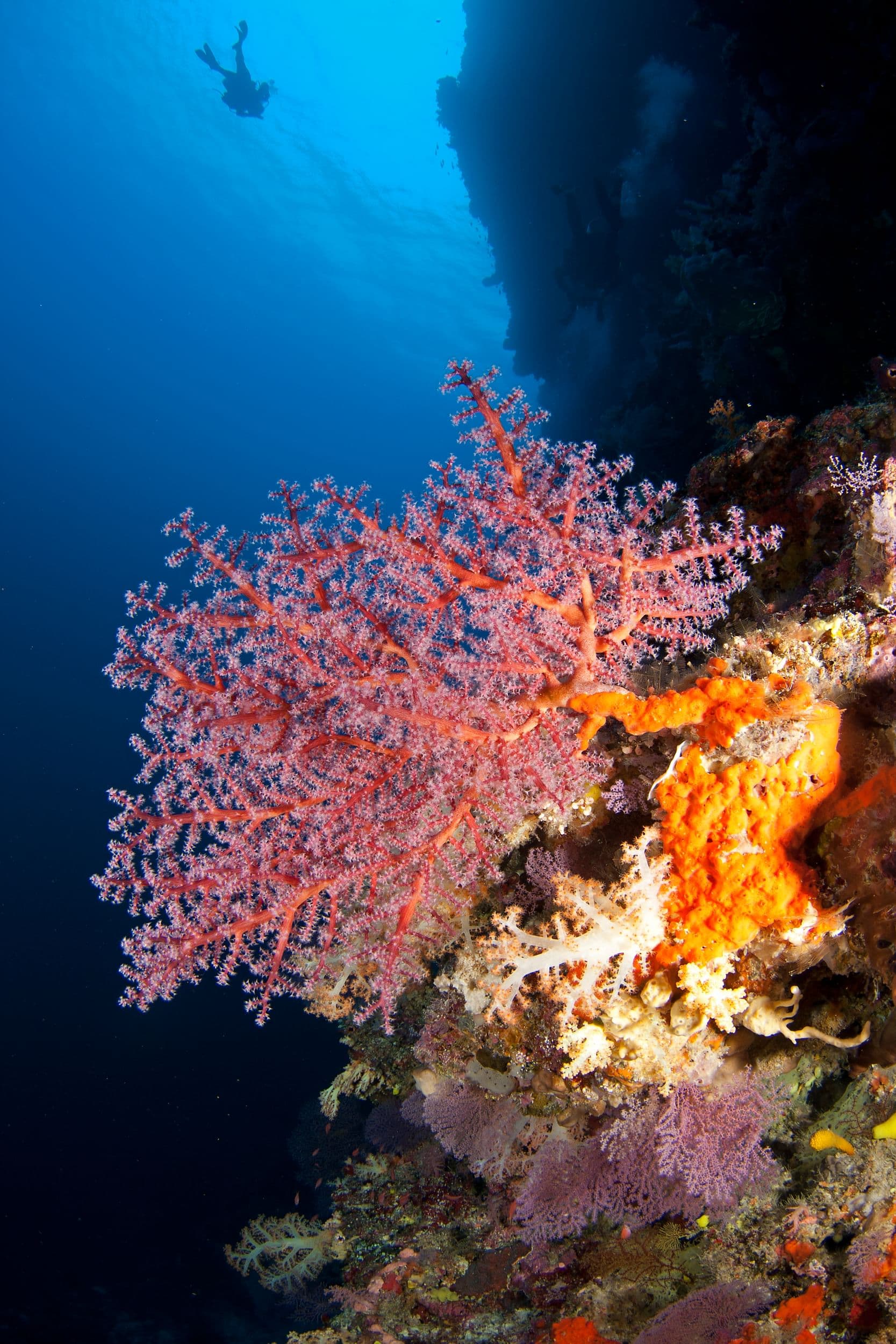
On the south side of Tubbataha's North Atoll islet, Amos Rock (some charts call it Southwest Rock) is one of the marine park's signature wall dives. You start over a coral slope in the shallows, follow it as it steepens, and watch it drop away into a sheer face that runs past 70 metres into the Sulu Sea. It is a site that rewards current: when the water moves, the pelagic action switches on and grey reef sharks, big jacks and schooling fish stack up along the edge. Because Tubbataha sits 150 kilometres offshore with no land to sleep on, Amos Rock is a liveaboard dive, full stop — and it only opens for a short season each year.
Quick answer: Amos Rock is a liveaboard drift wall dive in Philippines. Best season: Mid-March to mid-June (the only months Tubbataha is open). Level: Advanced — genuine current and a deep wall; not for new divers. Depth: 5m over the reef top to a wall dropping past 70m; most diving 12-30m. Typical visibility: Typically 25-40m.
Facts verified September 2026
What makes Amos Rock special
Tubbataha is a UNESCO World Heritage marine park, and Amos Rock is one of the dives that earns it that status. The topography does the work for you: a gentle, coral-covered slope in the shallows that steepens through the mid-water and then simply falls away into a vertical wall. Peer over the lip and the reef vanishes below you into deep blue — the base sits somewhere past 70 metres, well beyond recreational range, which is exactly the point. You dive the top third of a genuinely oceanic wall.
What sets this site apart from a pretty reef wall is the position. Amos Rock catches current sweeping around the North Atoll, and that moving water is a magnet. The wall becomes a cleaning station and a highway at once: sharks patrolling the edge, jacks balling in the blue, and reef fish hanging into the flow to feed. On a good day it is one of the more reliably thrilling dives in the Philippines.
What you'll see
The wall itself is dressed in healthy hard coral up top and, as you drop, big gorgonian sea fans, purple fans and whip corals reaching out into the current. But most divers come here for what cruises past it.
When the current runs, this is prime pelagic territory. Keep one eye on the reef and one on the blue.
- Grey reef sharks and whitetip reef sharks — the headline act, often patrolling the wall in numbers
- Schooling jacks and big-eye trevally, plus mackerel hunting the current lines
- Napoleon (humphead) wrasse, large groupers, snapper and dense clouds of fusiliers
- Eagle rays gliding along the drop-off, and the occasional manta when plankton is up
- Green and hawksbill turtles resting on ledges, with Moorish idols, angelfish and surgeonfish over the coral
Conditions and who it's for
Be honest with yourself about this one. Amos Rock is an advanced dive. The current can be strong and, more to the point, unpredictable — it can shift direction or push you down the wall, and a deep drop-off leaves little margin for a diver who is not comfortable managing buoyancy and depth in moving water. This is not a site for your first ocean dives.
You want solid buoyancy control, experience with drift diving, and the discipline to hang on your planned depth rather than chasing a shark deeper than you should. Nitrox is a real advantage for extending bottom time at 20-30 metres, and Tubbataha liveaboards generally offer it. Visibility is usually excellent — 25 to 40 metres — so you will see the action coming, but the same clear, deep water can make it tempting to drift over the edge. A reef hook and a surface marker buoy are standard kit here.
When to dive it
Tubbataha has one of the shortest seasons in diving. The park is only open to liveaboards from roughly mid-March to mid-June, when the Sulu Sea flattens out and the seas are calm enough for the crossing. Outside that window the monsoon shuts the whole area down — there is no off-season alternative, so your travel dates are dictated entirely by the park.
Within the season, all months are strong. March and April tend to bring the calmest, clearest water; May and June can see more plankton, which sometimes brings mantas and whale sharks into the wider park but can trim visibility slightly. For Amos Rock specifically, the constant is current — pick a tidal window with movement and the site delivers.
How you actually dive it
Everything at Tubbataha is run from a liveaboard tender. The park is 150 kilometres from Puerto Princesa on Palawan, roughly a ten-hour overnight crossing, and there is no accommodation on the reef itself — just a ranger station. Boats moor near the atolls and shuttle divers to each site by RIB.
A typical Amos Rock dive is a negative entry near the reef top to get below any surface current, a quick orientation over the slope, and then a drift along the wall at your chosen depth while the current carries you and the big fish come to you. Divemasters read the tide and brief the direction; you follow the wall on your shoulder, watch the blue, and let the current do the swimming. Deco discipline matters — with the bottom past 70 metres it is easy to creep deep, so set a hard limit and stick to it. Most operators run three to four dives a day at Tubbataha, and Amos Rock is one you will often get to repeat across a trip.
Faneca dives Amos Rock on our Tubbataha Reef liveaboard itineraries, which run only during the short mid-March to mid-June season when the park is open — talk to our concierge early, as these sailings book out well ahead.
Amos Rock: common questions
What is the best season to dive Amos Rock?
Mid-March to mid-June (the only months Tubbataha is open)
What experience level do I need for Amos Rock?
Advanced — genuine current and a deep wall; not for new divers
How deep is Amos Rock?
5m over the reef top to a wall dropping past 70m; most diving 12-30m
What marine life will I see at Amos Rock?
Grey reef and whitetip sharks, jacks, mackerel, snapper, groupers, Napoleon wrasse, eagle rays, turtles, occasional mantas
