Delsan Wreck
Tubbataha's best-known wreck site isn't really about the wreck at all.
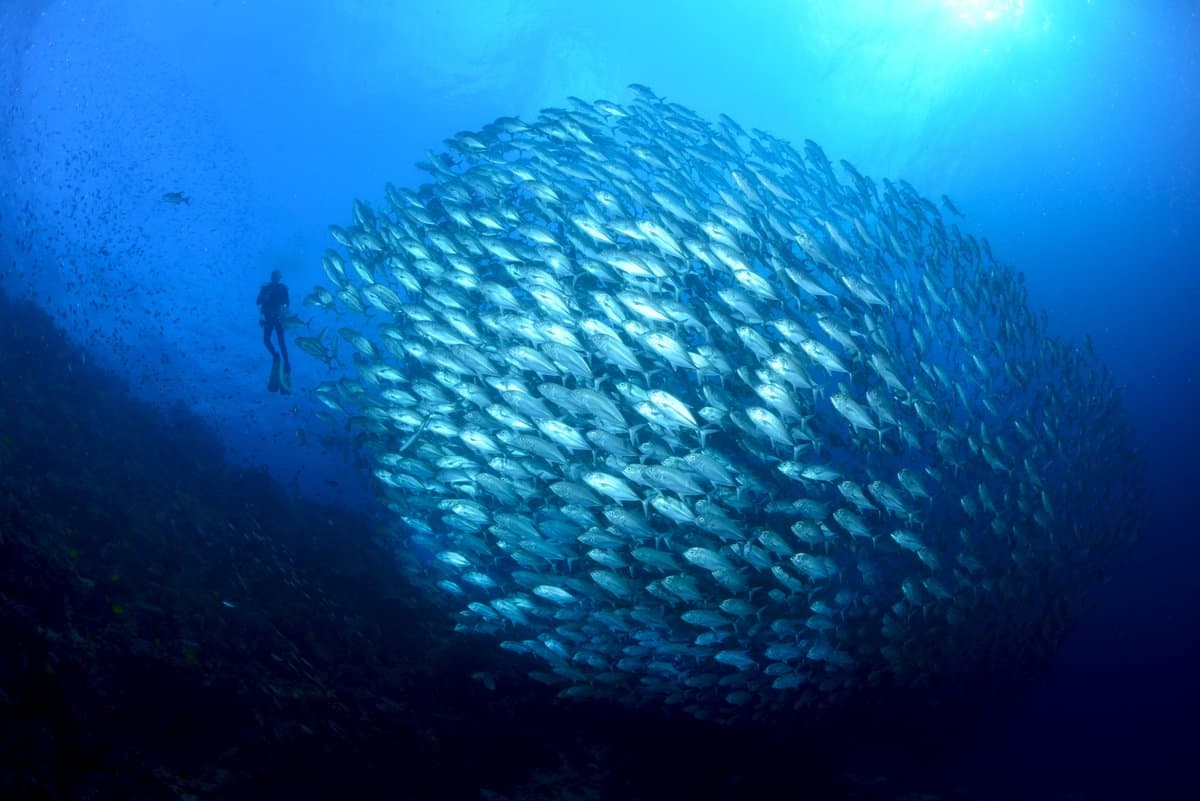
Delsan Wreck is Tubbataha's best-known wreck site, but the diving here is a wall dive with a name. The small freighter that gives the site its title sits too high to bother most scuba divers, so you drop instead onto a coral corner in the Sulu Sea where reef sharks patrol, jacks tornado in the blue, and tuna and passing mantas cruise the edge. It's one of the standout dives on the South Atoll, and on a Philippines liveaboard it reliably delivers the pelagic action Tubbataha is famous for.
Quick answer: Delsan Wreck is a boat/liveaboard drift and wall dive along a coral corner in Philippines. Best season: Mid-March to mid-June (the only season Tubbataha is open). Level: Suitable for most certified divers; Advanced/AOW recommended for current. Depth: Reef top from ~5m; wall sloping to 20-30m, dropping beyond 40m. Typical visibility: Typically 15-30m, occasionally reduced to 5-15m with plankton or surge.
Facts verified September 2026
What makes Delsan Wreck special
Every dive site in Tubbataha trades on the same currency: clean, remote, heavily protected reef in the middle of the Sulu Sea, a full night's sail from Puerto Princesa. Delsan Wreck earns its place among the marquee South Atoll dives because it stacks two attractions in one drop. There is the wreck itself, a small freighter that ran aground on the reef flat and has since been swallowed by coral, and there is the wall and corner beside it that funnels current and, with it, fish.
The wreck is the reason for the name, but be honest with your expectations: much of it sits in water too shallow to dive, with a portion breaking the surface. You'll typically begin near the old anchor, which rests deeper and away from the hull, then work the reef and wall. What you remember afterward is rarely the steel. It's the wall of jacks, the silhouette of a reef shark holding into the current, and the sense that at any moment something big could materialise out of the blue.
What you'll see
This is classic Tubbataha big-fish territory, and Delsan delivers a broad cast. The reef sharks are the headline act, usually grey reef and whitetip, cruising the wall and the sand at the base. Out in the blue you'll scan for the fast movers: schooling jacks and barracuda, meaty yellowfin and dogtooth tuna, and big trevally hunting the reef edge.
Mantas and devil rays pass through, most reliably in April and May, though as with all pelagics they're a gift rather than a guarantee. Closer to the coral you'll find the supporting cast that makes Tubbataha so photogenic: green and hawksbill turtles, sweetlips hanging under ledges, schooling batfish, hefty groupers, and a dense, healthy carpet of reef fish over the coral-clad wreck and wall.
- Grey reef and whitetip sharks along the wall and sandy base
- Schooling jacks, barracuda and big trevally in the blue
- Yellowfin and dogtooth tuna cruising the drop-off
- Mantas and devil rays, most likely April-May
- Green and hawksbill turtles, sweetlips, batfish and groupers on the reef
Conditions and who it's for
Delsan is not a technical dive, and the diving itself is straightforward: a wall and corner with plenty to hold your attention at recreational depths. What raises the bar is Tubbataha's current. It can run strong here and, more awkwardly, it can shift direction and strength during a single dive as it wraps the corner. Good buoyancy, a reef hook, and comfort with drift diving make the difference between a relaxed dive and a busy one.
On paper the shallow, fish-rich reef top is beginner-friendly, and calm days do happen. But Tubbataha as a whole rewards experience, and most operators require an Advanced Open Water certification and a logged-dive minimum for the trip. If you're newly certified, this is a destination to grow into rather than start with. Fit, current-comfortable divers of most levels will love it; nervous beginners in a ripping current will not.
When to dive it
You don't choose when to dive Delsan so much as when Tubbataha lets you. The park sits in open ocean and is only accessible during a short calm-weather window, roughly mid-March to mid-June, when the seas settle enough for the overnight crossing and the moorings hold. Outside that window the park is closed and unreachable.
Within the season, April and May are the sweet spot for pelagic encounters, including the best odds of mantas and the clearest water. Early March and June can bring more plankton and slightly softer visibility, sometimes trading a little clarity for productive, fishy water. Whenever you go, expect warm water around 28-30°C and plan on a 3mm to 5mm wetsuit.
How you actually dive it
There is no shore access and no day-tripping to Tubbataha: the reefs are around 150km from Puerto Princesa, and the only way to dive Delsan is by liveaboard during the March-June season. Boats moor or drift the South Atoll and run tender dives from the mothership, dropping you at the corner and picking you up wherever the current delivers you.
A typical plan is a negative or prompt descent to get below the surface push, then a working of the wall and corner at 15-25m while you watch the blue for pelagics, drifting back up over the coral and the shallow wreck to off-gas among the reef fish. Bring a reef hook for holding position in current, a surface marker buoy for the drift pick-up, and a good camera: this is a wide-angle site, all sharks, schools and blue water rather than macro.
Faneca dives Delsan Wreck as part of our Tubbataha Reef liveaboard itineraries, which run only during the park's short March-to-June season; speak to our concierge to check dates and availability.
Delsan Wreck: common questions
What is the best season to dive Delsan Wreck?
Mid-March to mid-June (the only season Tubbataha is open)
What experience level do I need for Delsan Wreck?
Suitable for most certified divers; Advanced/AOW recommended for current
How deep is Delsan Wreck?
Reef top from ~5m; wall sloping to 20-30m, dropping beyond 40m
What marine life will I see at Delsan Wreck?
Grey reef & whitetip sharks, schooling jacks & barracuda, tuna, trevally, occasional manta, turtles, batfish, groupers
