Monad Shoal
A dawn descent to the one seamount on Earth where thresher sharks show up almost every morning.
Monad Shoal is the reason divers set an alarm for 4am in the northern Philippines. This submerged seamount off Malapascua is the world's only reliable site to watch pelagic thresher sharks glide in to a dawn cleaning station, and diving Monad Shoal well is more about patience and stillness than distance covered. Here is what the site actually is, what you will see, and how to dive it properly.
Quick answer: Monad Shoal is a day-boat dawn dive on a submerged seamount / cleaning station in Philippines. Best season: Threshers year-round; best visibility and calmest seas roughly January-May. Level: Advanced (AOW or equivalent) — depth plus a pre-dawn start. Depth: Plateau top ~16-20 m; cleaning-station viewing lines ~20-27 m. Typical visibility: Typically 10-25 m, best in the dry months; poorest in November-December.
Facts verified September 2026
What makes Monad Shoal special
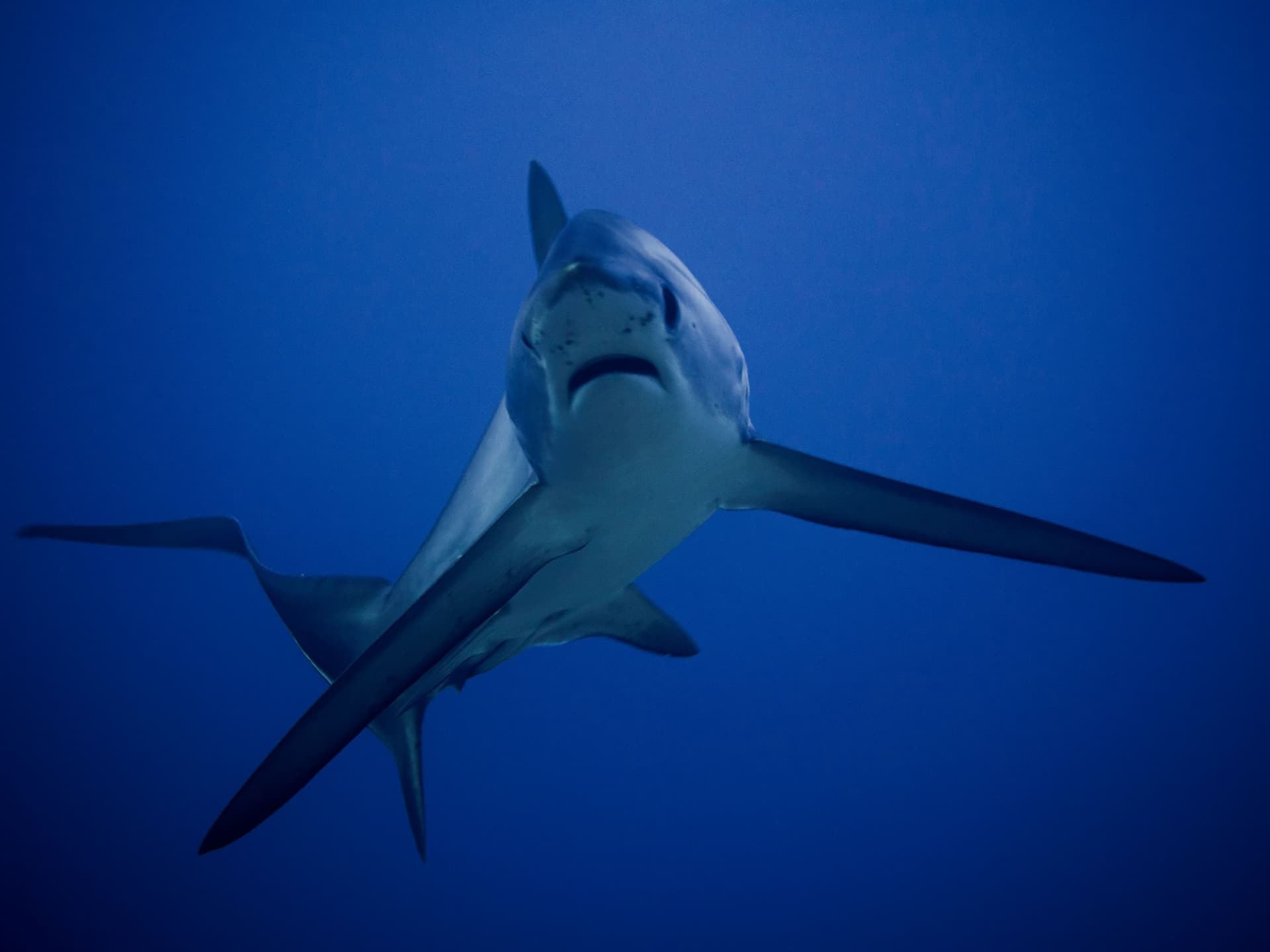
Most shark encounters in diving come down to luck, chum or a lot of bottom time in blue water. Monad Shoal is different. This is a flat-topped seamount that rises from a 200-metre drop-off to a plateau at roughly 16 to 20 metres, and along its edge sit cleaning stations where small cleaner wrasse set up shop each morning. Pelagic thresher sharks — deep-water animals you would almost never otherwise see — rise from the darkness at first light to hang in the current and let the wrasse pick parasites from their gills and skin.
That daily, predictable behaviour is what makes Monad Shoal the world's only site where you can reasonably expect to dive with threshers on a given morning. No other place on the planet offers the same reliability. It is the anchor dive of any diving trip to Malapascua, and the single biggest reason the island earned its reputation.
What you'll see
The star is the pelagic thresher shark (Alopias pelagicus) — a slender, wide-eyed shark whose scythe-like tail can be as long as its body, giving adults an overall length around three metres. On a good morning you may see several passing along the reef edge, sometimes circling back over the cleaning stations. They are curious but shy, and their oversized eyes are extremely sensitive to light, which shapes everything about how the dive is run.
Threshers are the headline, but they are not the only reason to be here:
- Devil rays (mobula) cruising the plateau, and occasional manta rays
- Hammerhead sharks on rare mornings, more often at nearby Kimud Shoal in season
- Whitetip reef sharks resting on the sand
- Garden eels, feather stars, lionfish and reef fish across the plateau
- The cleaner wrasse themselves — the small workers the whole system depends on
Conditions and who it's for
Be honest with yourself about this dive. It is deep, dark and early. You will roll off the boat in low light, descend to 20-plus metres before your eyes have fully adjusted, and then stay largely still in cool water waiting for animals that may or may not appear on schedule. Current over the plateau is usually mild to moderate but can strengthen on the edges. None of it is technical, but all of it rewards good buoyancy, calm air consumption and comfort at depth.
For those reasons Monad Shoal is an Advanced Open Water dive (or equivalent experience). Nitrox is a real advantage given the depth and the waiting. If you are newly certified, a few warm-up dives around Malapascua's easier sites first will make the pre-dawn thresher dive far more enjoyable — and far more likely to produce a sighting, because a relaxed, motionless diver is exactly what these light- and movement-shy sharks will tolerate.
When to dive it
The best thing about Monad Shoal is that the threshers are resident year-round — there is no closed season for the main event. What changes with the calendar is the diving comfort. Visibility and sea conditions are best in the dry months, roughly January through May, with March to May typically offering the calmest seas and cleanest water. November and December bring the poorest visibility and the choppiest surface conditions, though the sharks are still down there.
If your priority is simply seeing threshers, almost any month works. If you also want easy crossings, clear water and the chance to pair the trip with the region's macro and hammerhead diving, aim for the first half of the year.
How you actually dive it
This is a day-boat dive out of Malapascua, not a site you reach on a liveaboard. Boats leave the beach in the dark — often around 4:30 to 5am — for the short crossing so you are in the water at first light, when the sharks are most active. Expect a fast negative or line descent to the plateau, then you settle in behind the marked viewing lines that the marine sanctuary maintains along the cleaning stations.
The etiquette is strict and it exists to protect the animals: stay behind the rope, keep low and still, do not chase, and — critically — no flash or strobe photography, because the threshers' huge eyes are acutely light-sensitive and bright bursts drive them off. Guides may reposition small groups quietly, but the golden rule is to let the sharks come to you. Watch your depth and gas, respect the sanctuary fee and rules, and treat a blank morning as part of wild diving — most divers who put in a couple of dawns here go home having shared the reef with a thresher.
Faneca dives Monad Shoal on our Philippines trips based out of Malapascua — pre-dawn day-boat dives rather than a liveaboard, timed for the first-light cleaning station, ideally in the calmer, clearer months of the year. Talk to our concierge about pairing it with the wider Visayas macro and shark diving.
Monad Shoal: common questions
What is the best season to dive Monad Shoal?
Threshers year-round; best visibility and calmest seas roughly January-May
What experience level do I need for Monad Shoal?
Advanced (AOW or equivalent) — depth plus a pre-dawn start
How deep is Monad Shoal?
Plateau top ~16-20 m; cleaning-station viewing lines ~20-27 m
What marine life will I see at Monad Shoal?
Pelagic thresher sharks year-round, plus devil (mobula) rays, occasional manta rays and hammerheads, cleaner wrasse
