Swimming with Whale Sharks: The Complete Liveaboard Guide
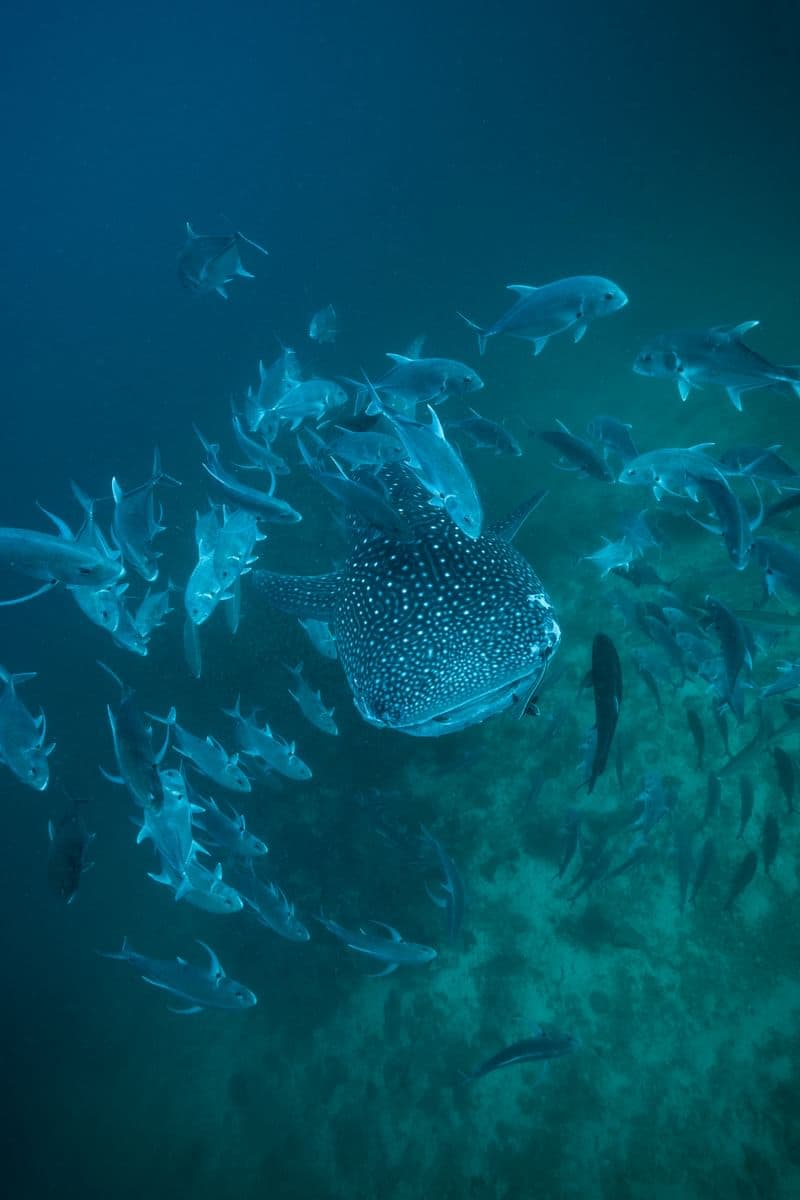
The first time you see a whale shark underwater, your brain short-circuits. You know they're big. You've read the stats. But nothing prepares you for a 10-metre animal materialising out of the blue, mouth open, filtering a cubic metre of water per second, completely indifferent to your existence. Your regulator falls out of your mouth. You forget to breathe. You fumble your camera. This is normal.
Here's how to make sure it happens in the right place, at the right time, with the right approach.
The Best Liveaboard Destinations for Whale Sharks
Maldives — South Ari Atoll (August to November)
This is the most reliable whale shark encounter on the planet from a liveaboard. South Ari Atoll has a resident population of juvenile whale sharks — mostly 4-8 metre individuals — that feed along the atoll's outer edge year-round, with peak sightings from August through November.
You'll snorkel, not scuba. The sharks cruise at 1-3 metres depth along the surface, hoovering plankton. Boats spot them from the sundeck, drop you in ahead of the shark's path, and you swim alongside for anywhere from 30 seconds to 15 minutes depending on the animal's mood.
Water temp: 27-29°C. Visibility: 15-30 metres. Expect 2-5 sightings per week during peak season. Some weeks deliver daily encounters.
The downside: you're sharing the water with snorkellers from every boat and resort in the atoll. Group sizes can hit 20-30 people per shark. It's managed, but it's not intimate.
Djibouti — Bay of Tadjoura (November to January)
Nobody talks about Djibouti, and that's exactly why it's special. Between November and January, juvenile whale sharks — 3-7 metres — congregate in the Bay of Tadjoura's shallow, warm waters. Some weeks you'll see 5-10 animals in a single morning.
The water is warm (26-28°C), visibility ranges from 5-15 metres (plankton-rich, so don't expect crystal clarity), and the sharks are feeding near the surface. Snorkelling is the standard approach.
Group sizes are tiny. On a good day, it's you, your guide, and a whale shark. No queue of 30 snorkellers. No jet skis. Just the animal and the plankton soup it came for. Liveaboard options are limited — this is expedition-style travel, not luxury. The boats are basic, the logistics are rough, and Djibouti City won't win any tourism awards. But the encounters are raw and real.
Mexico — Isla Holbox / Isla Mujeres (June to September)
Every summer, whale sharks gather off Mexico's Yucatan Peninsula in ridiculous numbers. We're talking 200+ animals in a single aggregation, feeding on tuna spawn and plankton blooms. It's the largest known gathering of whale sharks anywhere.
This is strictly snorkelling — Mexican regulations prohibit scuba with whale sharks. You go out by panga (small boat), two snorkellers plus a guide per boat, and you slip in next to sharks that can hit 12+ metres. The water is 27-29°C, visibility is 8-20 metres, and the sheer scale of the aggregation is overwhelming.
The catch: this isn't a liveaboard destination. It's day-trip territory. But it's too good to leave off the list. If you're combining a Caribbean holiday with diving elsewhere, a day trip from Cancun is a 2-hour drive from Isla Mujeres departure points.
Oman — Dhofar Coast (October to December)
Oman's Dhofar region is emerging as a serious whale shark destination. The Arabian Sea upwelling brings nutrient-rich water to the surface from October through December, attracting whale sharks to feed. Sightings are less predictable than the Maldives, but when they show up, you're often the only boat.
Water temp: 22-26°C (cooler than you'd expect for the Arabian Peninsula). Visibility: 10-20 metres. The diving infrastructure is still developing, so expect fewer operator choices and more adventure.
Philippines — Oslob, Cebu (Year-round)
Let's talk about Oslob, because someone's going to ask.
Yes, you can see whale sharks at Oslob every single day, year-round, guaranteed. That's because they're being fed. Local fishermen dump shrimp into the water at dawn, and the sharks show up on cue like dogs at dinner time. It's a trained behavior that's been running since 2011.
Here's what's wrong with it:
The sharks have altered their natural migration patterns. They're no longer travelling hundreds of kilometres to feed — they're hanging around a single bay, waiting for handouts. Research from Large Marine Vertebrates Research Institute Philippines (LAMAVE) shows these sharks have higher injury rates from boat strikes, signs of malnutrition from an unnatural diet, and reduced diving behavior.
You'll be in the water with 50-100 other tourists, touching distance from the sharks, while boats rev engines overhead. The "regulations" are loosely enforced. Guides push you toward the sharks for better photos. It's a zoo without the enclosure.
Can you get a photo? Absolutely. Is it an ethical wildlife encounter? No. We don't recommend it, and we won't book it. Plenty of places offer genuine wild whale shark encounters. Go to one of those.
Snorkelling vs Scuba for Whale Sharks
Most whale shark encounters are snorkelling-only, and there's good reason for that.
Whale sharks are surface feeders. They cruise at 0-5 metres depth, mouths open, filtering plankton. Scuba divers sink below the action and produce bubbles that can spook the animals. Snorkellers match the shark's depth, move more quietly, and cause less disturbance.
Exceptions exist: in the Maldives, you'll occasionally spot whale sharks on a dive at 15-20 metres, and in Mozambique's Tofo Beach, scuba encounters happen at cleaning stations. But for dedicated whale shark trips, pack fins, mask, and a snorkel. Leave the BCD on the boat.
Approach Etiquette
Every reputable operator follows some version of these rules:
- Don't chase the shark. Position yourself in its path and let it come to you. Whale sharks swim at 3-5 km/h — faster than you think.
- Maintain 3 metres distance. Closer isn't better. The shark will change course if you crowd it.
- Never touch. Their skin is sensitive, and your touch can transfer bacteria.
- No flash photography. It startles them.
- Stay to the side, not in front. Blocking their path causes them to dive.
- Limit your time. 15 minutes per encounter is plenty. Give the animal space.
The best encounters happen when you stay calm, float still, and let the shark decide how close it wants to come. The ones that approach you voluntarily — those are the magic moments.
Camera Settings That Actually Work
Whale sharks are big, close, and fast-ish. Your camera settings need to account for all three.
GoPro / action cameras: Wide angle, 4K if you've got it. Shoot video, not stills — you'll get usable frames from the video. Turn off the screen to save battery. Stabilisation on.
Mirrorless / compact in housing: 10-17mm fisheye or widest zoom setting. Aperture f/8, ISO 400-800, shutter 1/250 minimum. Shoot burst mode. Auto white balance works fine at the surface. Natural light only — strobes are useless at these distances and can spook the shark.
Dome port vs flat port: Dome every time for snorkelling. You'll want those split shots with the shark below and the boat above.
The single most important thing: get the eye in focus. A sharp eye with a slightly blurred tail is a great photo. A sharp tail with a blurred eye is a reject. Focus on the eye.
What Size Groups to Expect
This varies enormously by destination:
- Maldives: 10-20 snorkellers per sighting (multiple boats converge)
- Djibouti: 2-6 people
- Mexico: 2 snorkellers per panga (strictly regulated)
- Oman: 4-8 people (fewer boats operating)
- Oslob: 50-100+ (avoid)
Smaller groups mean longer encounters, less stress on the animal, and better photos. If group size matters to you — and it should — ask your operator before booking.
Looking for a liveaboard itinerary that includes whale shark encounters? Faneca can match you with departures timed for peak season in the Maldives and beyond. Just tell us when you're free.
- Manta Ray Diving: Where, When, and How to See Them — The other gentle giant you need on your list
- Best Time to Dive: A Season-by-Season Guide — Timing your trip for peak marine life
- The Complete Liveaboard Packing Guide — What to bring for snorkelling and diving
- First-Time Liveaboard: What to Expect Day by Day — Everything else you need to know before boarding
Related Articles
The Complete Liveaboard Packing Guide
What to bring, what to leave behind, and the gear essentials that experienced liveaboard divers swear by.
First-Time Liveaboard: What to Expect Day by Day
Never done a liveaboard? Here's the inside scoop on the schedule, the meals, the diving, and the delightful chaos.