Palau Diving Season: Month-by-Month Conditions and Spawning Calendar
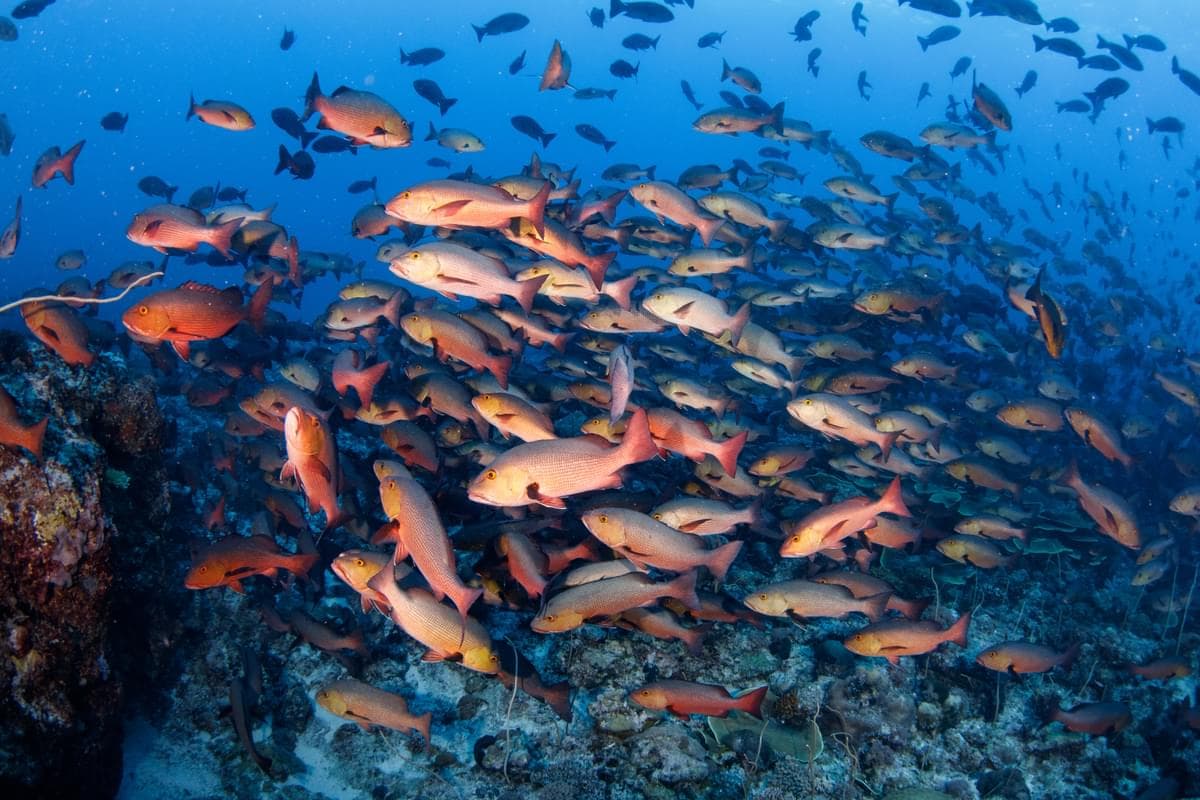
Most "Palau diving season" guides stop at the weather: dry season good, wet season green, book December. True as far as it goes — but Palau's most jaw-dropping diving runs on a second calendar the moon writes, and almost no one maps it to actual months. This guide does both: the dry-versus-wet tradeoff in plain terms, then the new-moon and full-moon aggregations that turn a good week into the trip you talk about for a decade.
A quick honesty note before we start, because it shapes everything below. We're an independent agency — we don't own the liveaboards, and we charge the same as booking the boat direct. So we have no reason to oversell a month. When we say "this window is a gamble," that's the advice, not a sales angle.
The short answer
For the calmest seas, best visibility, and reliable manta action, aim for roughly December to March (the broader dry window runs about November to May). Visibility on the outer reefs in the dry season is frequently 30m-plus and can top 40m, seas are flat, and the manta cleaning station at German Channel is at its busiest.
But if your heart is set on a spawning spectacle — bumphead parrotfish or red snapper by the thousand — the month matters far less than the moon phase. Those events happen nearly every month; you just have to be on the right boat in the right week. More on that below, because it's the part the boilerplate pages skip.
Palau's two seasons, honestly
Palau sits near the equator, so it never really gets cold and the water barely moves on the thermometer — typically 28-30°C (82-86°F) year-round, with the occasional dip toward 26°C, most likely around February and March. A 3mm shorty suits most divers; a 3mm full-length plus a hood is the comfortable choice if you chill easily or do a lot of repetitive dives. Nobody needs a drysuit here.
What does change with the season is the sky, the wind, and the water clarity:
- Dry season (roughly Nov-May, best Dec-Mar/Apr): Light winds, calm crossings to the outer sites, blue water, and visibility that makes wide-angle photographers giddy. This is the postcard window.
- Wet season (Jul-Oct, peak rain Jul-Sep): More rain, fresher winds, livelier surface conditions, and greener water — visibility can drop to around 15-20m as plankton blooms. That plankton isn't all bad news: it's exactly what pulls mantas in to feed (as opposed to the winter cleaning-station behaviour). Crowds thin, too.
Key takeaway: Dry season buys you clarity and calm. Wet season trades some of that for plankton-fed feeding action and fewer divers — a fair deal if you're experienced and flexible.
Month-by-month at a glance
| Months | Seas & visibility | Headline draw |
|---|---|---|
| Dec-Mar | Calmest, clearest (often 30-40m+) | Peak manta season at German Channel; prime photography |
| Apr-May | Still good, transitioning | Shoulder season; spawning expeditions continue; thinner crowds |
| Jun-Aug | More rain, fresher seas | Camouflage grouper aggregation window (new moon, once a year) |
| Jul-Sep | Wettest, greenest (≈15-20m) | Plankton blooms, manta feeding, quietest boats |
| Oct-Nov | Conditions firming up again | Transition back to dry; good value before peak |
Treat the visibility figures as typical ranges, not guarantees — Palau's outer reefs are current-swept and a single tide change can swing clarity. Conditions vary year to year, so confirm the outlook for your dates with us before you commit.
The spawning calendar most pages omit
Here's the part worth the read. Palau is arguably the best place on Earth to witness reef-fish spawning aggregations, and they run to a lunar clock that's predictable enough for liveaboards to schedule around. The headline events are tied to the new moon and the full moon, and they recur most months — which is why a "spawning expedition" boat plans its departures around moon phase, not around peak tourist season.
Below is the moon-phase map. We've kept the timings hedged where the science deserves it: spawning is biology, not a train timetable, and individual events can shift a day or two and occasionally fizzle.
Bumphead parrotfish — the new moon event
In the days leading up to the new moon, thousands of metre-long bumphead parrotfish gather in Palau's channels to spawn — reportedly the largest known aggregation of the species anywhere. The timing is usually quoted as around three days before the new moon, at dawn, in shallow channel sites (Ulong Channel is the classic name associated with the spectacle). Males headbutt, then the group surges upward releasing plumes of eggs. It's loud, chaotic and unforgettable.
When: Most months, on the new-moon window. Not a "specific season" event — pick the boat whose departure brackets a new moon.
Red (bohar / two-spot) snapper — the full moon event
This is the one that draws the predators. Every month, in the 5-6 days leading up to the full moon, 5,000-10,000 two-spot red snapper (Lutjanus bohar) aggregate at dawn on deep reef sites — Shark City (roughly 37km / 23 miles from Koror) is the marquee location, with other outer promontories in the mix. The school balls up, swims into the blue, and erupts in tornados of spawning fish and clouds of gametes. Bull sharks and oceanic blacktips patrol the edges, drawn by the frenzy. It is not a beginner dive — depth, current and dawn timing all stack up.
When: Most months, on the full-moon window. As with the bumpheads, moon phase beats calendar month.
Camouflage grouper — the once-a-year night event
Unlike the monthly spawners, camouflage grouper (Epinephelus polyphekadion) aggregate to spawn just once a year, on a new moon sometime between June and August, and they do it at night (observed roughly four hours after sunset). Hundreds — sometimes thousands — gather in specific passages and spiral upward in pairs while reef sharks pick off stragglers. This one lands squarely in the wetter season, which is part of why it's less famous: you trade dry-season comfort for a genuinely rare, narrow-window event.
Sailfin / sea bream snapper — the spring aggregation
Worth a mention because it overlaps the tail of the good-conditions window: large snapper aggregations (sailfin / sea bream snapper) are associated with the new moon in roughly March to May, in the Peleliu area, with sharks circling the bait-ball. Several spawning itineraries time late-April departures around bumphead and sea bream activity.
Spawning quick-reference
| Species | Moon phase | Best months | Where (typical) | Difficulty |
|---|---|---|---|---|
| Bumphead parrotfish | ~3 days before new moon | Most months | Ulong / shallow channels | Advanced (current) |
| Two-spot red snapper | 5-6 days before full moon | Most months | Shark City, deep outer reefs | Advanced (depth, dawn, sharks) |
| Camouflage grouper | New moon, at night | ≈ Jun-Aug (once/yr) | Reef passages | Advanced (night) |
| Sailfin / sea bream snapper | New moon | ≈ Mar-May | Peleliu area | Advanced |
Key takeaway: If a spawning aggregation is your "why," book a moon-phase expedition and let the lunar calendar — not the brochure season — set your dates. Tell us which event you're chasing and we'll line your trip up with the right moon and the right boat.
Mantas, sharks and the rest of the cast
Even outside spawning weeks, Palau's signature dives perform on a seasonal rhythm:
- Manta rays at German Channel: Peak December to March, with mating activity often cited November to February, when mantas crowd the cleaning stations in the clear, calmer water. In the wetter months they shift to feeding on plankton blooms — still mantas, different behaviour.
- Grey reef sharks at Blue Corner: This world-famous reef-hook dive delivers sharks by the dozen on the right current more or less year-round, but the dry season's calmer seas and better viz (roughly Nov-Apr) make it the easier, prettier experience.
- Jellyfish Lake: Best visited November to April. One honest 2025-2026 caveat: the golden jellyfish population has temporarily dropped from millions to a few thousand on recent climate patterns, so the famous "wall of jellies" may be thin. The lake is open; just go in with calibrated expectations. We'll tell you the current state when you book.
For a deeper dive-site breakdown — Blue Corner, German Channel, Ulong, Peleliu and more — see our companion guide on Palau's best dive sites and when to go, and the wider portrait in Palau: underwater wonderland.
What it costs (and the fees nobody warns you about)
Palau is a liveaboard-led destination, and prices vary widely by boat and season. As a rough, current sense (always confirm live rates with us — they move):
- 7-night liveaboard: broadly US $4,000-$7,000 per person depending on vessel, cabin and dates. Premium boats and spawning-timed expeditions sit at the upper end.
Then there are the government fees, which are real, mandatory and easy to overlook when you're budgeting:
- Pristine Paradise Environmental Fee: US $100, paid by all air arrivals (now usually bundled into the airfare).
- Rock Islands permit: around US $50 per person, valid roughly 10 days.
- Dive permit: around US $30 per day.
Those figures are accurate as of mid-2026 to the best of our research, but Palau's conservation fees do get revised — treat them as ballpark and confirm the current rates with us before you finalise a budget. We'd rather quote you a hedged range than a precise-but-stale number.
So, when should *you* go?
- Want the easiest, clearest, manta-rich trip? Go December-March. Calm seas, big visibility, peak German Channel mantas.
- Chasing a spawning spectacle? Pick the moon phase first — new moon for bumpheads, full moon for red snapper — and the month falls out of that. These run most of the year.
- After the once-a-year camouflage grouper, or quieter boats and lower shoulder pricing? Look at June-August, and accept greener water as the price of admission.
- Photographer prioritising wide-angle clarity? Dry season, every time.
Whatever you're optimising for, the move is the same: tell us the dates you can travel and the one thing you most want to see, and we'll tell you honestly whether the moon and the season line up — or whether shifting your week by a few days transforms the trip. That's the whole point of using a concierge who isn't trying to fill a specific cabin: start planning your Palau trip with us.
Related Guides
Related Articles
%20-%20Large.jpg&w=828&q=75)
Best Time to Dive: A Season-by-Season Guide
When to visit the world's top liveaboard destinations for the best conditions and marine life encounters.
Galápagos Diving: What to Expect on Your First Trip
Hammerhead highways, curious sea lions, and currents that demand respect — here's what awaits in the enchanted islands.