German Channel
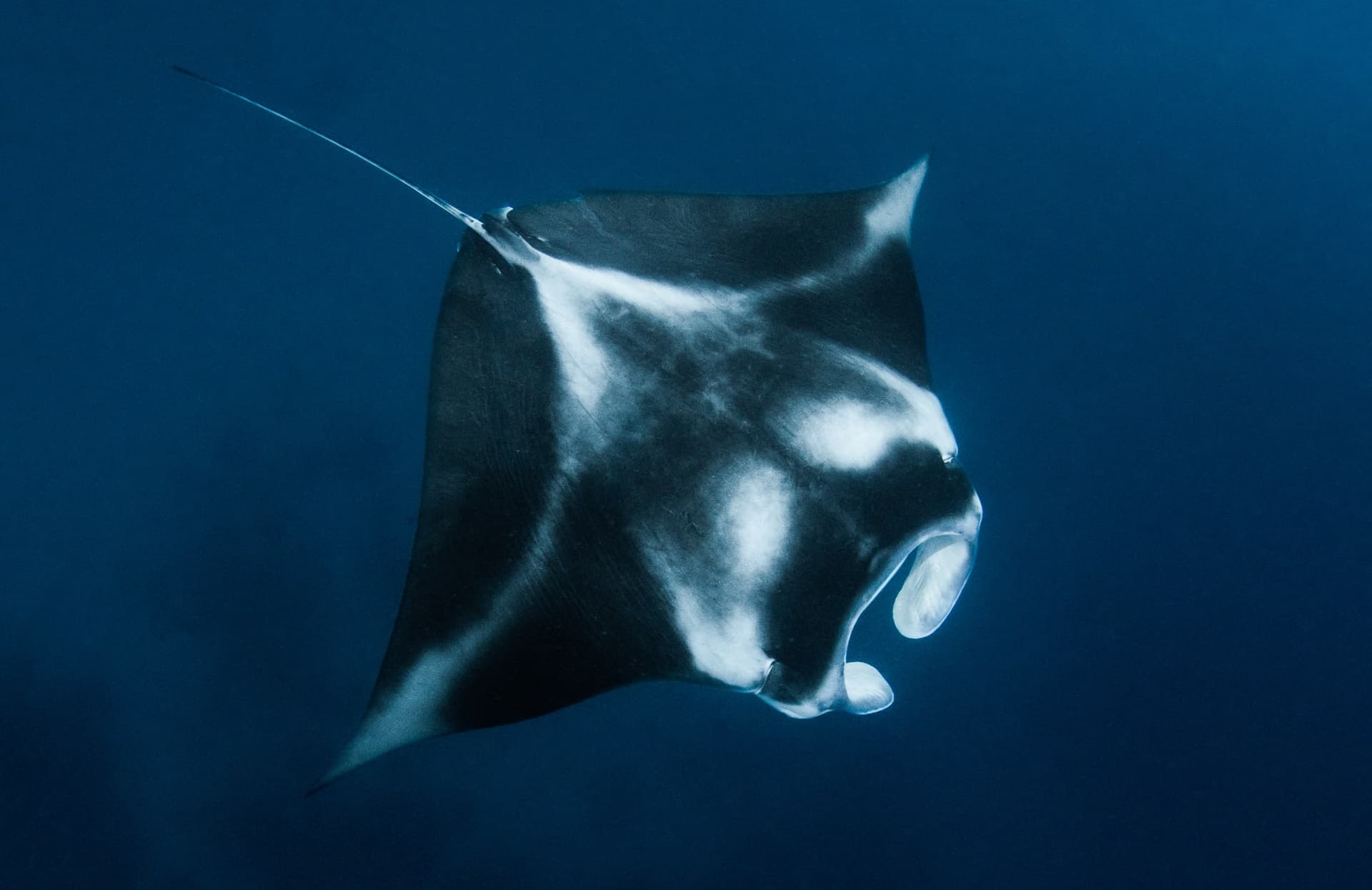
The man-made cut through Palau's reef where mantas queue up to be cleaned.
Diving German Channel is a lesson in what happens when moving water meets a reef. This broad sand-bottomed passage was blasted through Palau's southern barrier reef by German phosphate engineers in 1908, and more than a century later it has become one of the finest manta ray dive sites in the Pacific. On the right tide, you settle onto the sand at 18 metres, watch cleaner wrasse go to work, and wait — because sooner or later a manta the size of a dinghy glides in over your head, banks, and hangs motionless above a coral bommie to be groomed. It is patient, unhurried diving with a very big payoff.
Quick answer: German Channel is a sand-channel manta dive with drift potential; reef hooks used when current runs in Palau. Best season: November–April dry season; peak manta activity December–March on plankton-rich tides. Level: Advanced Open Water recommended — depth plus tidal current make it more than an entry-level dive. Depth: 12–25m; cleaning stations sit on a sandy plateau at 15–20m, with the outer reef dropping deeper. Typical visibility: Typically 20–30m, occasionally more; can drop when plankton blooms feed the mantas.
Facts verified September 2026
Why German Channel is Palau's signature manta dive
The channel exists because of bird droppings. In the early 1900s, German colonial engineers wanted a shortcut to move phosphate — mined from centuries of seabird guano on Angaur — out to ships waiting in deep water, so in 1908 they blasted a passage straight through the barrier reef. What they left behind is a wide, sandy corridor that funnels oceanic water in and out of the lagoon with every tide.
That tidal pumping is the whole story. Twice a day the channel carries nutrient-rich, plankton-laden water across a series of coral outcrops on the sand flat. Those outcrops are cleaning stations, staffed by cleaner wrasse, and the mantas come to them the way you would return to a favourite barber. Add the flushing current's gin-clear visibility and you have a rare combination: a reliable large-animal encounter on a forgiving sand bottom rather than a sheer wall.
What you'll see underwater
Mantas are the headline, and German Channel delivers them in two modes: hovering over the bommies to be cleaned, and — on a good plankton tide — barrel-rolling through the water column with mouths agape, feeding. Reef manta wingspans here commonly run three to four metres. But the channel is a busy piece of reef in its own right, and the supporting cast is excellent.
Expect a full spread of Palau's pelagic and reef life alongside the mantas.
- Reef manta rays at the cleaning stations and, on feeding tides, in the open water above
- Grey reef sharks patrolling the channel mouth and cruising the sand
- Eagle rays, green and hawksbill turtles, and the occasional leopard shark resting on the bottom
- Napoleon (humphead) wrasse, big-eye trevally, barracuda and snapper schooling in the current
- Garden eels, nudibranchs and reef fish across the sand flat and coral heads
Conditions and who German Channel diving suits
Be honest with yourself about current, because that is what defines this dive. German Channel is tidal, and the flow ranges from a lazy drift to a genuine rip depending on the state of the tide and the size of the exchange. Good operators plan the dive around the tide table — slack or gentle incoming water for parking at the cleaning stations, stronger outgoing water when they want to turn it into a drift.
Depth is moderate but real: the cleaning stations sit around 15–20 metres and you can slip deeper toward the outer reef, so you are managing bottom time and often air in current at the same time. This is why an Advanced Open Water certificate (or solid comparable experience) is the sensible baseline. You do not need to be an expert, but you should be comfortable with a negative entry, reef-hooking into current, and holding a stop while the boat drifts. Water is warm year-round at 27–30°C, and visibility usually sits in the 20–30 metre range, dropping a little when the plankton that draws the mantas is thick in the water.
When to dive it
Palau's dry season, roughly November through April, gives you the calmest seas, the most settled weather and the best all-round visibility. Within that window, December to March is the stretch to target for mantas: cooler, plankton-rich tides concentrate their feeding and cleaning activity, and encounter rates climb accordingly.
The wetter months from May to October still dive well and see fewer boats, but seas can be lumpier and manta sightings less predictable. Whatever the month, the daily tide matters more than the calendar — a well-timed dive on a modest exchange will out-fish a badly timed one during peak season, so trust your guide's read of the tide over any fixed schedule.
How you actually dive German Channel
Most dives begin with a negative entry over the channel mouth, a quick descent to the sand, and a swim or drift to the cleaning-station bommies. There you settle in, keep low and still, and let the mantas come to you — crowding a cleaning station is the fastest way to send one away. A reef hook earns its place here: hook into dead reef or rubble at the edge of a bommie, go neutral, and you can hang effortlessly in the current and simply watch. Keep it off living coral.
When the tide turns the dive into a drift, you unhook and let the channel carry you along the reef toward the exit, sharks and jacks stacking up in the moving water. It is a straightforward plan executed with care, which is exactly why timing and a guide who knows the site are worth more than any single technique.
Faneca dives German Channel aboard the Black Pearl on the Best of Palau itinerary, which is the way to do it justice — a liveaboard lets your guide pick the exact tide window for the mantas rather than being tied to a day boat's fixed departure from Koror.
German Channel: common questions
What is the best season to dive German Channel?
November–April dry season; peak manta activity December–March on plankton-rich tides
What experience level do I need for German Channel?
Advanced Open Water recommended — depth plus tidal current make it more than an entry-level dive
How deep is German Channel?
12–25m; cleaning stations sit on a sandy plateau at 15–20m, with the outer reef dropping deeper
What marine life will I see at German Channel?
Reef manta rays, grey reef sharks, eagle rays, Napoleon wrasse, barracuda, snapper and jack schools, turtles, nudibranchs
