Blue Corner
Palau's legendary reef-hook wall, where the current does the swimming and the sharks do the rest.
There are a handful of dives that define a country, and in Palau that dive is Blue Corner. Picture a reef plateau jutting into the open Pacific, a wall dropping into blue on two sides, and a current that turns the whole place into an underwater wind tunnel. You clip a reef hook into dead rock at the lip, let out a little air, and hang there like a kite on a string while grey reef sharks patrol the edge in front of you and a river of barracuda and jacks pours past overhead. Blue Corner diving is not subtle, and it does not need to be — it is simply one of the best big-animal dives on the planet, and it has earned every bit of that reputation.
Quick answer: Blue Corner is a drift wall / reef plateau with reef-hook hang in Palau. Best season: November–April (dry season); best shark action January–April. Level: Advanced — reef-hook and current experience strongly recommended. Depth: Plateau at 15–25 m; reef top from ~8 m, wall drops to 30 m and beyond. Typical visibility: ~15 m on an outgoing tide, 25–30 m+ on a clean incoming tide.
Facts verified September 2026
Why Blue Corner is famous
Blue Corner is a reef promontory on the outer edge of Palau's Ngemelis reef system, where the wall bends sharply and a shallow plateau pushes out into the deep water of the Philippine Sea. That geography is the whole story. Ocean current hits the corner, accelerates around it, and lifts nutrient-rich water up the wall and onto the plateau. Where there is current and food, there is life — and at Blue Corner life arrives in numbers that are hard to believe until you are hanging there watching it.
What makes this dive site special is not one single animal but the density and the choreography of everything at once. Sharks, big schooling pelagics, a resident cast of reef fish, and turtles all use the same stretch of reef, and the current stacks them into layers you can watch without moving a fin. It is consistently ranked among the greatest dives in the world, and unlike many sites that trade on a single lucky encounter, Blue Corner delivers this on an ordinary day.
What you'll see
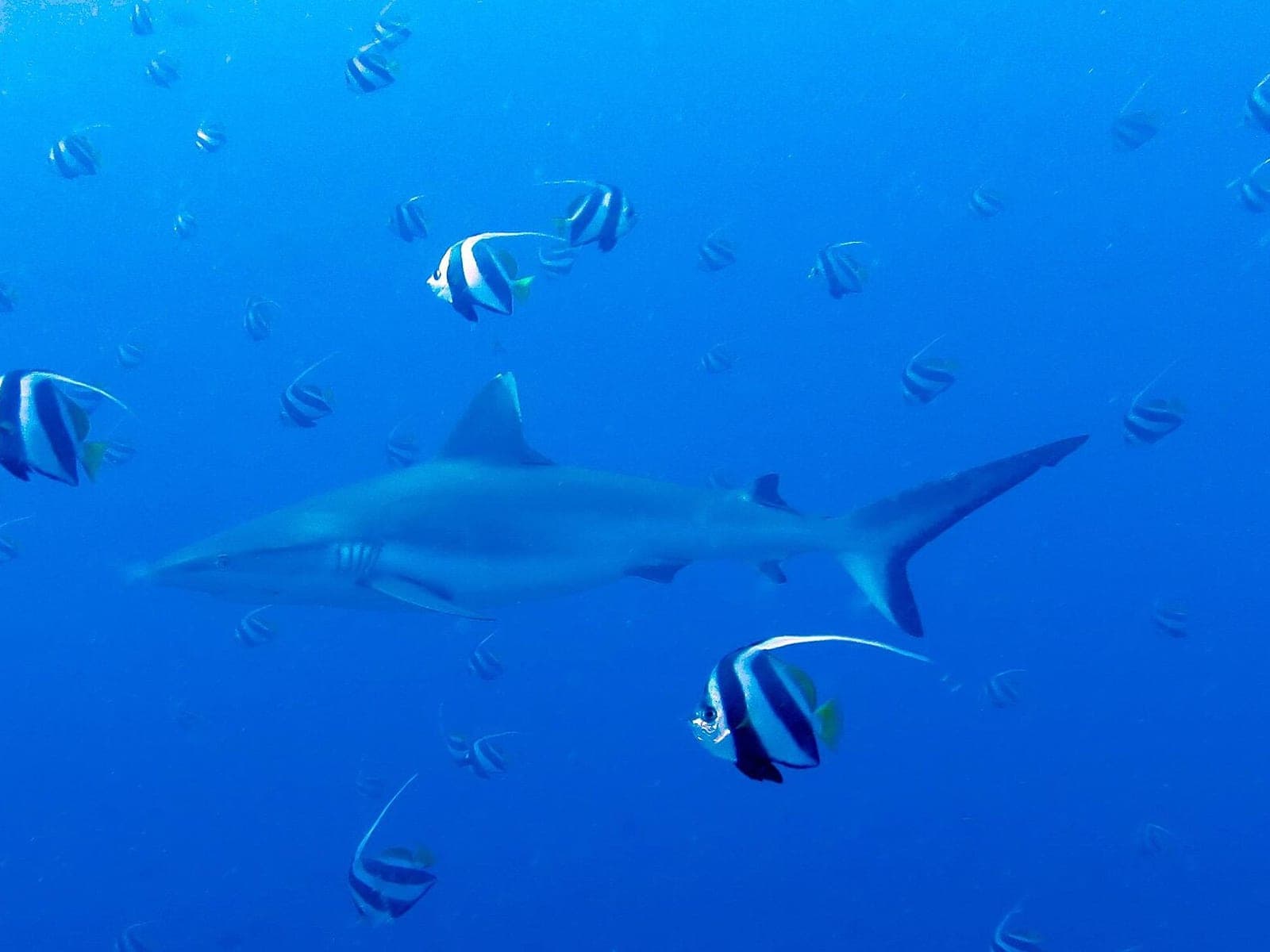
Grey reef sharks are the headliners. On a good incoming tide it is normal to have dozens in view at once, holding into the current just off the reef edge, close enough that you stop counting. Around and above them the water fills in with pelagics and reef life:
- Grey reef sharks patrolling the plateau edge, sometimes joined by whitetips
- Big schools of barracuda, big-eye trevally (jacks) and snapper stacked in the current
- Napoleon (humphead) wrasse — often large, curious individuals that cruise right up to divers
- Bluefin tuna, mackerel and the occasional wahoo hunting the bait balls
- Hawksbill and green turtles grazing the reef top
- Spotted eagle rays and, in season, the odd manta or passing hammerhead
Conditions and who it's for — an honest read
This is an advanced dive, and it is worth being straight about why. The current at Blue Corner is strong and genuinely unpredictable — it can run hard in one direction, switch, or develop an up- or down-current with the tide and moon phase. That is exactly what brings the animals, but it means this is not a site for your tenth dive. You want solid buoyancy, comfort in blue water, and a calm head when things pick up.
The reef hook is the key that unlocks the whole experience: a stainless hook on a short line that you set into dead reef rock at the lip, then add a touch of air so you kite up off the bottom. Hooked in, you stop fighting the current and simply watch. Setting it well — into bare rock, never live coral — and unhooking cleanly to drift off at the end are skills your guide will brief in detail. If you are AOW-certified with a handful of current dives behind you, you will be fine and you will love it. If you are newer, Palau has gentler sites to build up on first, and any honest operator will tell you the same.
When to dive Blue Corner
Palau dives year-round, but the sweet spot is the dry season from November to April, when the seas are calmest and visibility is at its best. Shark activity peaks from roughly January to April, and that stretch also brings the best odds of the big fish aggregations the site is known for. Visibility swings noticeably with the tide: an outgoing tide can drop it to around 15 metres and murkier green, while a clean incoming tide opens the water to 25–30 metres of blue.
The tide is as important as the calendar. Guides plan Blue Corner around slack-to-incoming water, both for cleaner visibility and because the shark action tends to switch on with the inflowing current. This is a site you want to dive on the operator's timing, not the clock's.
How you actually dive it
A typical dive drops you on the outer wall, where you drift and descend along the reef to around 20–25 metres before working up onto the plateau at the corner itself. As you reach the lip you find a patch of bare rock, set your hook, and settle in facing the current while the sharks and schools work the edge in front of you. After your hang you unhook, let the current carry you up and over the reef top at 8–12 metres, and spend the shallow end of the dive drifting the coral garden on the plateau — often the most relaxed and colourful part of the whole dive.
Blue Corner sits within easy reach of Palau's other marquee sites — Blue Holes just around the wall, German Channel's manta cleaning stations, and the world-class drift of Ulong Channel — so it is almost always dived as part of a multi-site day. It can be reached by day boat from Koror, roughly a 45–60 minute run each way, but the corner rewards divers who can be first in the water on the right tide and dive it more than once. That flexibility is where a liveaboard changes the experience entirely.
Faneca dives Blue Corner aboard the Black Pearl on our Best of Palau itinerary, and this is a site that genuinely rewards the liveaboard approach — being moored close by lets us put you in on the right tide, dive the corner more than once, and pair it with Blue Holes, German Channel and Ulong Channel on the same trip.
Blue Corner: common questions
What is the best season to dive Blue Corner?
November–April (dry season); best shark action January–April
What experience level do I need for Blue Corner?
Advanced — reef-hook and current experience strongly recommended
How deep is Blue Corner?
Plateau at 15–25 m; reef top from ~8 m, wall drops to 30 m and beyond
What marine life will I see at Blue Corner?
Grey reef sharks, Napoleon wrasse, barracuda, big-eye trevally, snapper, tuna, turtles, occasional eagle rays and mantas
