Maldives Liveaboard or Resort? How to Choose for Diving
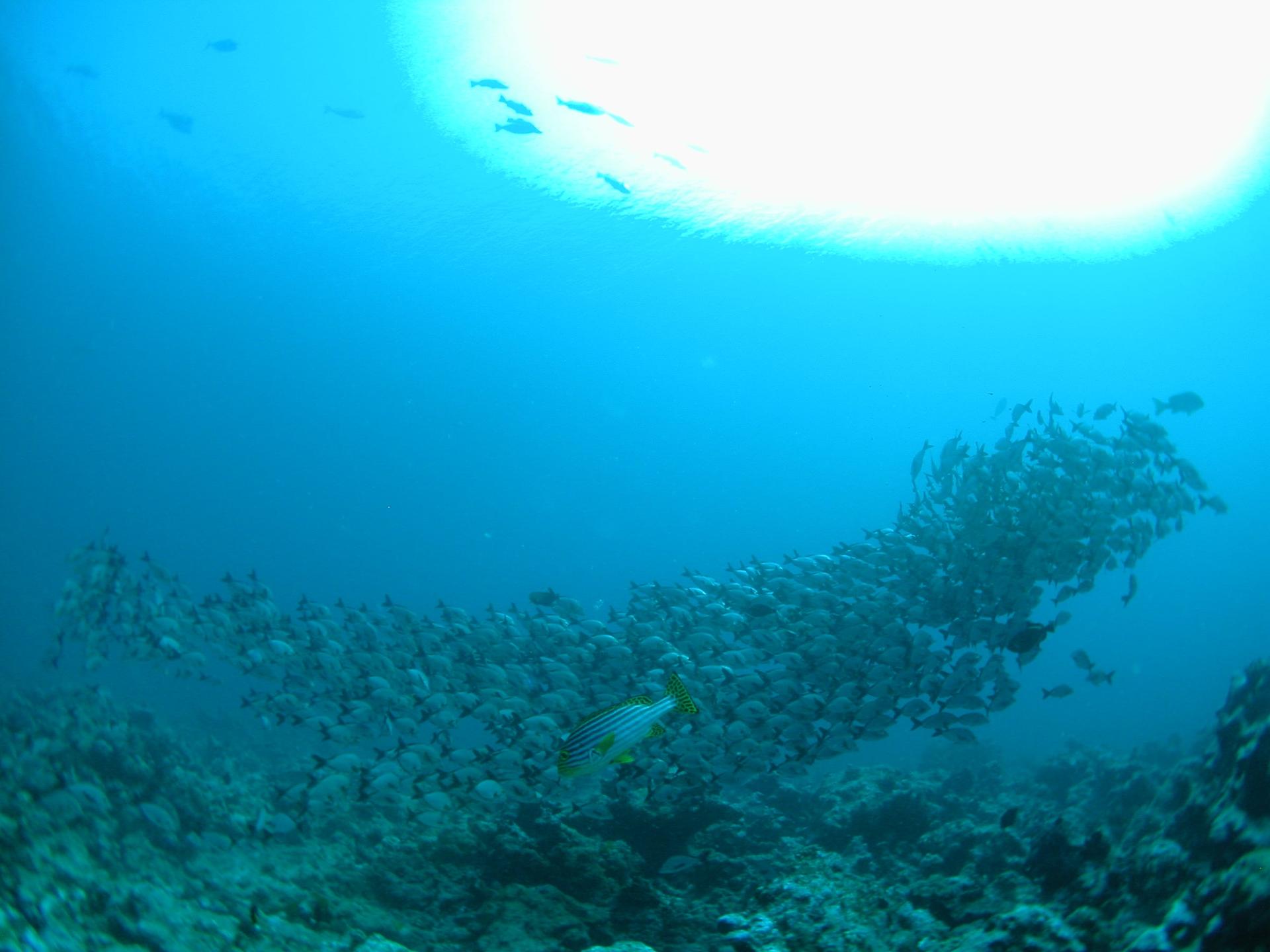
Photo: TANAKA Juuyoh, CC BY 2.0
In the Maldives a liveaboard, a resort and a guesthouse can all put you on good dive sites. A resort's dive boat reaches the channels of its own atoll, and so does a dive centre on a local island. The liveaboard adds range: several atolls in one week, three dives a day, and the long routes to the far south. It takes away a room on land, a beach, and on most routes anything for a non-diver to do.
This guide sets the three side by side. It goes further than the Maldives line in our general guide to liveaboard or resort diving. We sell the boats, and for some travellers the resort is still the better booking.
The short answer
| Liveaboard | Resort island | Guesthouse on a local island | |
|---|---|---|---|
| Sites you reach | Several atolls in one week. On the long routes, the deep south or the far north | The house reef, and the channels and pinnacles (thilas) within a boat ride of the island | The sites within a day boat's reach of that island |
| Dives a day | Up to three, with a night dive on some boats. Usually 16 to 18 dives in seven nights | Usually two boat dives in the morning, with an afternoon or house-reef dive if you want it | Usually two or three from the dive centre's boat |
| Who it suits | Divers who want as much diving and variety as a week allows | Couples and families where not everyone dives, newer divers, anyone who wants one dive a day and a beach | Divers on a tighter budget who are happy with a simple room and village life |
| How the bill is built | One fare per person for the cabin, full board and the diving, from €1,795 for seven nights. Green tax and, on some boats, a service charge and a fuel surcharge are added | The room by the night, a meal plan and the transfer, then the diving by the dive or in a package, with tax and service charge on top | A room and meals at local prices, a ferry, speedboat or domestic flight, then the diving by the dive or in a package |
The fare in the first column is today's lowest for a confirmed seven-night sailing with space, per person sharing a cabin.
If diving is the reason for the trip and everyone travelling dives, take the boat. If one of you does not dive, or the diving is one part of a holiday, take the resort. If the budget decides and you do not need resort comforts, look at a guesthouse on an island with a dive centre.
What each one is like for a diver
On a liveaboard the boat meets you at the airport, usually Malé, and you live on it for the week. Most Maldives liveaboards dive from a dhoni, a separate dive boat that carries the tanks and compressors. The boat moves between dives or overnight, and the crew picks each site for the current and the tide on the day. The standard week covers the central atolls: North and South Malé, Ari and Vaavu, with channel dives such as Fotteyo Kandu, manta cleaning stations and the whale shark area off South Ari. You share a cabin, the decks and the dive schedule with the other guests, and you are at sea all week.
At a resort the dive boat goes to sites within reach of the island, which means the thilas and channels of one atoll, sometimes its neighbour. How good that diving is depends on where the island sits. A resort near the channels on the rim of an atoll dives very differently from one deep inside a lagoon, so check the dive centre's site list before you choose the room.
From a guesthouse the diving works like a resort's. Life on land is different: see below.
What only the boat reaches
Several atolls in one week. A resort boat works one atoll. A liveaboard week links three or four and moves on when the weather turns. That variety is the main thing the fare buys.
The deep south. Huvadhoo's shark channels, the lone island of Fuvahmulah and Addu, the last atoll in the chain, are dived together only from a liveaboard, mostly from January to March. The diving is more exposed, and boats typically ask for Advanced Open Water and 50 or more logged dives. Fuvahmulah on its own can also be dived from the island, where divers stay for a week at a time. What needs the boat is linking the three. The Deep South route page has the season, the flights and the dates, and our Fuvahmulah guide describes the island.
The far north. A few longer trips each year go to the far northern atolls, on boats that typically ask for more experience than the central week does.
Baa Atoll in the manta season, from May to November, is a partial case. Liveaboards go, and so do the resorts and guesthouses of Baa itself. Hanifaru Bay is snorkel-only for everyone, by permit, whichever way you arrive. The Hanifaru Bay and Baa Atoll route page explains how a boat week there works.
What a resort does better
- A house reef. Where a resort has a good one, you can dive or snorkel it from the shore, at your own pace and more than once a day. Not every island has one worth the name, so ask.
- Privacy and space. A room and somewhere to be alone. On a boat you share the decks all week.
- Non-divers and children. A beach, a lagoon and snorkelling from the shore. On most liveaboard routes a non-diver has the sundeck and a book.
- One atoll, dived properly. Diving the same channel several times, on different tides, teaches you more about it than a single pass from a boat that leaves the next morning.
- Freedom over dates. Arrive any day and stay as long as you like. Boats sail on fixed dates.
The third option: a guesthouse on a local island
Guesthouses on inhabited islands have opened a third way to dive the Maldives. A number of local islands have dive centres whose day boats reach the same channels the resorts use. Dhigurah sits beside the South Ari whale shark area. Fulidhoo is in Vaavu, near its channels. Dharavandhoo, in Baa, is a short boat ride from Hanifaru Bay. Fuvahmulah is dived from the island itself.
The diving can be as good as from a resort nearby, for a much lower room price. The green tax is lower too: US$6 per person per night at guesthouses and hotels with 50 rooms or fewer on inhabited islands, against US$12 at resorts, larger hotels and on tourist vessels, which is what a liveaboard is.
What changes is life on land. These are Muslim communities, not resorts, and the rooms are simple.
- Alcohol is not available on inhabited islands. It is served only at resorts and on liveaboards, and you may not bring it into the country.
- Dress away from the tourist beach covers shoulders and thighs, for men and women. Swimwear is for the beach set aside for visitors and for the boat.
- During Ramadan visitors do not eat, drink or smoke in public in the daytime.
For a diver who wants the water and not the villa, it is a sound choice.
What it costs
A liveaboard fare covers the bed, the food, about three dives a day and the travel between atolls. A resort bill has more parts, with boat fees and equipment often as separate lines after the room, the meals and the transfer.
Divide each bill by the dives. For someone who dives three times a day, the liveaboard usually comes out lower per dive than a resort. For one dive a day, or for a couple where one person does not dive, it does not. Our Maldives liveaboard cost guide sets out every charge on the boat side, by route and season.
Which suits you
An experienced diver. The boat. You get the channels of several atolls, and the deep-south and far-north routes are open to you. The dry season, December to April, has the clearest water.
A newer diver. It depends on your logbook. On the central atolls boats typically ask for Open Water to Advanced and about 30 logged dives, and Advanced is strongly recommended for the channel dives. Baa Atoll weeks in the manta season ask for less, between 10 and 30 logged dives depending on the boat. With fewer dives than that, or none in current, a resort or a guesthouse is the better first trip, and the boat can wait a year. Our requirements guide compares routes.
A couple where one dives. Usually the resort. The exceptions are the Baa Atoll manta weeks, where everyone snorkels in the bay, and the boats that welcome non-divers on central routes. Not every boat does, so tell us who is travelling. Our guide to liveaboards with a non-diving partner goes through it.
A family. The resort. Children have a beach and a shallow lagoon, PADI's junior certification starts at age 10, and nobody is confined to a deck. Boats set their own minimum ages, and a week at sea is long for a child who does not dive.
A photographer. Either. The boat gives more dives and more subjects in a week. A resort lets you return to the same cleaning station or house reef day after day, and gives you a room for the equipment.
A snorkeller. A resort with a good house reef is the best base in most months. From May to November a Hanifaru week on a boat is the one liveaboard trip built around a snorkel. Mantas feeding in the bay are never certain, and our season guide gives the months.
Doing both
A boat week and resort nights combine well, in either order.
Boat first, then the resort. The rest comes after the diving, which also helps with flying after diving. DAN's guidance is to wait at least 12 hours after a single no-decompression dive and at least 18 hours after several dives a day or several days of diving. A seaplane is a flight, and so is a domestic turboprop. Boats plan the last dive so that the interval is kept before a flight on the morning you leave, and that covers a seaplane to a resort as well. Tell us your plan and we will confirm the times in writing.
Resort first, then the boat. A few easy dives from land let you check your weighting and adjust to the time zone, and the days in hand cover a delayed flight or a late bag before the boat's fixed sailing day.
Two practical points. Seaplanes fly only in daylight, so if your international flight lands in the late afternoon, expect a night near the airport before the transfer. And at the resort end of a trip, stop diving the day before you fly.
Maldives dates with space
The next sailings with space, live:
| Date | Destination | Route | Nights | From |
|---|---|---|---|---|
| 23 Nov 2026 | Maldives | Heart of the Maldives | 7 | €2,458 |
| 26 Nov 2026 | Maldives | Central Atolls | 7 | €2,713 |
| 29 Nov 2026 | Maldives | Best of Central Atolls (7 nights) | 7 | €4,185 |
| 5 Dec 2026 | Maldives | Best of Central Maldives (Ari) | 11 | €1,480 |
| 20 Dec 2026 | Maldives | Deep South (Male to Gan) | 13 | €5,749 |
| 4 Jan 2027 | Maldives | Best of Central Atolls | 7 | €3,291 |
Every date is on the Maldives calendar, and the routes are on our Maldives liveaboards page.
Four short questions
Is a liveaboard or a resort better for diving in the Maldives?
For the amount and variety of diving, the liveaboard. For a holiday where diving is one part, or where someone does not dive, the resort.
Can a newer diver join a Maldives liveaboard?
On the central atolls, yes: boats typically ask for Open Water to Advanced and about 30 logged dives. The deep south asks for Advanced Open Water and 50 or more.
Can a non-diver come on a Maldives liveaboard?
On some boats and some routes. The Baa Atoll manta weeks suit a snorkeller best, because Hanifaru Bay is snorkel-only for everyone. Otherwise a resort is the better choice.
Is a liveaboard cheaper than a resort?
Per dive, usually, if you dive three times a day. In total it depends on the resort. A guesthouse on a local island is usually the cheapest way to dive the Maldives.
Send us your dates, your logged dives and who is travelling through the concierge, and we will say in writing whether a boat fits and which one.
Related Guides
Related Articles
When to Dive the Maldives: Month by Month
Two monsoons, different atolls, different animals. When to go depends entirely on what you want to see, and most operator websites will not tell you the real tradeoff. Here is the month-by-month for 2026.
Diving the Azores: Blue Sharks, Mobulas and the North Atlantic's Largest Protected Network
In 2024 the Azores created the largest network of marine protected areas in the North Atlantic, about 287,000 km² of ocean that blue sharks, mobulas and sperm whales pass through. Here is why we think it is the most underrated diving in Europe, island by island and month by month.