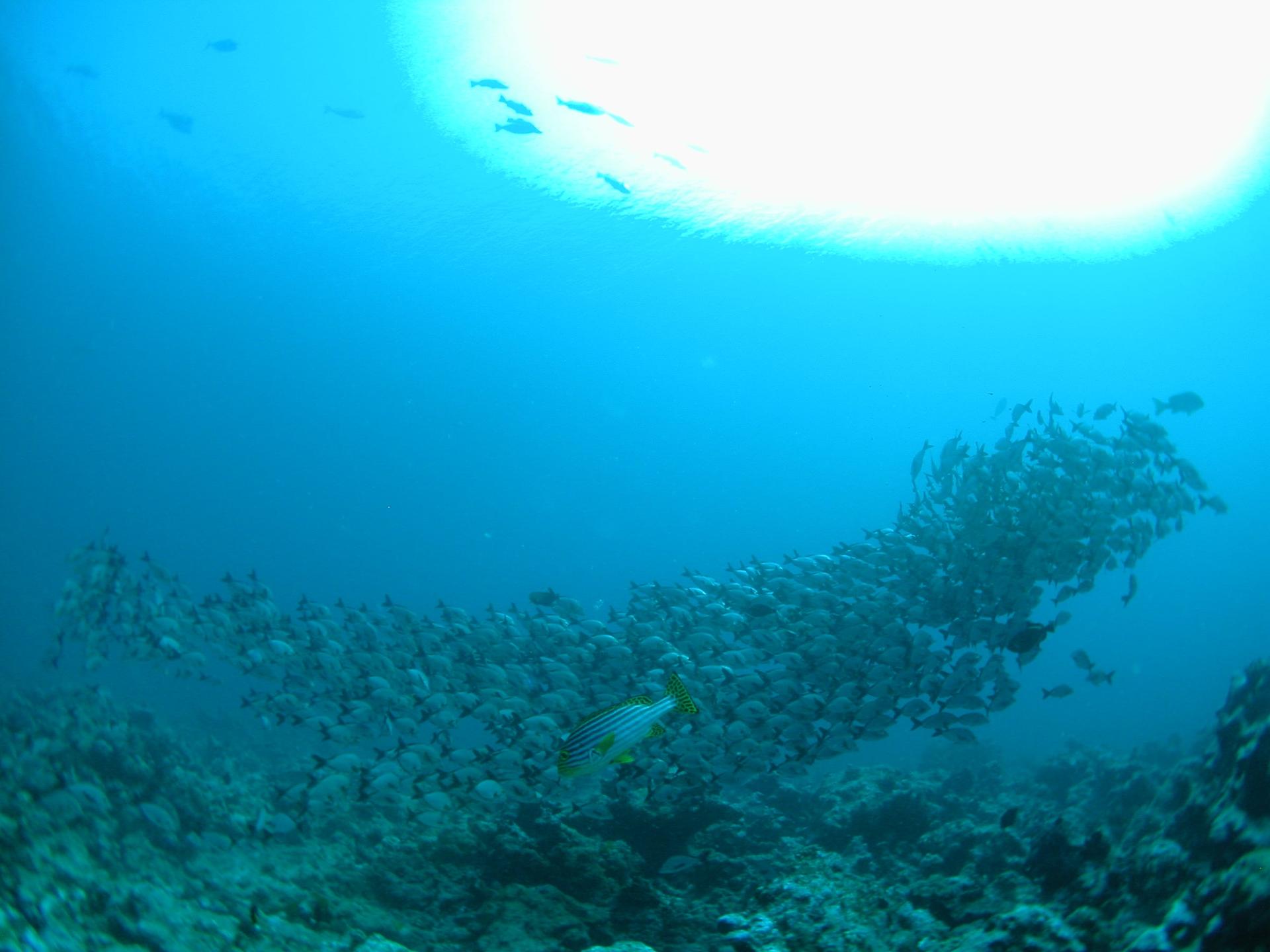
Maaya Thila
A small, round pinnacle inside North Ari Atoll, dived by day for its reef and after dark for whitetip reef sharks on the hunt.
Maaya Thila is one of the best-known dives in Ari Atoll and the usual night dive of a central-atolls week. It is a single round pinnacle, about 80 metres across, standing on sand inside North Ari Atoll a few kilometres north-west of Maayafushi island. It has been a protected marine area since 1995. At night whitetip reef sharks, giant trevally and moray eels hunt across the top, and that is the dive most people come for.
Quick answer: Maaya Thila is a submerged pinnacle (thila) inside the atoll, dived by day and as a night dive in Maldives. Best season: All year. December to April (northeast monsoon) usually has the calmest sea and the clearest water; the night dive runs in both seasons. Level: Boats typically ask for Open Water to Advanced Open Water and about 20 to 50 logged dives on central-atolls weeks. The night dive suits divers with settled buoyancy who have dived in the dark before. Open Water divers stay above 18 m. Depth: Reef top at about 6 to 8 m; sand at 30 to 40 m around the base; dives are planned to 30 m at most. Typical visibility: About 20 to 30 m in the northeast monsoon, sometimes more; less on an outgoing tide, in plankton and after dark.
Facts verified November 2026
What Maaya Thila is
In Dhivehi a thila is a pinnacle whose top stays under water even at low tide, and a kandu is a channel through the atoll rim. Maaya Thila is the first kind. It stands inside the atoll, not in a channel mouth, so it is more sheltered than the outer passes, although tidal current still sweeps it.
The pinnacle rises from sand at 30 to 40 metres to a flat top at about 6 to 8 metres. The sides are steep and cut with small caves and overhangs, lined with soft corals and sea fans. At around 80 metres across it is small enough to swim round in one dive when the current allows, which is why it works after dark: there is always reef beside you.
It has been a protected marine area since 1995, among the first dive sites in the country to be listed. Survey dives by the Maldives Marine Research Institute between 2009 and 2018 recorded whitetip reef sharks and grey reef sharks here in every season.
What you will see
By day, whitetip reef sharks rest on the sand around the base or circle the pinnacle, and grey reef sharks gather on the side the current is coming from. Researchers describe groups of up to ten grey reef sharks as common.
After dark the roles change. Whitetip reef sharks are night hunters, and here they work the reef in small groups. Giant trevally and moray eels hunt alongside them, and marbled rays move over the sand.
- Whitetip reef sharks: resting by day, hunting in groups at night
- Grey reef sharks on the up-current side by day
- Giant trevally and other jacks hunting across the reef top after dark
- Moray eels out of their holes at night
- Marbled rays, octopus and turtles
- Soft corals and sea fans in the caves and overhangs
The night dive and your torch
The hunters here have learned to use divers' lights. Trevally and sharks follow the beams and strike at fish that are lit up. That is a human effect on the hunt, and it is the reason for the main rule of the briefing: do not hold your beam on a sleeping or sheltering fish, and do not point out prey to the predators. Keep the light low and moving, or on the reef just ahead of you.
Nothing is fed on this dive and nothing should be touched. It is a popular night dive, so other groups may be on the pinnacle at the same time. Stay with your own guide and follow the light signals agreed in the briefing.
Conditions and who it is for
With little current this is an easy dive at moderate depth. With strong current it is not: the pinnacle is small, the water around it is 30 to 40 metres deep, and a diver swept off the top is in open water. Crews then keep the dive for experienced divers or move it. Carry a surface marker buoy on every dive here, day or night.
Boats on central-atolls weeks typically ask for Open Water to Advanced Open Water certification and somewhere between 20 and 50 logged dives. Open Water divers should plan the dive above 18 metres, which loses little, because the top and the upper walls are where the night hunting happens. For the night dive you want settled buoyancy and, ideally, earlier dives in the dark. Water is about 27 to 31°C through the year.
The descent matters most at night. A small pinnacle is easy to miss in poor visibility, and below it there is only sand, deeper than the 30-metre limit for recreational diving in the Maldives. Go down with your guide, keep the reef in view and watch your depth, not the sharks.
When it is dived
Maaya Thila is dived in every month and the sharks are recorded all year. The northeast monsoon, roughly December to April, usually brings the calmest sea and the clearest water. In the southwest monsoon, May to November, there is more wind, rain and plankton and visibility is lower.
Within the day, the tide decides. An outgoing tide carries lagoon water over the pinnacle and can cut visibility sharply. Guides check the current before the dive and choose the entry point, or put the dive off, on what they find.
How the dive runs
Boats on central-atolls weeks usually anchor nearby for the evening and dive the thila from the dhoni after dusk. Many also dive it by day. You descend with the guide to the top or the up-current edge, go down the wall to the depth agreed in the briefing, then work back up slowly around the pinnacle and finish on the top.
The top lies a little below safety-stop depth. The stop is made at about 5 metres just above the reef if the water is still, or drifting off it under a surface marker buoy if the current is running.
Maaya Thila is dived on central-atolls weeks that include North Ari Atoll, most often as the night dive. Not every departure reaches it and the current has the last word, so say in your concierge brief if it matters and we will point you to the weeks that plan it. See also our Maldives liveaboards page and the night diving guide.
Maaya Thila: common questions
What is the best season to dive Maaya Thila?
All year. December to April (northeast monsoon) usually has the calmest sea and the clearest water; the night dive runs in both seasons
What experience level do I need for Maaya Thila?
Boats typically ask for Open Water to Advanced Open Water and about 20 to 50 logged dives on central-atolls weeks. The night dive suits divers with settled buoyancy who have dived in the dark before. Open Water divers stay above 18 m
How deep is Maaya Thila?
Reef top at about 6 to 8 m; sand at 30 to 40 m around the base; dives are planned to 30 m at most
What marine life will I see at Maaya Thila?
Whitetip reef sharks, grey reef sharks, giant trevally, moray eels, marbled rays, octopus, turtles, fusiliers, soft corals and sea fans