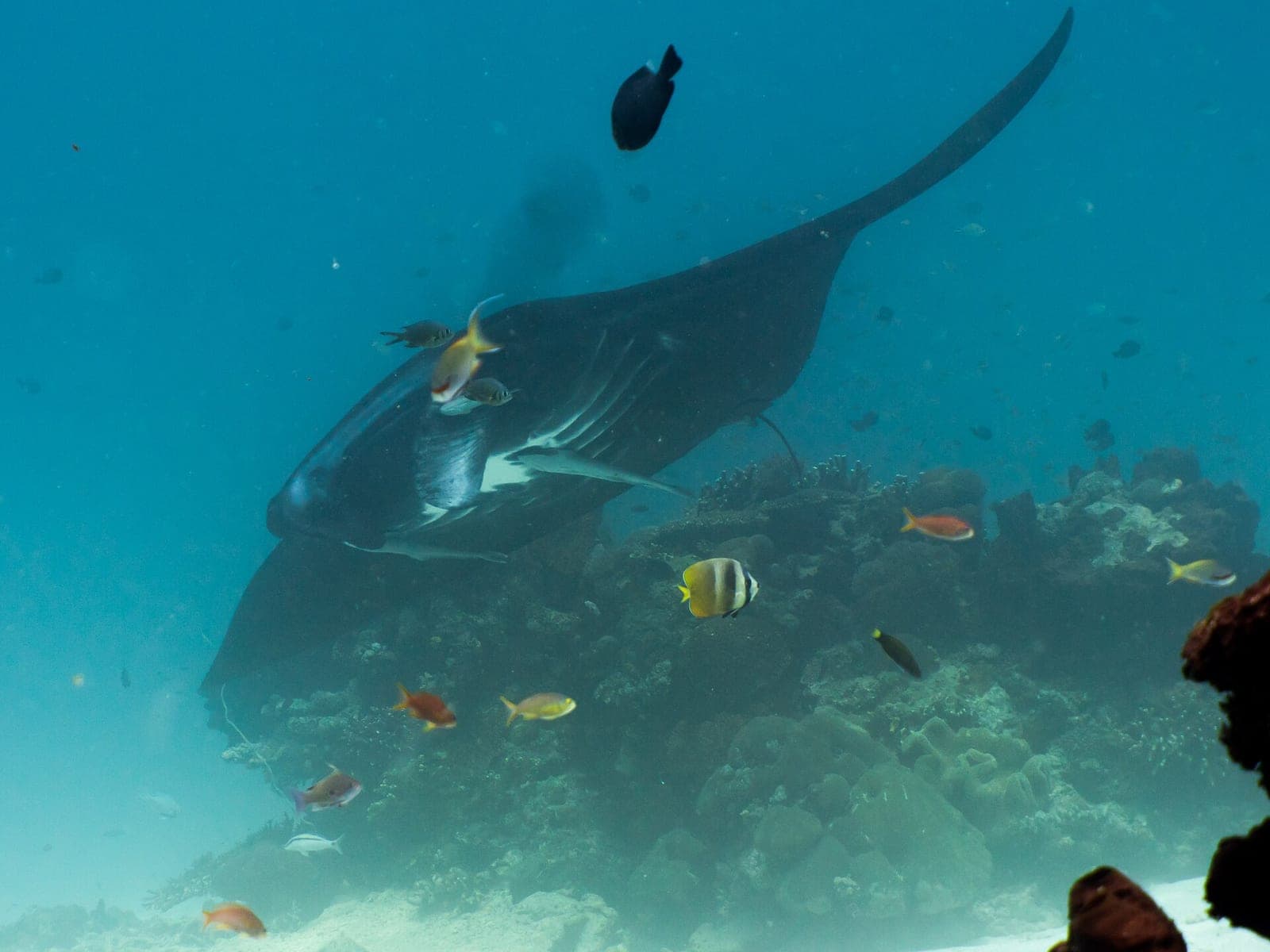
Hanifaru Bay
One funnel-shaped bay, a clashing current, and sometimes two hundred manta rays wheeling through plankton at once.
Hanifaru Bay is the most famous manta aggregation on Earth, tucked into the eastern rim of Baa Atoll in the Maldives. It is also one of the most tightly protected — a snorkel-only marine reserve where scuba tanks are banned outright. Understanding why matters, because it shapes everything about how you experience it. When the plankton pours in and the mantas arrive to feed, this shallow cul-de-sac of reef delivers a wildlife spectacle that no purpose-built dive site can match. This guide covers what actually happens here, the honest conditions, the strict access rules, and how a Maldives liveaboard gets you there at the right moment.
Quick answer: Hanifaru Bay is a snorkel-only plankton-feeding aggregation site inside a protected channel/bay (not a scuba dive) in Maldives. Best season: Southwest monsoon, May–November; peak aggregations late July to early October. Level: Snorkel-only — suitable for confident swimmers/snorkelers of all levels; no dive certification needed. Depth: Shallow bay, roughly 7–24 m; snorkeled from the surface (no scuba permitted). Typical visibility: Reduced during feeding events (roughly 5–15 m) because the water is thick with plankton; clearer between events.
Facts verified September 2026
Why Hanifaru Bay is unlike any dive site
Most great manta encounters happen at cleaning stations, where a handful of rays hover to be groomed. Hanifaru is a feeding site, and that changes the scale entirely. The bay is a small, dead-end pocket of reef shaped like a funnel. When the southwest monsoon current meets the outgoing tide, the two collide right at the mouth of the bay and drive a dense soup of plankton into the shallows, where it has nowhere to disperse. The mantas follow the food.
On a good day you might share the water with a few dozen reef mantas. On an exceptional one, well over a hundred can pack the bay at the same time, and the feeding turns into behaviours you rarely see anywhere else — chain feeding, where rays line up nose-to-tail, and cyclone feeding, where dozens spiral in a slow tornado to trap the plankton between them. It is genuinely one of the great wildlife gatherings in the ocean, and it is the reason Baa Atoll became a UNESCO Biosphere Reserve in 2011.
What you'll see
The headline act is the reef manta ray, and in peak season the numbers can be staggering. Whale sharks — usually juveniles drawn by the same plankton bloom — turn up too, though far less predictably than the mantas. Manage your expectations on the whale sharks: they are a bonus, not a guarantee.
- Reef manta rays (Manta alfredi) — from a handful up to 100+, chain and cyclone feeding
- Juvenile whale sharks — seasonal and less frequent, but a real possibility
- Mobula rays mixed into the aggregation
- Dense schools of reef fish and the occasional eagle ray around the bay's edges
- The plankton itself — the thick, particle-heavy water is the whole point, so expect soup, not blue
Conditions and who it's for
Because scuba is banned, this is a snorkeling experience, and that levels the playing field — you do not need a certification, only the confidence to swim and free-float in open water while a lot is happening around you. That said, it is not always the gentle drift people imagine. Feeding is current-driven, so there is usually water moving, and when mantas swarm the bay it can get crowded with both animals and other snorkelers. Good fins, a comfortable mask, and the composure to hold position without kicking at the wildlife go a long way.
Visibility is the honest caveat. During the best feeding events the water is thick with plankton and clarity drops to roughly 5 to 15 metres — the mantas are close and constant, but this is not a crystal-blue postcard scene. Between events the water clears but the animals thin out. You are trading visibility for density, and the trade is worth it.
When to dive it
The season tracks the southwest monsoon, running May through November. The aggregation builds toward the middle of the season, with the most reliable big gatherings from late July into early October. Peak months are usually August through October.
Timing within the season matters as much as the month. The strongest feeding tends to cluster around the new and full moons, when tidal exchange is greatest and pushes the most plankton into the bay. A good operator watches the moon, the tide tables and the Manta Trust's sightings network, then moves you to the bay on short notice when conditions line up. Outside May–November the bay is quiet and the mantas shift to other parts of the atoll, so trips are firmly seasonal.
How you actually dive it — the rules
Hanifaru has been a Marine Protected Area since 2009 and access is strictly managed by rangers. Scuba has been prohibited since 2012 because bubbles and heavy gear disrupt feeding, so everyone enters on snorkel. Expect a park fee (around USD 20 per person) collected at the ranger station, a cap on how many boats and swimmers can be in the water at once — a maximum of roughly five vessels and 80 people — and time-limited slots rather than open access. Only small tender boats (dhonis) are allowed in; motoring, fishing and touching are forbidden.
There are firm distance rules: keep clear of the animals, give whale sharks several metres of space, and never chase, block or reach out to a manta. Rangers are on the water enforcing all of this. Follow it — the rules are the reason the spectacle still exists.
Faneca reaches Hanifaru via our Maldives liveaboards, which cruise Baa Atoll and slot the bay in when the rangers, tides and moon align — but be clear that Hanifaru itself is a snorkel-only Marine Protected Area, not a scuba dive, so enquire about liveaboard itineraries timed to the May–November manta season if this is the encounter you're after.
Hanifaru Bay: common questions
What is the best season to dive Hanifaru Bay?
Southwest monsoon, May–November; peak aggregations late July to early October
What experience level do I need for Hanifaru Bay?
Snorkel-only — suitable for confident swimmers/snorkelers of all levels; no dive certification needed
How deep is Hanifaru Bay?
Shallow bay, roughly 7–24 m; snorkeled from the surface (no scuba permitted)
What marine life will I see at Hanifaru Bay?
Reef manta rays (Manta alfredi) in the dozens to 100+, juvenile whale sharks, mobula rays, schooling reef fish
