When to Dive Bikini Atoll: Seasons, Weather Windows and the Booking Reality
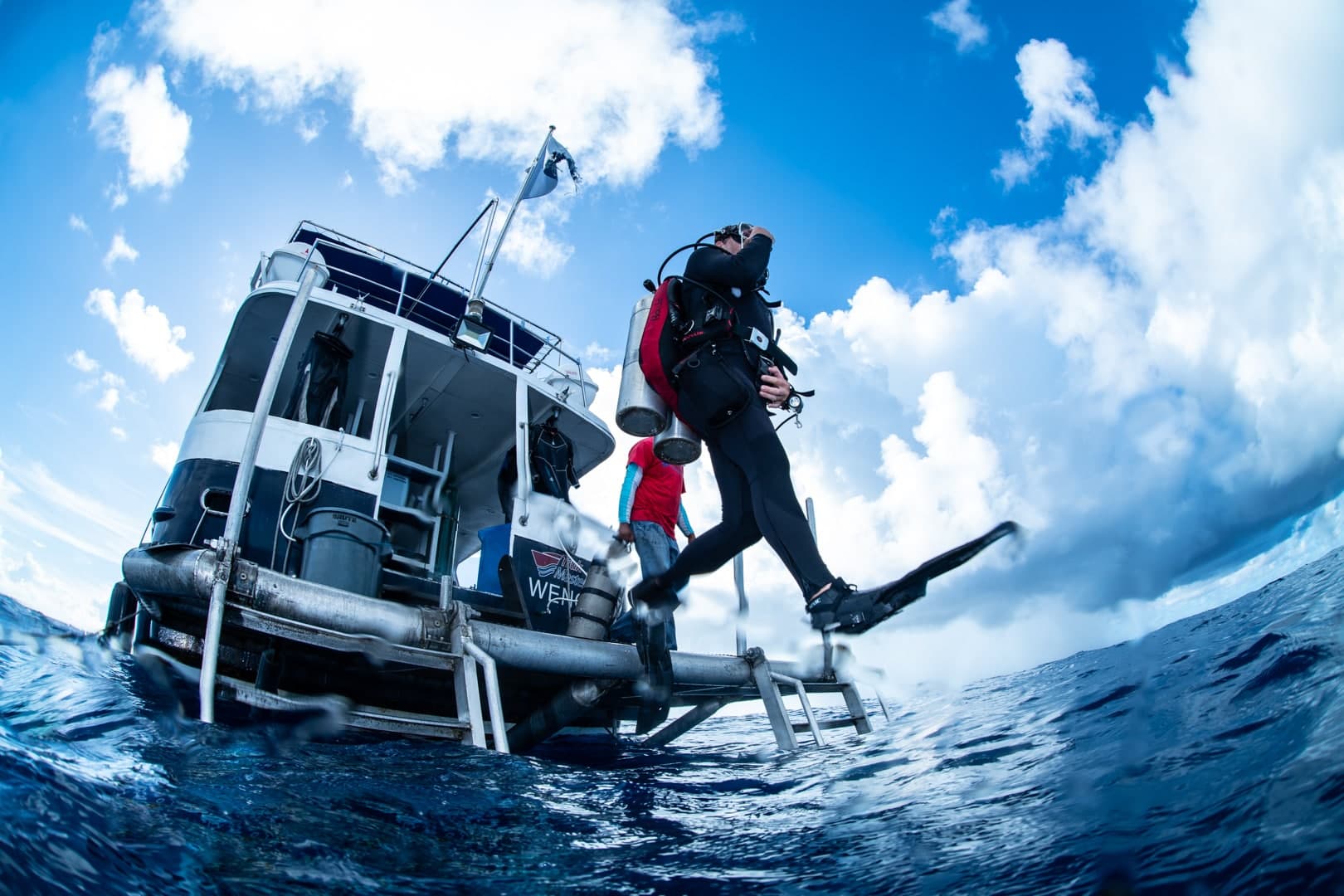
Bikini Atoll has a hard operating season: May to October, and that is it. Water temperature barely matters to the decision — it sits at 28–30°C year-round, even at wreck depth — because the real constraints are trade winds, a 2,000-mile ocean crossing to get the boat there, and the fact that essentially one liveaboard with 16 spaces serves the entire destination. If you want a specific year, plan on committing 12–18 months out, sometimes longer.
That is the answer in three sentences. The rest of this guide is the reasoning — because at Bikini, more than almost anywhere else we book, the calendar is not really about weather. It is about scarcity.
The season at a glance
- Operating window: May through October. No boats run November to April.
- Best conditions: roughly May to early July — the northeast trades have died, the ITCZ disturbances haven't fully ramped up, and the lagoon is at its calmest.
- Still very good: July through October, with more frequent (short) tropical squalls and a slightly higher chance of a rough crossing day.
- Water temperature: 28–30°C at the surface, and still around 27–28°C at 50m on the USS Saratoga. A 3mm or 5mm suit covers a week of long decompression hangs.
- Visibility: typically 20–30m inside the lagoon; it is good enough year-round that nobody picks a month for viz.
If your only question was "which month," you can stop here: aim for May, June or early July if you get a choice. Most people do not get a choice, for reasons we will get to.
Why the season is May to October
Bikini sits in the northern Marshall Islands, and its weather runs on a simple annual cycle. From roughly December through April, the northeast trade winds blow hard and consistently. That makes the long open-ocean passages unpleasant to dangerous for a liveaboard, chops up the lagoon, and turns surface support for deep decompression diving — divers hanging on lines for 60–90 minutes, tenders holding station above them — into a genuinely bad idea. Deco diving needs a calm surface more than most diving does.
From May onwards the trades fade and the doldrums take over: light, variable winds and a flat, glassy lagoon. From July the Inter-Tropical Convergence Zone drifts north over the Marshalls, bringing moist southerly air and short-lived tropical disturbances — a squall rolls through, dumps rain for an hour, and the sun comes back. Annoying, rarely trip-limiting.
The other reason is pure logistics. No boat is based at Bikini. The vessel that serves it repositions there for the season — historically from Truk Lagoon, about 2,000 nautical miles away — runs its Bikini charters back-to-back, then sails home before the trades return. A short season is not a marketing choice; it is what the Pacific allows.
The typhoon question, honestly
Bikini sits near the typhoon belt, and you should know what that does and does not mean.
Most Pacific typhoons are born in or near the Marshall Islands region and then intensify as they track west — toward Micronesia, the Philippines and Japan. So while the November–April period is the formal storm season (another reason no boats run then), the May–October diving season is not storm-proof either. What you realistically face in season:
- Short tropical disturbances, especially July–October: a day of wind and rain, sometimes a shuffled dive schedule.
- A small but real chance that a developing system forces the boat to reposition or sit out a day inside the lagoon. The lagoon itself is decent shelter; the crossings are the exposure.
- A very small chance of a season-disrupting storm. It has happened in the region. No operator will guarantee you 12 flat days, and any that implies it is overselling.
Our honest framing: weather cancels or reshapes a Bikini trip far less often than logistics do — vessel scheduling, the Majuro–Kwajalein flight chain, dry-dock years. Buy comprehensive travel insurance that covers trip disruption, not just the diving. This is remote-expedition travel and it occasionally behaves like it.
What a Bikini season actually looks like
Because there is effectively one boat, the whole global season is countable. A typical year:
- The vessel finishes its Truk winter schedule and makes the multi-day crossing to the Marshalls around April/May.
- It runs somewhere between 8 and 12 back-to-back charters of 10–12 nights each, most departing from Kwajalein, reached via Majuro on the island-hopper route.
- Each trip carries around 16 divers maximum — often fewer, since technical charters self-limit for bandwidth on the deco line.
- By late October the boat sails back west, and Bikini closes for six months.
Multiply that out and the entire world gets roughly 150–200 diver slots per year at Bikini Atoll. For comparison, Truk Lagoon handles that many divers in a busy fortnight. That single number explains everything about how booking works here.
The booking reality: 12–18 months, minimum
Here is what we tell clients, with no softening:
- Master Liveaboards' Pacific Master is currently the mainstay operation, running the May–October window and returning to Truk for the rest of the year. Their peak-season departures fill first; late-season gaps (September–October) occasionally discount, which is the closest thing to a deal Bikini ever offers.
- The Dirty Dozen Expeditions runs tech-focused charter seasons at Bikini in some years and not others — their recent seasons sold out almost immediately, they skipped a year entirely, and their next announced season opened at long lead times and started selling out two years ahead. That is the market you are competing in.
- Group charters (a tech instructor block-books the whole boat) routinely absorb entire departures before individual spaces ever go on sale.
So the practical advice: decide you are going, then book the year, and treat the month as negotiable. If May–June matters to you, you are realistically booking 18+ months out. A diver who waits to see "what's available next summer" usually finds the answer is nothing.
One more filter, and it matters more than the calendar: Bikini is a technical destination. The signature wrecks lie at 45–55m, and operators require appropriate certification and logged deco experience — we cover exactly what you need in our Bikini Atoll tec requirements guide. If you are 12–18 months from booking anyway, that is precisely the time to close any training gap. And if deep decompression wreck diving is not what you want your holiday to be, do not book Bikini out of bucket-list momentum — Truk Lagoon delivers world-class wrecks largely within recreational limits, on many more boats, at half the price.
What you'll see, month by month (spoiler: it barely changes)
Bikini is not a destination you time for marine life — the fleet of 1946 is the headline act, and it does not migrate. That said, the lagoon is far from sterile:
- Sharks, all season. Bikini's reef shark population rebounded impressively during the decades humans stayed away. Expect grey reef sharks on most dives, with silvertips and the occasional silky in the mix. No seasonal peak worth planning around.
- Resident wreck life — huge schools of jacks and snapper over the Saratoga, anemones colonising gun turrets — is constant May through October.
- Topside, June tends to bring the calmest, sunniest stretch; September–October a few more squalls and dramatic skies.
The honest summary: a May trip and a September trip differ mainly in sea state and price, not in what you see underwater. Take whichever departure you can actually get.
Who should wait, and who should book now
Book now (well, 12–18 months from now):
- Certified technical divers with real deco experience who have Truk, Scapa or Malin Head behind them and want the summit
- Divers who can be flexible on month and can absorb a five-figure total cost — our full cost breakdown itemises it, but plan on €10,000–14,000 all-in from Europe
- Anyone for whom "the last measurable season" logic resonates: with one boat and periodic skipped years, access to Bikini is not guaranteed to get easier
Wait, or choose differently:
- Recreational divers without deco training — spend the money on Truk and come back to Bikini when the certification is real
- Anyone who needs fixed dates a few months out; Bikini punishes short planning horizons
- Divers who dislike remote-travel uncertainty — the Marshall Islands flight chain alone will test you
If Bikini is the goal, the sequence that works is: confirm your training pathway, pick a target season 12–18 months out, and get on a departure list early. We track the Bikini schedule and can tell you which departures actually have individual spaces versus which are charter-blocked — talk to our concierge and we will map the realistic options against your certification and dates, including the Truk-first route if that is the honest next step.
Related Guides
Related Articles
%20-%20Large.jpg&w=828&q=75)
Best Time to Dive: A Season-by-Season Guide
When to visit the world's top liveaboard destinations for the best conditions and marine life encounters.
Galápagos Diving: What to Expect on Your First Trip
Hammerhead highways, curious sea lions, and currents that demand respect — here's what awaits in the enchanted islands.