Red Sea vs Maldives: Which Liveaboard Should You Book First?
This is the question we get more than any other. Someone's decided they want to do a liveaboard. They've watched the YouTube videos, read the blogs, stalked the Instagram accounts. They're in. Now they need to pick a destination, and it almost always comes down to these two.
Here's the short answer: for your first liveaboard, book the Red Sea. It's cheaper, closer to Europe, easier diving, and the marine life is genuinely excellent. The Maldives is the upgrade — more expensive, further away, but a different class of experience once you've got some liveaboard dives under your belt.
Here's the long answer.
The Head-to-Head Comparison
| Category | Red Sea (Egypt) | Maldives |
|---|---|---|
| Liveaboard cost | €1,200-2,500/week | $2,500-5,000/week |
| Flight from Europe | 4-6 hours, €200-500 return | 10-12 hours, €600-1,200 return |
| Water temperature | 22-28°C (season dependent) | 27-30°C year-round |
| Visibility | 20-40 metres | 15-30 metres |
| Current strength | Mild to moderate | Moderate to strong |
| Dive difficulty | Intermediate | Intermediate to advanced |
| Sharks | Hammerheads, oceanic whitetips, grey reef | Whale sharks, reef sharks, nurse sharks |
| Mantas | Rare | Common (seasonal) |
| Coral | Excellent hard coral, walls | Good soft coral, overhangs |
| Wrecks | World-class (Thistlegorm, Abu Nuhas) | Minimal |
| Best season | Mar-May, Sep-Nov | Jan-Apr (east), Jun-Nov (west) |
| Visa | On arrival, $25 | On arrival, free (30 days) |
| Tipping culture | Expected, €50-100/week | Expected, $100-200/week |
| Alcohol on board | Available on most boats | Often restricted or unavailable |
Cost: Red Sea Wins, Decisively
Let's talk money, because it matters.
A solid Red Sea liveaboard — comfortable boat, good food, experienced guides, hitting the Brothers/Daedalus/Elphinstone route — runs €1,500-2,200 per person for 7 nights. Budget boats exist for €1,200. Premium boats top out around €2,500.
A comparable Maldives liveaboard — similar quality boat, similar itinerary length — costs $2,800-4,500. The range is wider because the Maldives market spans from no-frills local boats to floating five-star hotels. Budget options exist around $2,000 but they're usually shorter trips (5 nights) with less experienced crew.
Then add flights. From London, Paris, Berlin, or Lisbon, you're looking at €200-500 return to Hurghada or Marsa Alam. Direct flights, 4-6 hours, cheap airlines competing for your business.
The Maldives: €600-1,200 return from Europe, usually with a connection in the Gulf (Dubai, Doha, Abu Dhabi). 10-12 hours total travel time. Then a domestic transfer — either a seaplane ($300-500 return to remote atolls) or a speedboat ($100-200) to your liveaboard departure point.
Total trip cost comparison (from Europe):
- Red Sea: €1,700-3,200 all-in
- Maldives: $3,500-6,500 all-in
The Red Sea is roughly half the price. For a first-timer testing whether liveaboard diving is their thing, that's a significant difference.
Diving Conditions: Red Sea Is More Forgiving
The Red Sea is famous for its visibility. On a clear day at Elphinstone or the Brothers, you'll see 30-40 metres in every direction. The water is calm inside the reef, currents are manageable on most sites, and the diving ranges from 5 to 40 metres depending on what you're after.
For a diver with 30-50 logged dives and an Advanced Open Water certification, the Red Sea's main routes are entirely doable. You'll encounter current at the offshore sites (Brothers, Daedalus), but it's typically predictable and the guides brief it well. Entry and exits are straightforward — zodiac drops, current drifts, and boat pick-ups are smooth on well-run operations.
The Maldives asks more of you. Channel dives in the atolls involve riding current through narrow passages between islands (kandus), where the flow accelerates and can push you into deep water if you're not paying attention. Whale shark snorkelling requires comfort in open water. Some sites have downwellings that can pull you below your planned depth.
Visibility in the Maldives is often 15-25 metres — good, but not Red Sea good. The plankton that feeds the mantas and whale sharks also reduces clarity. You're trading viz for biomass, and it's a fair trade — but Red Sea visibility spoils you.
For a first-timer: Red Sea's conditions build confidence. Maldives conditions demand it.
Marine Life: Different Menus
This is where the comparison gets interesting, because they're genuinely different experiences.
Red Sea Marine Life
The Red Sea excels at sharks and wrecks.
The BDE route (Brothers, Daedalus, Elphinstone) delivers hammerhead sharks, oceanic whitetips, grey reef sharks, and thresher sharks. October is the peak month — hammerhead schools of 10-30+ at Big Brother, oceanic whitetips cruising the blue at Elphinstone. These are reliable, repeatable encounters during peak season.
Coral quality is outstanding. The Red Sea's hard coral gardens — particularly on the northern route (Ras Mohamed, Straits of Tiran) — are among the healthiest in the world. Walls covered in fan coral, table coral, fire coral, dropping into deep blue. The colours are vivid even at depth because the water is so clear.
Wrecks: the SS Thistlegorm is a top-five wreck dive globally. A WWII cargo ship at 30 metres, full of motorcycles, trucks, ammunition, and railway carriages. The Abu Nuhas wrecks (four ships piled on a single reef) are a wreck diver's playground. The Maldives has nothing comparable.
What the Red Sea lacks: mantas are uncommon, whale sharks are rare (occasional sightings in the south), and the reef fish diversity — while good — doesn't match the Indo-Pacific.
Maldives Marine Life
The Maldives excels at pelagics and diversity.
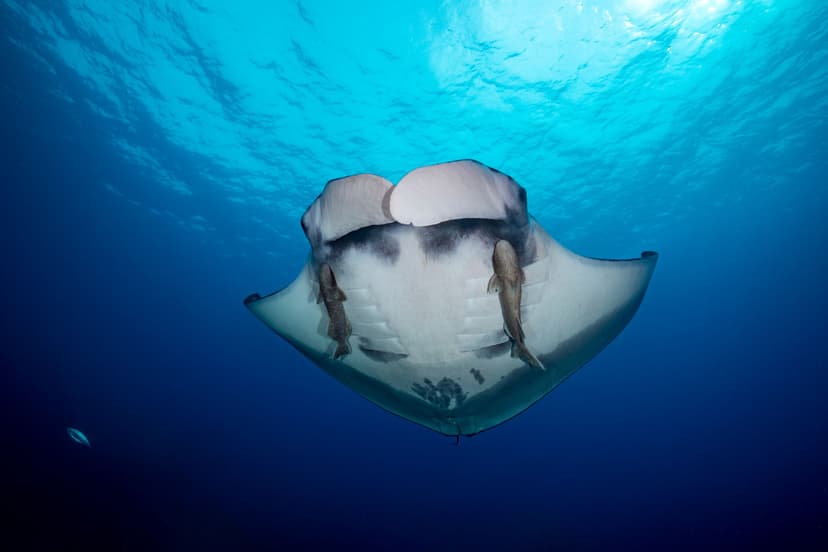
Manta rays are the headline act. Cleaning stations in the central atolls produce consistent manta encounters from January through April. Hanifaru Bay's feeding aggregations (June-November) can deliver 100+ mantas in a single snorkelling session.
Whale sharks in South Ari Atoll from August through November — reliable sightings on snorkelling excursions. Reef sharks (grey reef, whitetip, blacktip) on nearly every dive. Nurse sharks sleeping under overhangs. Eagle rays in the channels. The occasional hammerhead at deeper sites, though less predictable than the Red Sea.
The reef life is Indo-Pacific in character: colourful, dense, and varied. Anemonefish, butterflyfish, triggerfish, parrotfish, Napoleon wrasse. The biodiversity is higher than the Red Sea, but the coral health is more variable — some atolls still show bleaching damage from the 2016 El Nino event.
The Boat Experience
Red Sea liveaboards tend to be straightforward working boats — clean, functional, comfortable, but not luxurious (with exceptions at the high end). Cabins are tight but adequate. Food is solid — Egyptian and international. Most boats serve beer and wine. The crew is experienced and professional.
Maldives liveaboards lean more toward the luxury end. Even mid-range boats are well-appointed with nicer cabins, better food (often with a dedicated chef), and more deck space. The Maldivian dhoni (traditional boat) design offers wide, stable platforms. Many boats are alcohol-restricted or alcohol-free due to Maldivian regulations, though some carry permits.
The Maldives also has longer surface intervals between dives — the atolls are spread out, and transit time between dive sites can be 30-60 minutes. In the Red Sea, sites are closer together, meaning more time in the water and less time motoring.
Logistics from Europe
Red Sea: fly into Hurghada or Marsa Alam. Step off the plane. Transfer to the marina. Board the boat. The whole journey from European airport to liveaboard deck can take 6-8 hours.
Maldives: fly into Male. Clear immigration. Transfer to a domestic seaplane or speedboat. Arrive at the liveaboard. Total journey: 14-18 hours from a European airport, plus potential overnight layovers in the Gulf.
If you're working with limited holiday time — say, 10 days — the Red Sea gives you more dive days per day of travel. A 7-night Red Sea liveaboard uses 9 days total (including travel). A 7-night Maldives liveaboard uses 10-11 days with connections and transfers.
So Which One First?
Book the Red Sea first if:
- It's your first liveaboard and you want to test the format
- Your budget is under €3,000 all-in
- You have limited holiday time (8-10 days)
- You want sharks and wrecks
- You're based in Europe
- You have 30-50 dives logged
Book the Maldives first if:
- You've done liveaboards before and want something different
- Your budget is $4,000+ and you want more comfort
- Mantas and whale sharks are your priority
- You have 50+ dives and are comfortable with current
- You don't care about wrecks
- You want warm water guaranteed (28°C+)
The honest recommendation: Do the Red Sea first. Learn the rhythm of liveaboard life — the dive briefings, the gear setup, the surface intervals, the communal dining, the early mornings. Get comfortable with the format in forgiving conditions at a reasonable price. Then, when you book the Maldives six months later (and you will), you'll arrive as a competent liveaboard diver ready to make the most of a more expensive, more demanding destination.
The Red Sea is where you fall in love with liveaboard diving. The Maldives is where you realise you're never going back to resort diving.
Can't decide? Faneca specialises in sequencing liveaboard trips — first trip, second trip, dream trip. Tell us your experience level and budget, and we'll map out a progression that makes sense.
- Best Time to Dive: A Season-by-Season Guide — Timing both destinations for peak conditions
- Red Sea Liveaboard Diving: Brothers vs Northern Route — Choosing the right Red Sea itinerary
- Manta Ray Diving: Where, When, and How to See Them — Deep dive on the Maldives' star attraction
- 10 Mistakes First-Time Liveaboard Divers Make — Avoid the common pitfalls on your first trip
Related Articles
The Complete Liveaboard Packing Guide
What to bring, what to leave behind, and the gear essentials that experienced liveaboard divers swear by.
First-Time Liveaboard: What to Expect Day by Day
Never done a liveaboard? Here's the inside scoop on the schedule, the meals, the diving, and the delightful chaos.