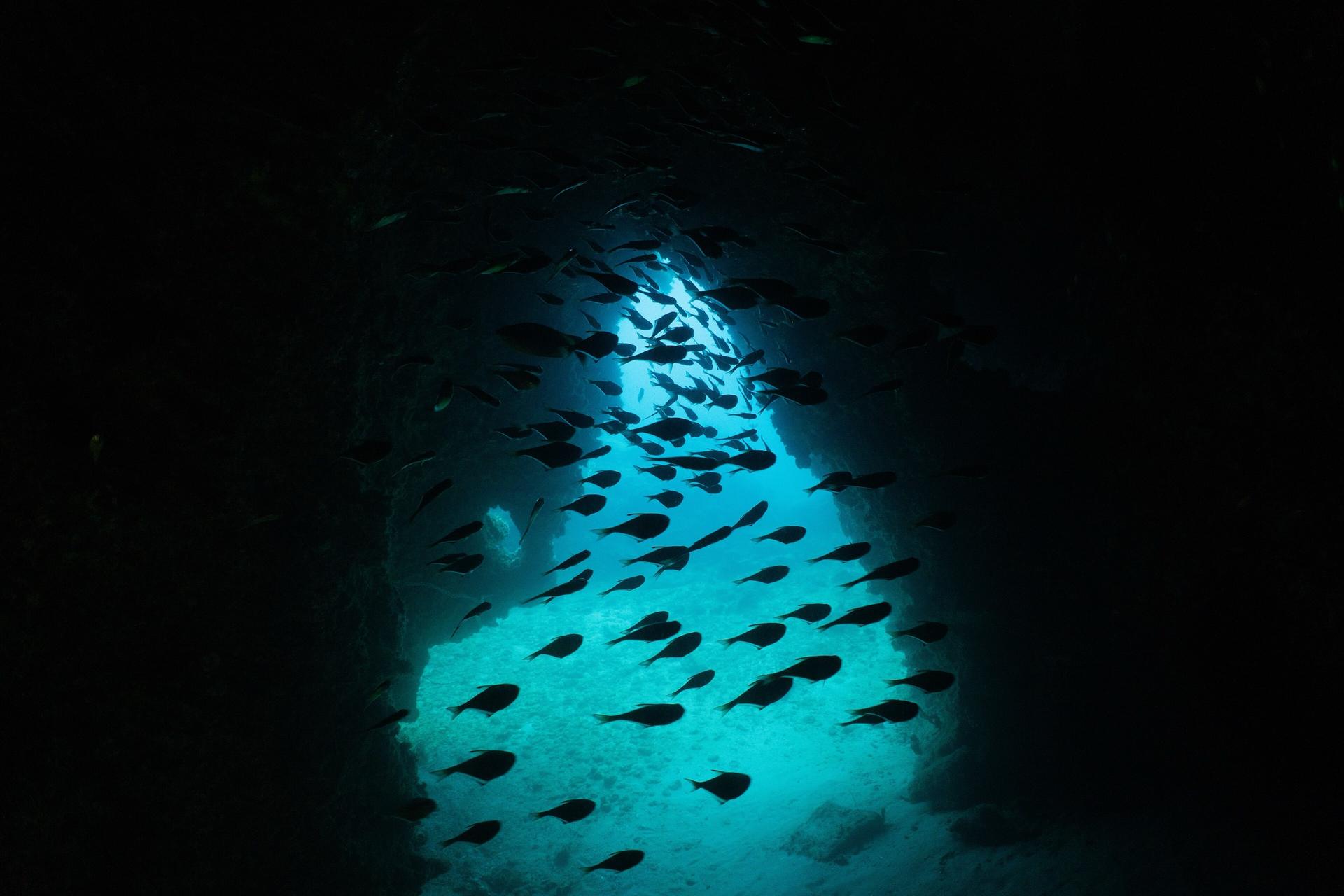
Elephant Head Rock
Three granite boulders break the surface in open water off Island 8. Underneath, the rock is stacked into channels, overhangs and swim-throughs.
Elephant Head Rock, Hin Pusar in Thai, is the Similan boulder dive at its most concentrated. Three rounded granite boulders show above the water in open sea off the south-west of Koh Similan, the island divers call Island 8, and the easternmost is said to look like an elephant's head. Below the surface the granite is piled into channels, overhangs and swim-throughs that run from the shallows to below 40 metres. With no island around it to break the sea, it gets more current and surge than most Similan sites, so boats usually dive it in the morning and keep it for divers with some experience.
Quick answer: Elephant Head Rock is an open-water granite boulder site with channels, overhangs and swim-throughs in Thailand. Best season: The park is open from about 15 October to 15 May. November to April usually brings the calmest sea; from about February to April expect more plankton and cold-water pulses at depth. Level: Boats typically treat it as a dive for Advanced Open Water divers with good buoyancy and some experience in current. Open Water divers who are taken here stay above 18 m with the guide. Depth: Boulder tops at the surface; swim-throughs from about 5 m to over 35 m; most of the dive between about 15 and 25 m; the boulders continue below 40 m. Typical visibility: Often 20 to 30 m in the dry months; down to about 15 m when plankton is in.
Facts verified November 2026
What Elephant Head Rock is
The Similan Islands are granite, and their west coasts face the open Andaman Sea as piles of huge rounded boulders. Elephant Head Rock is that landscape without an island attached: a group of boulders standing alone in open water off the south-west of Koh Similan, the largest island in the chain. Three of them break the surface.
Under water the boulders sit on and against each other at odd angles, and the gaps between them make channels, overhangs and swim-throughs from close to the surface to beyond 35 metres. In the middle of the site is a patch of sand at roughly 20 to 25 metres, with garden eels and resting rays, and the boulders carry on down past 40 metres on the deeper side.
Island numbers are not used the same way everywhere. Dive briefings and most maps call Koh Similan Island 8 and Koh Payu, just to the south, Island 7, and place Elephant Head Rock between them. The park's own list numbers the islands slightly differently and gives the number 7 to Hin Pusar itself. On the boat, Island 8 means Koh Similan.
The swim-throughs
The swim-throughs are the reason boats come here. Some are short and open, with the exit in view the whole way through; others are longer, narrower and deeper, between about 20 and 25 metres. Guides choose the route on the day by the current and by who is in the group.
Two things make them harder than they look. The first is surge: water moving in and out between the boulders pushes a diver forward and back inside a narrow gap. The second is the diver ahead of you, whose fins are close to your mask if you follow too tightly. Leave space, go through one at a time, and keep hands and fins off the rock, where the soft corals and sea fans grow.
What you will see
The fish life follows the shelter. Fish gather in the lee of the boulders and under the overhangs, out of the current, and that is where you find most of it.
- Whitetip reef sharks resting on the sand or under the boulders
- Oriental sweetlips and snapper in small groups under the overhangs
- Clown triggerfish, groupers, rabbitfish and bannerfish around the swim-throughs
- Giant moray eels, octopus and, in the gaps, mantis shrimp and fire gobies
- Garden eels and blue-spotted stingrays on the central sand
- Fusiliers and trevally in the blue off the boulders
- Soft corals and sea fans wherever light reaches between the rocks
- Leopard sharks now and then; mantas and whale sharks pass by occasionally but are rare here
Conditions and who it is for
The current decides this dive. It can be mild one morning and strong the next, it swirls and changes direction around the boulders, and it is usually strongest in the days around full and new moon. In a strong current the way to dive the site is to move from the shelter of one boulder to the next behind your guide; a diver who drifts off the rock is soon in open water. Carry a surface marker buoy and know how to deploy it.
Boats typically treat Elephant Head Rock as a dive for Advanced Open Water divers with steady buoyancy and some experience in current. Much of the site, and most of the swim-throughs, lies below 18 metres, the limit of an Open Water card, so Open Water divers who are brought here stay shallower with the guide and miss part of the dive. The crew may keep newer divers back on a strong day; that is normal on a Similan trip, and the sheltered east-coast reefs make a good alternative.
Depth is the other risk. The boulders run well below 40 metres, and in clear water it is easy to follow a fish down a gap and find your no-stop time running out. Agree a maximum depth in the briefing and watch your computer, not the boulder. From about January to April, internal waves can push cold water up the open western sides of the Similans, dropping the temperature by several degrees within minutes, so a full 3 mm suit is a sensible minimum.
When to dive it
Elephant Head Rock is inside Mu Ko Similan National Park, which is open from about 15 October to 15 May and closed through the southwest monsoon. The park authority confirms the dates each year, and no boat dives the Similans outside them.
Within the season, November to April usually brings the calmest sea and the clearest water. From about February to April more plankton is in the water: visibility softens, the cold pulses at depth are more frequent, and the big plankton feeders are a little more likely, though at this site they remain a rare sighting. October and May, at the edges of the season, can bring leftover swell, which makes the surge in the swim-throughs stronger.
How the dive runs
Liveaboards usually dive Elephant Head Rock as the first or second dive of a day in the Similans, when the light is good and before the day boats from the mainland arrive. There is usually no mooring line to follow, so you enter from the boat or tender with your gear ready and descend at once.
A typical plan enters south of the largest boulder, descends to around 20 metres, works through the channels and swim-throughs with the current and finishes on the north side of the big rock. The guide may reverse that on the day. Ascend away from the boulders, where the surge is weaker and the tender can see you, and make your safety stop at about 5 metres in open water under your surface marker buoy, not on the rock.
On the same day the boat will often dive other Similan boulder sites, such as Christmas Point on Island 9, and a sheltered east-coast reef in the afternoon or after dark. The trip then moves north to Koh Bon and Koh Tachai.
Elephant Head Rock is dived on the Similan days of our Similan and Surin liveaboards, usually as a morning dive. The current has the last word, so guides may swap it for a calmer boulder site; if it matters to you, say so in your concierge brief. For dates see the Thailand calendar, and for the month to go, when to dive the Similans.
Elephant Head Rock: common questions
What is the best season to dive Elephant Head Rock?
The park is open from about 15 October to 15 May. November to April usually brings the calmest sea; from about February to April expect more plankton and cold-water pulses at depth
What experience level do I need for Elephant Head Rock?
Boats typically treat it as a dive for Advanced Open Water divers with good buoyancy and some experience in current. Open Water divers who are taken here stay above 18 m with the guide
How deep is Elephant Head Rock?
Boulder tops at the surface; swim-throughs from about 5 m to over 35 m; most of the dive between about 15 and 25 m; the boulders continue below 40 m
What marine life will I see at Elephant Head Rock?
Whitetip reef sharks on the sand, sweetlips and snapper under the overhangs, clown triggerfish, giant moray eels, stingrays and garden eels, trevally and fusiliers; leopard sharks now and then; mantas and whale sharks are rare