Koh Tachai
A granite dome in open water where the current runs the show and the big animals follow it.
Diving Koh Tachai is about reading water. This submerged pinnacle sits alone in the blue between the Similan and Surin islands, exposed to everything the Andaman Sea sends its way — and what it sends is nutrient-rich current, and behind it, the pelagics. It is one of the most rewarding dive sites in Thailand, and one of the most honest: on a calm day it is a soft-coral garden full of fish; on a running day it is a proper drift on a wall of moving water, and that is exactly when the mantas turn up. This is a liveaboard site through and through, and it asks a little more of you than the Similans proper.
Quick answer: Koh Tachai is a submerged granite pinnacle, dived as a drift when current is running in Thailand. Best season: Late October to early May; peak pelagic action February to April. Level: Intermediate to advanced — current experience strongly recommended. Depth: 12m at the pinnacle top to 30-35m over the surrounding sand and boulders. Typical visibility: Typically 15-30m, but drops noticeably when cold, plankton-rich current moves in.
Facts verified September 2026
What makes Koh Tachai special
The dive site sits roughly 400 metres south of Koh Tachai island itself, a submerged rocky ridge often called the Twin Peaks or simply the Pinnacle. A dome-shaped granite boulder rises to around 12-15 metres, ringed by smaller rocks, sea fans and soft coral before the slope runs out into sand at 30-35 metres. Massive boulders create swim-throughs and current shadows where fish stack up and where you tuck in to catch your breath.
What sets Koh Tachai apart from the calmer Similan reefs to the south is its exposure. It stands alone in open water, so it catches current from every direction, and that current is the whole point. The nutrients it carries feed the plankton, the plankton feeds the food chain, and the food chain draws in the animals divers travel across the world to see. It is regularly rated among the top dive sites in Thailand for exactly this reason.
One honest note on access: Koh Tachai island has been closed to the public since 2016 to let it recover from tourism pressure, but the dive sites around it remain open. You are diving the water, not landing on the beach.
What you'll see
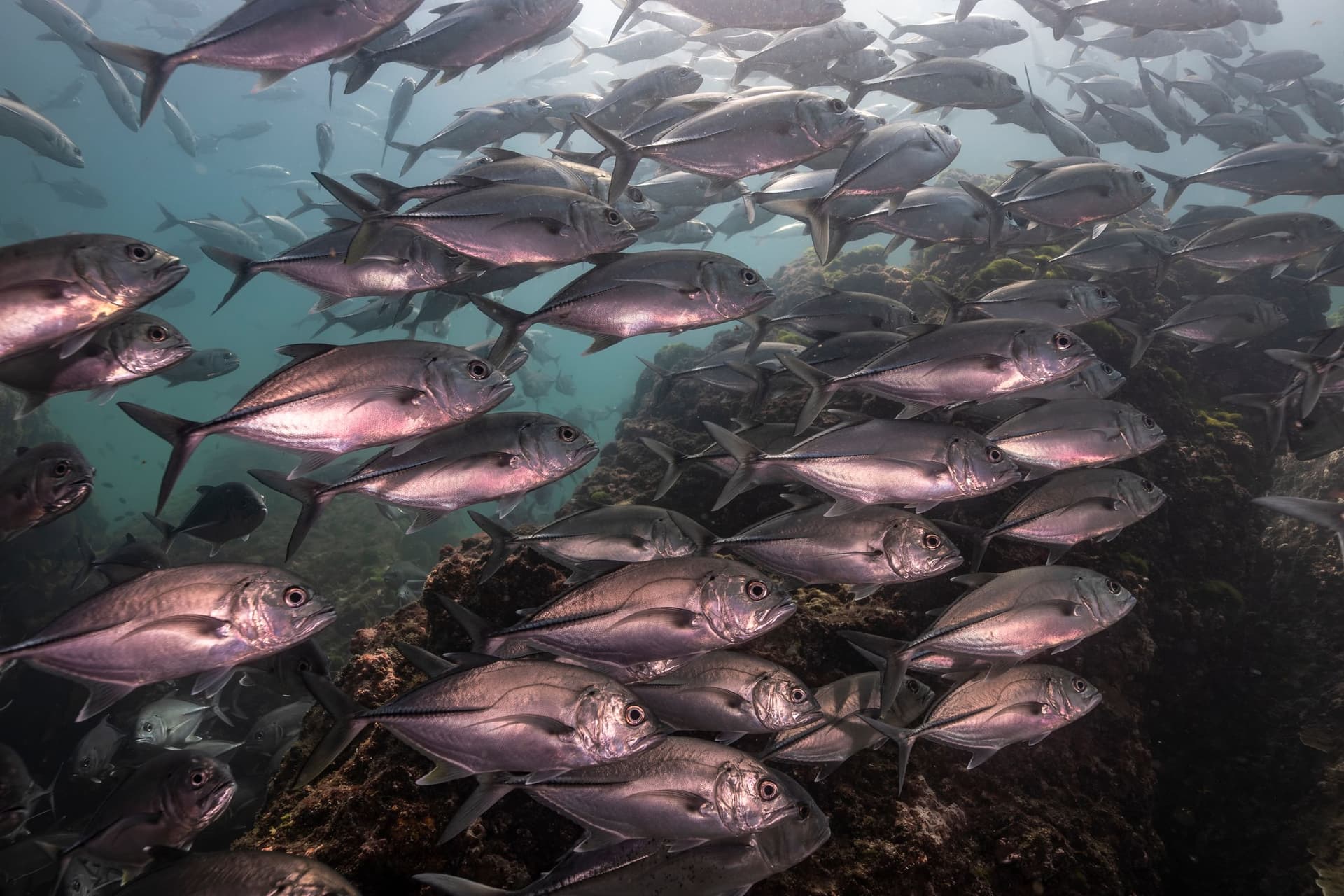
Koh Tachai is a big-animal site with a strong supporting cast. When the current runs, the fish action becomes genuinely spectacular — this is one of the best places in the Andaman to watch a barracuda tornado, hundreds of fish turning in a slow, hypnotic cylinder over the rocks.
Keep one eye on the reef and one on the blue. The reef holds the residents; the blue holds the reason you came.
- Manta rays — the headline draw, most likely Feb-Apr when plankton-rich current moves through the cleaning stations
- Whale sharks — a genuine but never guaranteed possibility in the same window
- Chevron barracuda and giant, bluefin trevally in hunting schools
- Dogtooth tuna and rainbow runners patrolling the current line
- Marble grouper, curious batfish, and dense clouds of fusiliers
- Soft coral, sea fans and reef fish across the boulders, with octopus and spiny lobster tucked into cracks
Conditions and who it's for
This is not a beginner site, and it is fairer to say so up front. The current at Koh Tachai is variable and frequently strong, and its defining trait is that it can change direction and strength during a single dive, seemingly at random. Local divers talk about the Green Monster — a cold, plankton-heavy current you can sometimes see coming as a greenish wall, bringing a temperature drop, murkier water and real push.
You want solid buoyancy, comfort with negative entries and reef hooks, and the discipline to stay with your guide and use the rocks for shelter. Divers with an Advanced certification and some current experience will get the most out of it and enjoy it; newer divers can be brought here in the right conditions, but it should be the crew's call on the day, not a fixed plan.
Visibility rewards and punishes the same mechanism: the current that brings the mantas can also cut visibility from a bright 30 metres to a murky 15. That trade-off is part of the deal, and part of why no two dives here are the same.
When to dive it
Koh Tachai is only diveable within Thailand's Andaman season. The Similan and Surin marine parks close from around 16 May to mid-October each year for ecosystem recovery, so the site is off-limits for roughly five months annually — build your trip around that window.
Within the open season, late October through early May all fish well. If mantas and whale sharks are your priority, aim for the February-to-April peak, when the shifting nutrient-rich currents fire up the cleaning stations at Koh Tachai and neighbouring Koh Bon. It is never a sure thing — these are wild animals over open water — but those months give you the best odds Thailand offers.
How you actually dive it
Because it sits well north of the day-boat reefs, Koh Tachai is realistically a liveaboard site — day trips from Khao Lak exist but are long and weather-dependent, and a liveaboard puts you on the pinnacle at the right state of tide rather than whenever a fast boat can reach it.
The plan is current-led. A good crew reads the flow, briefs a drift, and often drops you negative onto the pinnacle so you get down before the current sweeps you off. You work the up-current side and the boulder shelters, hang where the fish are stacking, and let the guide reposition you as the water shifts. On slack, calmer days you can circle the pinnacle more freely and enjoy the coral. Either way, watch your air and depth — it is easy to get absorbed in a barracuda school and look up to find you have drifted deep and far.
Faneca dives Koh Tachai aboard The Junk and Thailand Master on their Similan, Surin and Richelieu Rock liveaboard itineraries — the practical way to reach it, since the pinnacle lies north of the day-boat reefs and dives best on the right tide. Access is seasonal: the marine park closes from mid-May to mid-October, so these trips run late October through early May.
Koh Tachai: common questions
What is the best season to dive Koh Tachai?
Late October to early May; peak pelagic action February to April
What experience level do I need for Koh Tachai?
Intermediate to advanced — current experience strongly recommended
How deep is Koh Tachai?
12m at the pinnacle top to 30-35m over the surrounding sand and boulders
What marine life will I see at Koh Tachai?
Manta rays, whale sharks (seasonal), barracuda and trevally schools, dogtooth tuna, marble grouper, batfish, reef fish over soft coral
