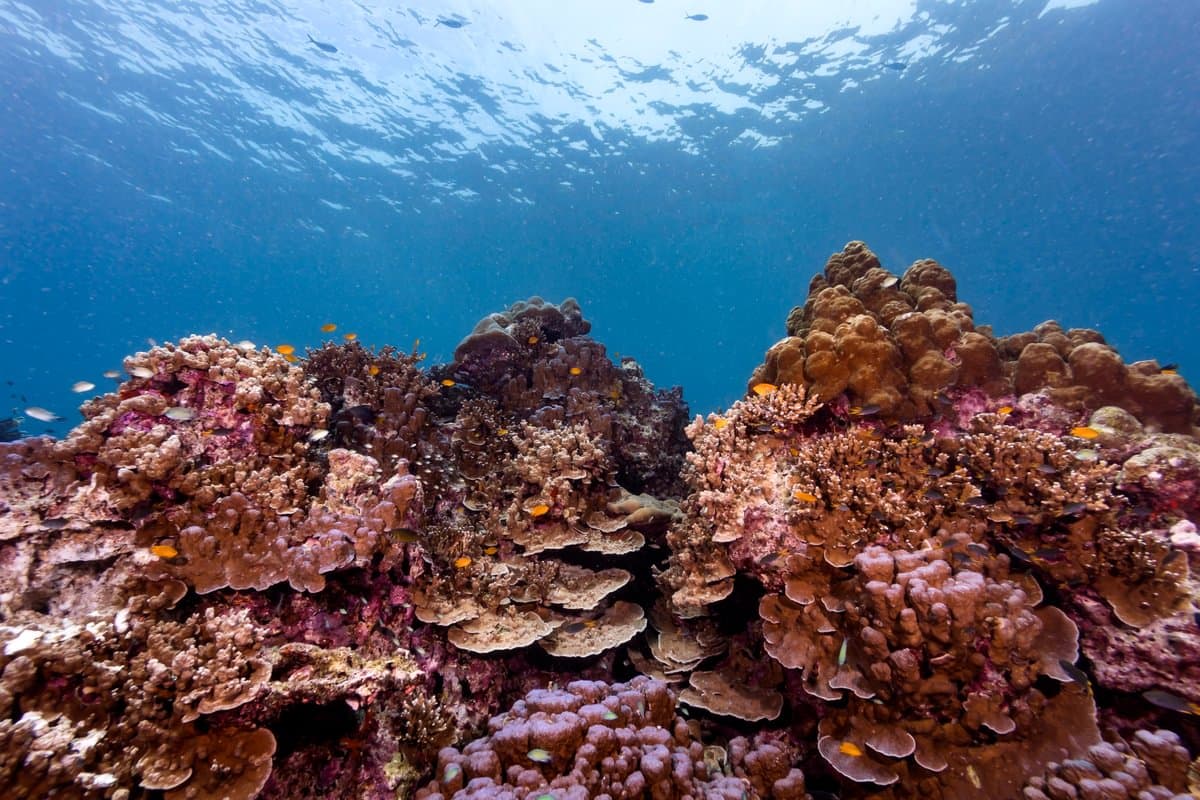
Richelieu Rock
Thailand's greatest dive site is a lone pinnacle in the open Andaman — and it earns the title.
Some dive sites impress you on the first descent; Richelieu Rock keeps unfolding across every one of them. This solitary limestone pinnacle sits alone in the open Andaman Sea, north of the Surin Islands and close to the Myanmar border, breaking the surface by just a metre or two at low tide before dropping away to 35 metres and beyond. There is no reef around it — only blue water, current, and a horseshoe of rock so densely upholstered in purple soft coral that the whole structure seems to breathe. It is, by broad consensus among Thai dive pros, the best dive site in the country, and one of the finest in Southeast Asia. Diving Richelieu Rock rewards patience: the more time you spend circling it, the more it gives you, from foraging whale sharks in the blue to a harlequin shrimp tucked into a crevice the size of your palm.
Quick answer: Richelieu Rock is a standalone submerged pinnacle / seamount in Thailand. Best season: Late October to early May; February–April for whale sharks and mantas. Level: Intermediate to advanced — AOWD and some current experience strongly recommended. Depth: 3 m to 35 m+ (most of the dive between 12–28 m). Typical visibility: Typically 15–30 m, up to 35 m on clear days; can drop to 10–15 m during plankton blooms.
Facts verified September 2026
Why Richelieu Rock is Thailand's finest dive site
Richelieu Rock owes everything to its isolation. Standing alone in open water, it sits in the path of nutrient-rich upwellings that feed plankton blooms, and that plankton is the engine of the whole ecosystem. It draws the small fish, which draw the predators, which draw the pelagics from the blue — and it feeds the filter feeders directly, which is why whale sharks and mantas cruise through when the water turns green.
The rock itself is a horseshoe of pinnacles wrapped around a shallow, sheltered bay, with smaller outcrops jutting from the surrounding slope. That shape matters. It gives you a bright, calm inner sanctuary for macro hunting and safety stops, and exposed outer walls where the current runs and the action concentrates. Every surface of it is smothered in soft coral, gorgonian sea fans, barrel sponges and anemones — one of the most saturated, colour-drenched reef structures you will dive anywhere.
The name is usually traced to Cardinal Richelieu, whose crimson robes echo the soft-coral colour, though the origin is genuinely uncertain and often wrongly credited to Jacques Cousteau. What is not in doubt is the site's reputation: ask a Thai dive guide to name the single best dive in the country and the answer is almost always this one.
What you'll see
Richelieu is that rare site that delivers at both ends of the size scale. On a good day you can be watching a whale shark materialise out of the blue one minute and photographing a harlequin shrimp the next. The macro life here is genuinely world-class, and rushing past it is the most common mistake visitors make.
- Whale sharks and manta rays — most likely February to April, drawn by plankton, though never guaranteed
- Big schools of barracuda, trevally and snapper funnelling around the pinnacles, with dogtooth tuna hunting the edges
- Tiger-tail and other seahorses, ornate and robust ghost pipefish, and pipefish tucked into the coral
- Harlequin shrimp, mantis shrimp and porcelain crabs for the patient macro diver
- Frogfish, leaf fish and a rich nudibranch count across the walls
- Tomato anemonefish and dense soft-coral gardens covering nearly every surface
Conditions and who it's for — an honest read
This is not a beginner's site, and it is worth being straight about that. Richelieu sits in open sea with no land to shelter it, so surface conditions can be lumpy and the current is the defining variable of any given dive. Some days the inner bay is calm and forgiving; other days the outer walls run hard enough that guides will reposition or skip the exposed sections entirely, even with experienced groups.
Realistically you want an Advanced Open Water certification, comfortable buoyancy, and some prior experience diving in current before you take this on. Good air consumption pays off directly here, because the best encounters reward divers who can hang patiently in one spot rather than finning against the flow. Depth is manageable — most of the good stuff sits between 12 and 28 metres — but the combination of current, blue-water disorientation and the temptation to chase pelagics deep means it demands attention. Water is warm year-round, 27–30°C, so a 3mm suit is plenty.
Visibility is usually a comfortable 15–30 metres, occasionally up to 35. Do not be disappointed by greener water, though — reduced visibility here often means a plankton bloom, and that is precisely what brings the whale sharks in.
When to dive Richelieu Rock
The Andaman diving season runs from late October to early May. Outside that window the southwest monsoon closes the site down: seas get rough, visibility collapses, and operators suspend trips for safety, so there is no diving Richelieu in the June-to-October low season.
Within the season, February to April is the prime window. These are the driest months with the flattest seas and the best odds for whale sharks and mantas, as the plankton blooms peak. It is also the busiest and most weather-reliable time. If you want colour and calm water over a pelagic gamble, February and March offer the cleanest conditions; if the big animals are your priority, weight your trip toward March and April and accept that the trade-off is slightly greener water.
How you actually dive it — and why liveaboard wins
Richelieu's isolation is the whole point, and it is also what makes access the deciding factor. The site lies 7–10 hours by boat from Phuket and 3–4 hours from Khao Lak, so day trips exist but they are long, weather-dependent, and give you a single visit at whatever tide and current you happen to arrive on. This is a site that changes completely from dive to dive, and one look at it rarely does it justice.
By liveaboard you dive it repeatedly across a stay — early morning before the day boats arrive, again in better light, and sometimes at dusk — which dramatically raises your odds of hitting the right conditions and the pelagic action. A typical plan is a slow circuit of the pinnacle timed to the current, working the sheltered side for macro and easing out to the exposed walls when the flow allows, then finishing in the shallow inner bay where the soft coral is brightest and the safety stop is effortless. Follow your guide's read on the current rather than a fixed route — at Richelieu, the water decides the plan.
Faneca dives Richelieu Rock aboard The Junk and Thailand Master on their Similan, Surin and Richelieu itineraries — and because the site rewards repeated dives across changing tides and currents, it is genuinely best experienced by liveaboard rather than a single long day trip.
Richelieu Rock: common questions
What is the best season to dive Richelieu Rock?
Late October to early May; February–April for whale sharks and mantas
What experience level do I need for Richelieu Rock?
Intermediate to advanced — AOWD and some current experience strongly recommended
How deep is Richelieu Rock?
3 m to 35 m+ (most of the dive between 12–28 m)
What marine life will I see at Richelieu Rock?
Whale sharks, manta rays, schooling barracuda and trevally, plus exceptional macro — seahorses, ghost pipefish, harlequin shrimp, frogfish
