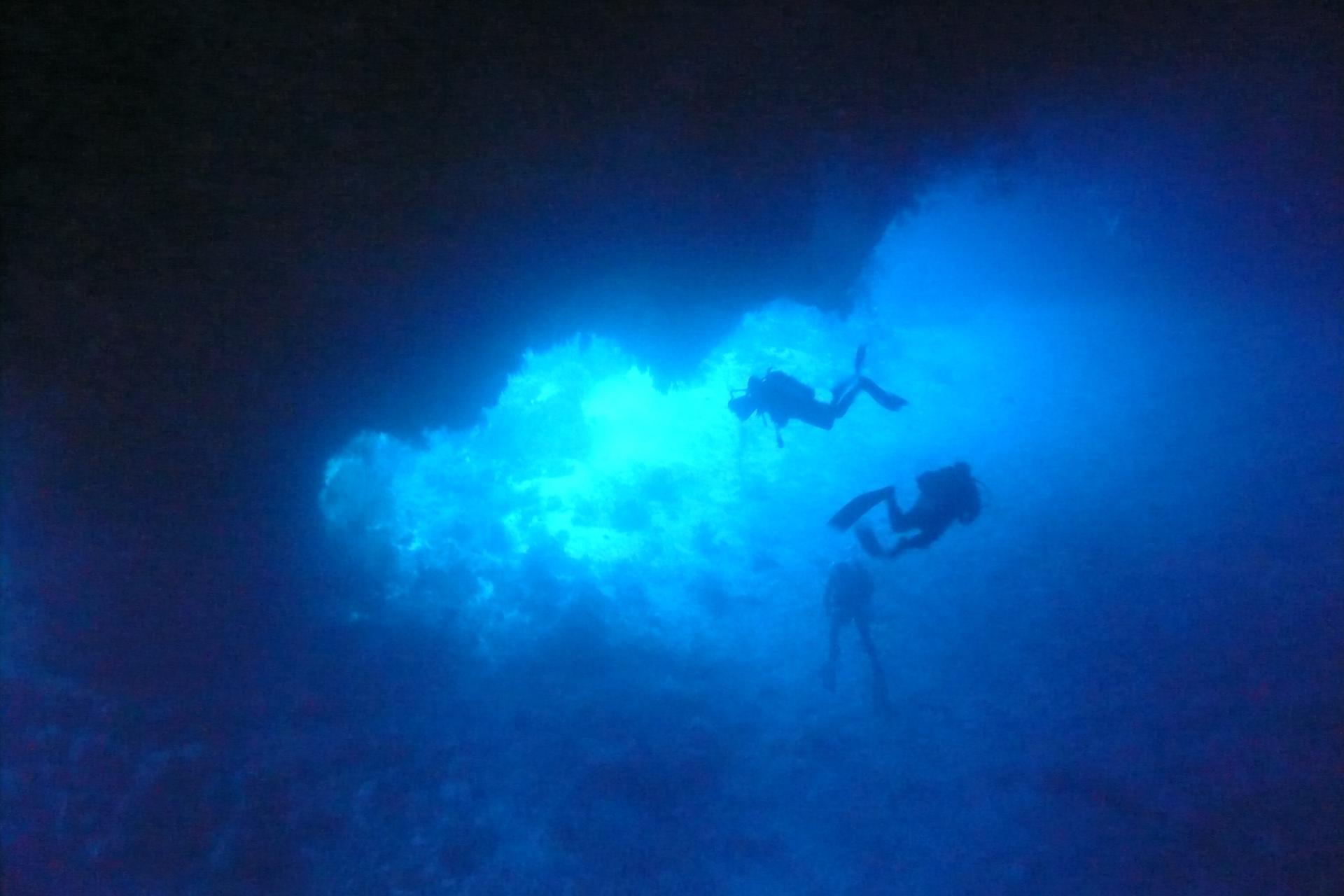
Siaes Tunnel
A long blue cavern in the wall at 30 metres, open at both ends, with sharks asleep on the floor.
Siaes Tunnel is a cavern cut into the outer wall north-west of Ulong Island, entered from the open wall at around 30 metres and open at both ends. Inside it is still and quiet, lit blue from the openings, with sea fans around the windows, black coral on the ceiling and whitetip reef sharks resting on the sand below. It is one of the deepest regular dives in Palau and needs to be treated that way: short, planned and well inside your limits. Done properly, it is one of the most atmospheric dives in the country and a complete change of pace from the current sites around it.
Quick answer: Siaes Tunnel is a deep cavern and wall dive in Palau. Best season: Year-round; November–April (drier season) for the calmest crossings and clearest water. Level: Advanced — Advanced Open Water minimum, deep-diving experience strongly recommended. Depth: Wall from the surface to beyond 70 m; tunnel entered at roughly 25–35 m; sandy floor around 40 m and deeper in places; exit around 27 m. Typical visibility: Typically 20–40 m, best on an incoming tide.
Facts verified November 2026
What Siaes Tunnel is
Siaes is the reef north-west of Ulong Island on Palau's western barrier reef, the same area as the drift dive at Siaes Corner. Its outer wall starts at the surface, where it is exposed at low tide, and drops vertically into deep water. Set into that wall is a long cavern, open at both ends and with large side windows, that runs through the reef roughly parallel to the face.
The openings start at around 25 to 35 metres and the sandy floor slopes from around 40 metres to deeper water in places, before rising again towards the far exit at around 27 metres. Light comes in from both ends and through the windows, so the inside is blue rather than dark, and there is no current inside. Scientists have even collected a colony of a cave-dwelling zoanthid here, at 39 metres in 2014; it became one of the specimens for Antipathozoanthus cavernus, a species described in 2017 that is also known from Japan and the Maldives.
What you'll see
Most divers remember the shape and the light first: the frame of the openings against the blue, divers in silhouette, and sea fans growing around the windows. Then the animals:
- Whitetip reef sharks and stingrays resting on the sandy floor of the cavern
- Grey reef sharks, bigeye jacks and snapper around the entrance and along the wall
- Sea fans and soft corals around the windows and walls, black coral on the ceiling
- Rare deep-water fish near the top of the tunnel, including multicolour pygmy angelfish and Burgess's butterflyfish
- Watchman gobies and their partner shrimps in burrows in the sand
- Pyramid butterflyfish and anthias along the outer wall on the way up
Conditions and who it's for
Siaes Tunnel is an advanced dive because of depth, not current. The entrance is already at recreational working depth and the floor is at or below the 40-metre limit, so bottom time disappears fast and nitrogen loading is high. Local operators ask for Advanced Open Water as a minimum and recommend deep-diving training, and they treat the safety stop at the end as compulsory, not optional.
Nitrox helps with no-decompression time but sets a hard floor: on 32 per cent at a maximum partial pressure of 1.4, your limit is about 33 metres, which is shallower than the floor of the tunnel. That means a planned depth, a guide who keeps the group above it, and divers who can hold their buoyancy precisely inside an overhead. Plan a generous gas reserve, keep close to your buddy, and if you are diving several times that day, take a long surface interval afterwards. Divers who are new to depth or uneasy in an overhead will enjoy Siaes Corner next door more.
When to dive it
The tunnel dives year-round in water of 28–30°C. The drier months, roughly November to April, bring calmer seas for the run out to Ulong and the most consistent visibility, but the bigger factor is the tide: an incoming tide pushes clean ocean water along the wall and into the tunnel, and visibility drops on an outgoing one.
Because there is no current inside, Siaes Tunnel is also a useful choice on days when the current on the nearby corners is too strong to dive them well. Our Palau diving season guide covers the months in detail.
How you actually dive it
You descend straight down the wall from the boat to the tunnel opening, enter and follow the floor and walls through the cavern at the depth the guide sets, then leave by the far opening onto the wall. Outside, you keep the wall on one side and work slowly shallower, often in a gentle drift, finishing with the safety stop near the reef edge.
Time inside is short. The skill is in staying calm and slow, so you can enjoy the light and the sharks on the floor without sinking towards them. Carry a torch to bring out the colour of the sea fans and corals near the windows: the natural light is enough to see by, but at this depth it turns everything blue.
Siaes Tunnel is on the Best of Palau itinerary we sell, dived on the days the boat works the western reef around Ulong, alongside Ulong Channel and Siaes Corner. Sites and order always depend on the weather and the tide.
Siaes Tunnel: common questions
What is the best season to dive Siaes Tunnel?
Year-round; November–April (drier season) for the calmest crossings and clearest water
What experience level do I need for Siaes Tunnel?
Advanced — Advanced Open Water minimum, deep-diving experience strongly recommended
How deep is Siaes Tunnel?
Wall from the surface to beyond 70 m; tunnel entered at roughly 25–35 m; sandy floor around 40 m and deeper in places; exit around 27 m
What marine life will I see at Siaes Tunnel?
Whitetip reef sharks and stingrays resting on the floor, grey reef sharks at the entrance, bigeye jacks and snapper, sea fans and soft corals at the openings, black coral, rare deep-water angelfish and butterflyfish, goby and shrimp pairs in the sand