Karang Makassar
A long, shallow rubble reef in central Komodo, dived as a drift, where reef mantas come to feed and to be cleaned.
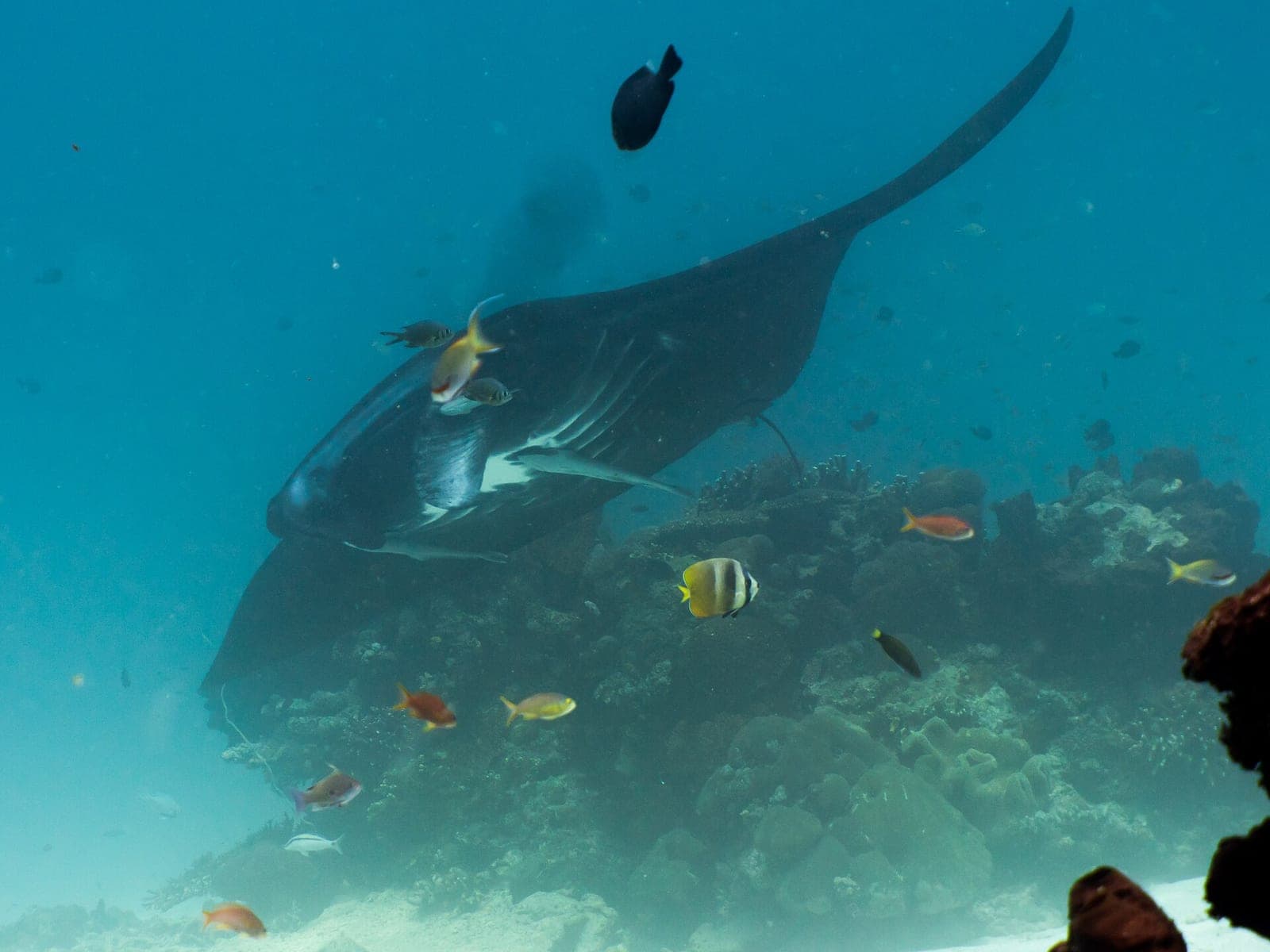
Karang Makassar is the site most Komodo boats mean when they say Manta Point. It is a long reef of coral rubble, sand and scattered coral heads in the centre of Komodo National Park, between Komodo Island and Tatawa Besar, dived as a shallow drift. Reef mantas come here to feed in the current and to be cleaned, and they are seen in most months. It is not the same place as Manta Alley, in the far south of the park, which is a colder and more exposed dive. This guide covers how the drift works, how to behave around the mantas and what the site offers when they do not show.
Quick answer: Karang Makassar is a shallow drift dive over a rubble reef with manta cleaning stations in Komodo. Best season: Diveable all year, with reef mantas seen in most months; dive centres disagree on the best ones. April to November has the calmest seas. Level: Open Water divers dive it with a guide on a gentle tide; drift experience makes it much easier when the current runs. Each boat sets its own minimum. Depth: Mostly 5 to 15 m over the rubble flats; the edges of the reef slope deeper. Typical visibility: Variable: often 20 m or more in the dry season, less when the water is green with plankton.
Facts verified November 2026
Karang Makassar, Manta Point and Manta Alley
Karang means reef in Indonesian. The site is also sold as Makassar Reef and as Manta Point, and all three names mean the same place: a strip of rubble and sand that operators put at anything from 1.5 to 3 kilometres long, more than one dive can cover.
Manta Alley is a different site at the southern end of Komodo Island, with colder water and its largest manta gatherings in the wet season, usually December to February. A manta dive on a short trip from Labuan Bajo usually means Karang Makassar. Manta Alley is mostly dived from boats that stay out overnight and reach the south. If mantas are the reason for your trip, ask which of the two is on the route.
A study published in 2022 identified 1,085 individual reef mantas in the park from photographs taken between 2013 and 2018 at four main sites: Karang Makassar, nearby Mawan, Manta Alley, and the Cauldron in the north. Individual mantas tended to favour particular sites.
How the drift works
The boat drops the group at the up-current end of the reef and you drift a metre or two above the rubble, pausing near the coral heads the mantas use as cleaning stations. On a gentle tide the entry is an ordinary one. When the water is moving, the guide will ask for a quicker descent so the group stays together.
Crews do not agree on the best tide: some favour a rising tide and others go near slack to keep the dive easy. Either way it is a one-way dive. Once you have drifted past a manta you cannot fin back to it, and trying only burns gas.
If the group reaches the sloping reef at the edge of the site, the last minutes and the safety stop are spent there in the shallows. Otherwise the guide sends up a surface marker buoy and you make the safety stop at about 5 m in open water while the boat follows the buoy. Since April 2026 the park office has asked dive boats to space their groups at each site, so you may wait your turn here.
Manta etiquette
These points follow the Manta Trust's code of conduct. They are also what makes an encounter last: a manta that is left alone often circles back, and one that is chased leaves.
- Stay low, close to the rubble, and keep still. Do not grab or kneel on living coral
- Stay at the side of a cleaning station, never on top of it, and do not swim over a manta that is being cleaned
- Keep about 3 m away and let the manta close the distance if it chooses
- Approach from the side, so the animal has a clear path ahead
- Never chase, never touch, and never block a manta that is swimming towards you
- Snorkellers share this reef. They stay on the surface and do not dive down onto the animals
Conditions and who it is for
This is one of the gentler drifts in the park. On a quiet tide Open Water divers do it comfortably with a guide, because the bottom is shallow. The difficulty is the current. Around new and full moon it can run hard across the flats, the rubble gives you nothing sound to hold, and a diver who cannot stay level and close to the group is separated quickly. If you are new to drift diving, say so and stay beside the guide. Requirements vary by boat: some shorter trips accept Open Water divers with a few logged dives, while bigger boats and longer routes typically ask for Advanced Open Water and 30 to 50 logged dives.
Carry a surface marker buoy, because the dive finishes away from the boat and snorkelling boats cross the same water. Reef hooks are a point of disagreement in Komodo: the park's published visitor rules list hooks and gloves as not allowed, and practice differs from boat to boat, so follow your crew's briefing and do not plan on hooking in. The water here is around 28 to 30°C for much of the year and about 25 to 28°C from July to September.
What you see, with and without mantas
The mantas here are reef mantas, Mobula alfredi. Some days there are many, feeding into the current or hanging over a coral head while small wrasse and butterflyfish clean them. Some days there are none, and no crew can promise them. Greener, plankton-rich water tends to bring more of them, because plankton is what they eat.
The rest of the site is better than a field of rubble sounds:
- Turtles resting among the coral heads
- Whitetip and blacktip reef sharks and eagle rays crossing the flats
- Bumphead parrotfish, cuttlefish and giant clams
- Small animals in the rubble for those who look closely, on occasion including blue-ringed octopus: look, never touch
When to go
Karang Makassar is dived all year and reef mantas are seen in most months. Dive centres do not agree on a best season: some name the wet-season months around December to February and others the middle of the dry season, so treat any single dive as likely, not certain. The dry season, roughly April to November, has the calmest seas and is when most liveaboards run. Our Komodo season guide sets out the year month by month.
Karang Makassar is in the centre of the park, so it is on most Komodo liveaboard routes, including the short loops from Labuan Bajo. Crews fit it in around the tide, often on the same day as Batu Bolong, and Siaba Besar is close by for an easier dive. See the dates on our Komodo calendar.
Karang Makassar: common questions
What is the best season to dive Karang Makassar?
Diveable all year, with reef mantas seen in most months; dive centres disagree on the best ones. April to November has the calmest seas
What experience level do I need for Karang Makassar?
Open Water divers dive it with a guide on a gentle tide; drift experience makes it much easier when the current runs. Each boat sets its own minimum
How deep is Karang Makassar?
Mostly 5 to 15 m over the rubble flats; the edges of the reef slope deeper
What marine life will I see at Karang Makassar?
Reef mantas, turtles, whitetip and blacktip reef sharks, eagle rays, bumphead parrotfish, cuttlefish and giant clams