Siaba Besar
A sheltered bay in central Komodo with resident green turtles, a coral garden, a sand slope full of small animals and very little current.
Siaba Besar is the calm dive in a park known for current. It is a sheltered bay on the larger of the two Siaba islands, in the centre of Komodo National Park, with a shallow hard-coral reef and a slope of sand beside it. Green turtles rest in the coral in numbers that have earned the site the name Turtle City among local dive centres, and hawksbill turtles are seen too. Because the bay is shallow and protected, crews use it for check dives at the start of a trip, for training and for night dives. It should not be confused with Siaba Kecil, the smaller island across the channel, which is a fast drift. This guide covers the layout, what lives where, and how to get the most from an easy dive.
Quick answer: Siaba Besar is a sheltered bay dive over a coral garden and a sand slope in Komodo. Best season: Diveable all year; April to November has the calmest seas and is the main liveaboard season. Level: All levels, including Open Water divers and divers in training; widely used as a check dive. Depth: Reef top at about 5 m; most of the dive between 5 and 18 m; the slope towards the channel continues past 20 m. Typical visibility: Often 10 to 25 m.
Facts verified November 2026
Siaba Besar and Siaba Kecil: two islands, two different dives
Besar means big and kecil means small. The two Siaba islands sit side by side in the centre of the park with a channel between them, and their dive sites have little in common.
If an itinerary lists only "Siaba", ask which one. Crews sometimes pair them on the same day: the bay as the easy dive and the drift when the tide suits.
- Siaba Besar: a protected bay with a shallow coral garden and a sand slope, slight current, suitable for every level and used for check dives and night dives
- Siaba Kecil: a drift along the reef wall of the smaller island, past overhangs and small caves, ending in a sheltered coral garden. It is fast when the tide runs, and then it is for experienced divers only
The layout and how it is dived
The bay has two halves. One is a hard-coral garden with its top at about 5 m, where the turtles rest. The other is a slope of sand and rubble, at around 10 to 12 m where most dives cross it, which looks empty until you slow down. Beyond the reef the bottom carries on down towards the channel, past 20 m, and that is the one place where you will feel current.
A typical dive starts on the sand, works slowly across it looking for small animals, then moves on to the coral for the turtles and finishes in the shallows. Some crews treat the reef and the sand as two separate dives, and the site is worth doing twice if the route allows. The safety stop is simple: at about 5 m over the top of the reef, inside the bay.
On a check dive the first minutes are for you, not the wildlife: weighting, trim, a mask clear, a look at how your own and your buddy's equipment is set up. The guide is watching how you move as well, which helps the crew decide how to group divers and which of the harder sites suit you later in the trip. Open Water divers should keep to the reef and the sand above 18 m and leave the deeper channel slope alone.
Turtles
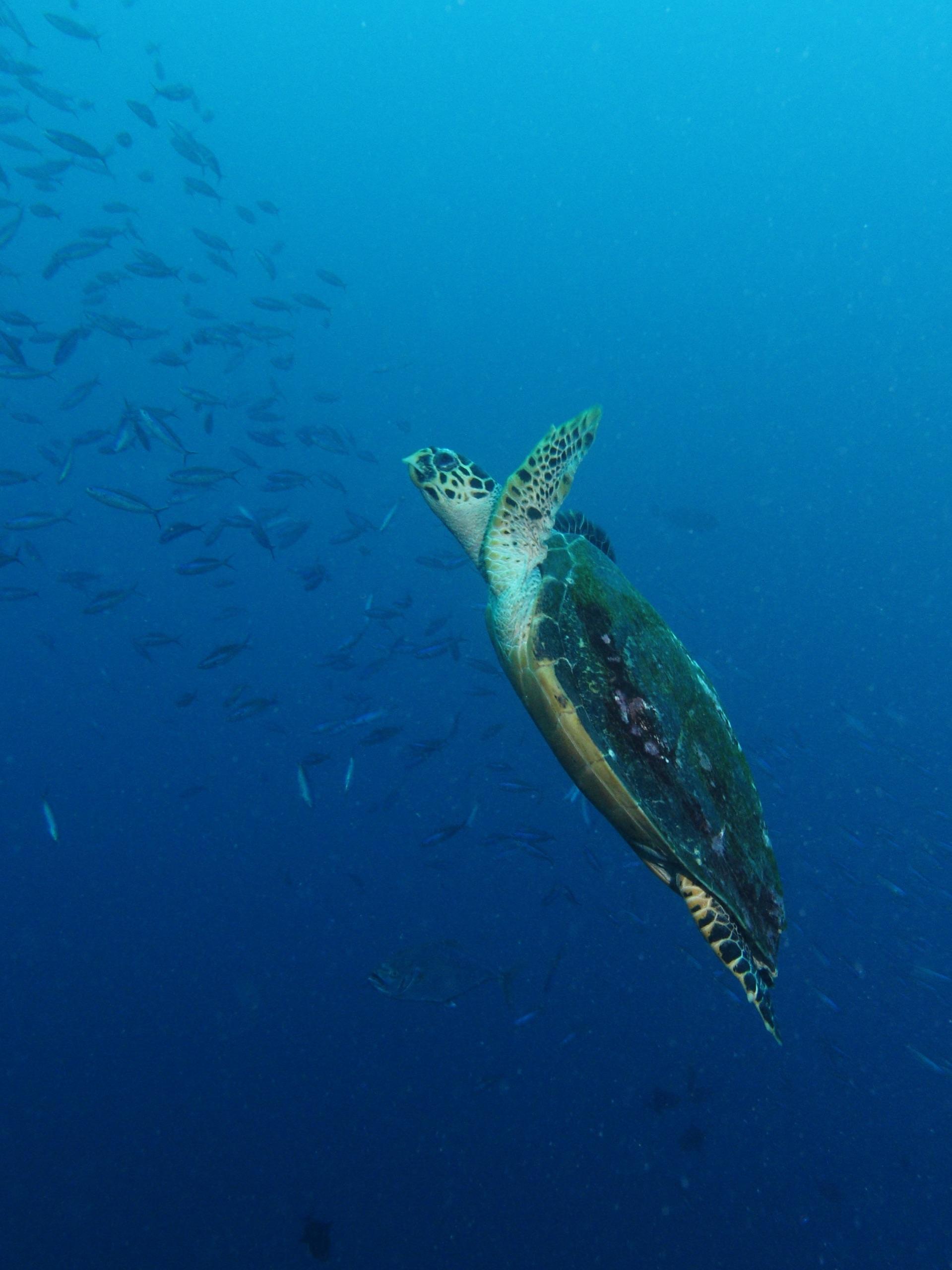
Green turtles are the reason for the nickname. They rest on the sand and wedged into the coral, often several on one dive and sometimes many more, and they are used to divers. Hawksbill turtles are seen here as well.
Being used to divers is not the same as wanting contact. Do not touch a turtle, do not hover directly above one, and never put yourself between a turtle and the surface, because it has to go up to breathe. Stay to one side, low and still, and let it carry on. Photographers get better pictures that way too.
Small animals on the sand
The sand slope is the part that divers with a camera come back for. Dive centres here regularly report frogfish, ghost pipefish, seahorses, flamboyant cuttlefish and many kinds of nudibranch. None of them is guaranteed and all of them are easy to swim past, so go slowly and watch where the guide points.
Look, do not rearrange. Keep your fins up and off the sand, do not move an animal for a photograph, and do not put a hand down: scorpionfish and other well-camouflaged fish sit on this bottom too. On the reef itself expect sweetlips around the coral heads and the occasional whitetip reef shark.
Conditions, season and night dives
The bay is sheltered from the tidal streams that run through much of the park, and the current inside it is usually slight. That is why crews use it for the first dive of a trip and for night dives.
It is diveable all year. April to November is the main liveaboard season, with the calmest seas, and from December to March there is more rain and wind. The water in the centre of the park is around 28 to 30°C for much of the year and about 25 to 28°C from July to September, and a 3 mm full suit is enough for most divers. For the pattern of the whole year, see our Komodo season guide. If this will be your first liveaboard, read what to expect on a first Indonesian liveaboard.
Siaba Besar is in the centre of the park and is a common first dive on Komodo liveaboard routes, including the short loops from Labuan Bajo. It is close to Karang Makassar and Batu Bolong, which makes it an easy dive to fit in beside them. See the dates on our Komodo calendar.
Siaba Besar: common questions
What is the best season to dive Siaba Besar?
Diveable all year; April to November has the calmest seas and is the main liveaboard season
What experience level do I need for Siaba Besar?
All levels, including Open Water divers and divers in training; widely used as a check dive
How deep is Siaba Besar?
Reef top at about 5 m; most of the dive between 5 and 18 m; the slope towards the channel continues past 20 m
What marine life will I see at Siaba Besar?
Green and hawksbill turtles, whitetip reef sharks, sweetlips, frogfish, ghost pipefish, seahorses, flamboyant cuttlefish and nudibranchs