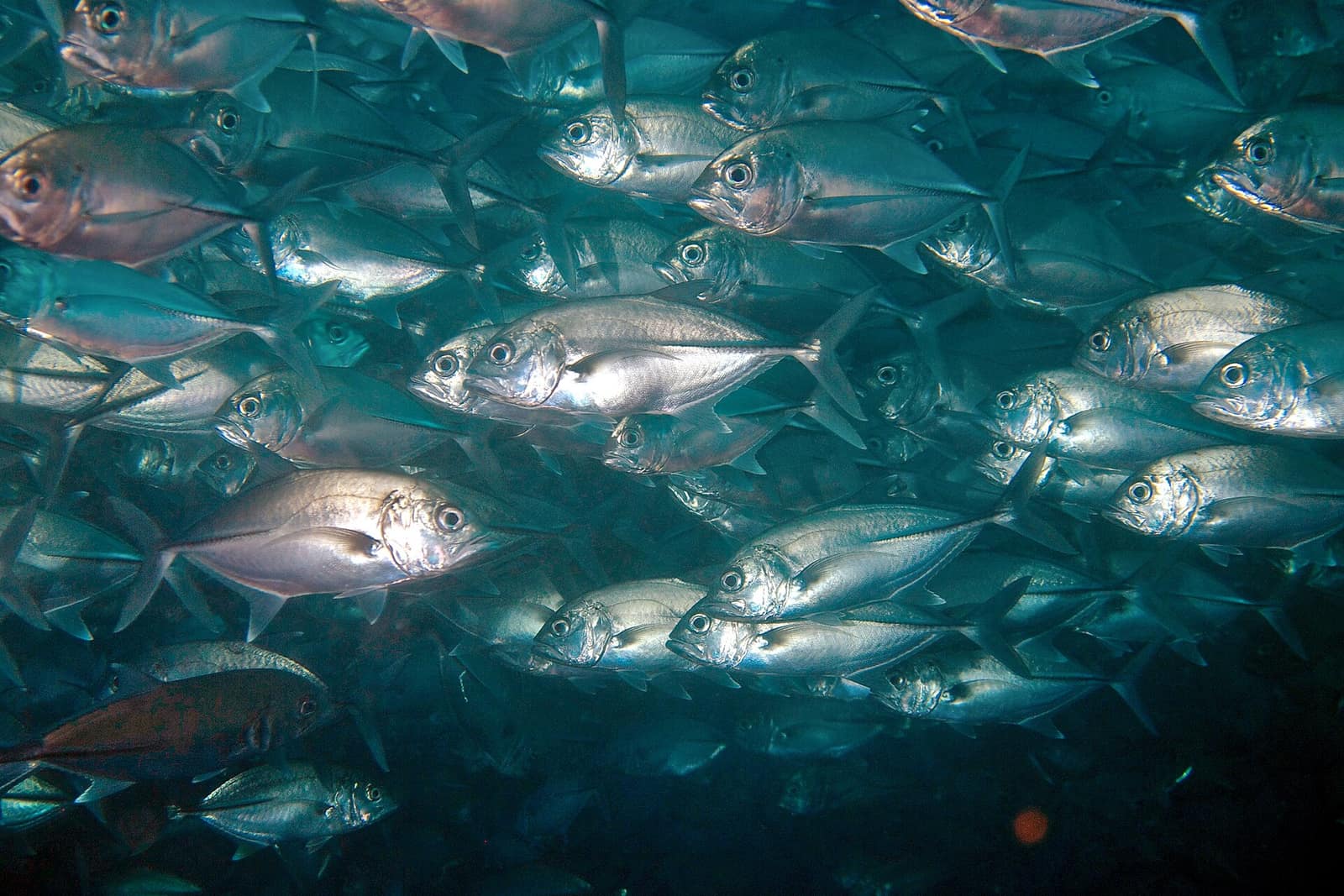
Castle Rock
A submerged seamount in northern Komodo where the current does the hunting for you, and grey reef sharks line up to watch.
Castle Rock is the dive that people book a Komodo liveaboard for and then talk about for years. It is a submerged pinnacle in the far north of Komodo National Park, off the little island of Gili Lawa Laut, and when the tide runs it turns into one of the most concentrated displays of predatory fish action in Indonesia. This is not a gentle reef. It is an advanced, current-driven dive that rewards divers who can hold their position and read the water, and it delivers grey reef sharks, chevron barracuda and tornadoes of trevally in return. Here is what the site actually is, what you will see, and how you dive it honestly.
Quick answer: Castle Rock is a current-swept seamount / pinnacle dive with negative entry and reef hooks in Komodo. Best season: April to November dry season; July-September for the best visibility. Level: Advanced — AOW minimum with genuine strong-current and negative-entry experience. Depth: Summit at roughly 5-7 m; plateau and walls dropping to 30 m+, with most of the action hooked in around 15-25 m. Typical visibility: Variable, commonly 10-30 m depending on tide and plankton.
Facts verified September 2026
What makes Castle Rock special
Castle Rock is a seamount that never breaks the surface. Its summit sits a few metres down depending on the tide, and its flanks fall away to 30 metres and beyond on every side. Because it stands alone in open water at the north-northeast tip of Komodo Island, it catches the full force of the tidal flow that pushes between the Flores and Indian Ocean systems. That current is the whole story here. It funnels around and over the seamount, pins nutrient-rich water against the rock, and concentrates baitfish into tight, nervous shoals.
Where the bait gathers, the hunters follow. On a strong incoming tide the pinnacle becomes a natural amphitheatre: you hook into the reef, stop finning, and simply watch predators work the current in front of you. Few sites in Komodo pack this much big-fish behaviour into a single dive, which is exactly why Castle Rock sits at the top of most north-route liveaboard itineraries.
What you'll see
The signature encounter is sharks. Grey reef and whitetip reef sharks patrol the up-current edge of the seamount, and on a good day a dozen or more will cruise the blue in front of you, holding station in the flow. They are the reason many divers call this the shark capital of Komodo.
Around and above them, the schooling action is relentless. Expect walls of big-eye trevally that can spiral into sun-blocking tornadoes, giant trevally and jacks slashing through fusiliers, and chevron barracuda hanging in tight formation. Between the pelagic drama, the reef itself is healthy and busy.
- Grey reef and whitetip reef sharks patrolling the current edge
- Big-eye trevally in tornado schools, plus hunting giant trevally and jacks
- Chevron barracuda, tuna and clouds of fusiliers and surgeonfish
- Eagle rays and, on the right conditions, passing manta rays
- Groupers, snappers and reef fish sheltering in the lee of the pinnacle
Conditions and who it's for
Be honest with yourself about this one. Castle Rock is not a beginner site and should not be your first current dive. The flow is regularly medium to very strong, can hit two to four knots at peak, and downcurrents are possible on the walls. Boats time the dive to the tidal window, but conditions can still ramp up mid-dive.
You want an Advanced Open Water certification as a floor, plus real experience with negative entries, reef hooks and holding position in moving water. Good buoyancy and air-efficient finning matter more than logged-dive count. If you are comfortable dropping fast, hooking in and staying calm while the current sings past your ears, you will love it. If strong current makes you anxious, north Komodo has gentler sites and there is no shame in choosing one.
Water is warm for Indonesia — roughly 25 to 28 degrees Celsius in the north, noticeably milder than the chilly upwellings of southern Komodo. A 3mm suit suits most divers. Visibility is variable, commonly 10 to 30 metres, best in the July to September window.
When to dive it
Castle Rock is a dry-season site. The prime window runs from April to November, when north Komodo enjoys its calmest surface conditions and clearest water. July, August and September typically deliver the best visibility, though they are also the busiest months on the liveaboard calendar.
Beyond the season, the single most important timing factor is the tide. The strongest and most rewarding fish action comes on an incoming or slack-to-incoming phase, which is also the safest way to dive the seamount. Your guides will plan the drop around that window rather than the clock, so trust the briefing when the schedule shifts.
How you actually dive it
This is a negative-entry dive. You roll in with an empty BCD and no hesitation, finning down immediately to reach the shelter of the reef at around 15 to 20 metres before the current can sweep you off the seamount. Get this part right and the dive is straightforward; get it wrong and you can be blown into the blue before you have equalised.
Once down, you hook into dead rock — never living coral — at roughly 20 to 25 metres, settle your breathing, and watch the show hands-free. When you have had your fill, you unhook and let the current carry you around and along the flank of the pinnacle, working gradually up and into the sheltered lee for your safety stop before deploying an SMB. A reef hook and a loud, well-practised surface signal are essential kit, not optional extras, because you may surface in open water away from the mooring.
Faneca dives Castle Rock on our northern Komodo liveaboard routes aboard the Blue Pearl and iLike, timed to the incoming tide when the shark and trevally action peaks — conditions permitting, since this is a current-dependent site and your guides will move the dive to the safest tidal window.
Castle Rock: common questions
What is the best season to dive Castle Rock?
April to November dry season; July-September for the best visibility
What experience level do I need for Castle Rock?
Advanced — AOW minimum with genuine strong-current and negative-entry experience
How deep is Castle Rock?
Summit at roughly 5-7 m; plateau and walls dropping to 30 m+, with most of the action hooked in around 15-25 m
What marine life will I see at Castle Rock?
Grey and whitetip reef sharks, big-eye and giant trevally, chevron barracuda schools, fusiliers, surgeonfish, tuna, eagle rays, occasional manta
